The Asteroid That Never Was: Deconstructing the 2015 Doomsday Prophecy That Sent a Chill Down the Spine of the Internet
Remember 2015?
For a few terrifying weeks, the internet wasn’t talking about pop culture or politics. It was whispering about something else. Something dark. Something coming from the void.
A shadow was falling over the Earth. A prophecy was spreading like digital wildfire. The message was simple and horrifying: A colossal asteroid was on a collision course with our planet, and the day of reckoning was just weeks away.
They said it would strike between September 15th and 28th.
They said the impact zone was Puerto Rico.
They said the world as we knew it was about to end.
And for a moment, in the dim glow of millions of screens, people believed it. They had to. The story was too specific, too chilling, to ignore. But this wasn’t just another random doomsday claim. This one was tied to the heavens themselves, to ancient texts and celestial signs that seemed to be aligning in a symphony of destruction. The official story? A ridiculous rumor. A nothingburger. But dig a little deeper, and you find a fascinating tale of fear, faith, and the desperate battle for truth in an age of information overload.
This is the story of the asteroid that never was. Or was it?
A Prophet’s Terrifying Vision: The Puerto Rico Prophecy
Every great conspiracy needs a voice. A patient zero. For the Great Asteroid Panic of 2015, that voice belonged to a self-proclaimed prophet named Efrain Rodriguez.
Rodriguez wasn’t some fringe character yelling on a street corner. He delivered his message with the calm certainty of a man who had seen the other side. He claimed to have received a direct message from God. A vision. It wasn’t vague or open to interpretation. It was a horrifyingly detailed blueprint for Armageddon.
The vision, as he described it, was pure blockbuster terror. A “rock from the heavens” would enter the atmosphere, screaming towards the Caribbean. It would strike near the island of Puerto Rico, hitting the sea between the towns of Arecibo and Mayagüez. The initial impact would be devastating, but it was only the beginning.
A truly cataclysmic 1,000-foot tsunami would rise from the shattered ocean. This wall of water would obliterate the East Coast of the United States, scour Central America, and swallow vast swathes of South America. Earthquakes would ripple across the globe, triggering volcanoes. Three days of darkness would descend upon the world. It was, in his words, a cleansing. A judgment.
What made Rodriguez’s claims so potent, so viral? He tethered them to an astronomical event that was already captivating the world.
Deep Dive: The Blood Moon Prophecy
You couldn’t escape the “Blood Moons” in 2014 and 2015. The term itself is electric. It sounds ancient, ominous, and biblical. And that’s exactly what it was meant to be.
The phenomenon is actually a “lunar tetrad”—a series of four consecutive total lunar eclipses, with no partial eclipses in between. During a total lunar eclipse, the Earth passes directly between the sun and the moon. The only light that reaches the lunar surface is filtered through Earth’s atmosphere, which scatters the blue light and allows the red light to pass through. This bathes the moon in a ghostly, coppery-red glow. A Blood Moon.
They’re not super rare, but this particular tetrad was special. Christian pastors Mark Biltz and John Hagee pointed out an incredible coincidence: all four eclipses in the 2014-2015 tetrad fell on major Jewish holidays—Passover and Sukkot.
The Celestial Timetable of Doom:
- April 15, 2014: Total lunar eclipse (Passover)
- October 8, 2014: Total lunar eclipse (Sukkot)
- April 4, 2015: Total lunar eclipse (Passover)
- September 28, 2015: Total lunar eclipse (Sukkot)
For believers, this was no coincidence. It was a sign. They pointed to scripture, to the Book of Joel 2:31: “The sun shall be turned into darkness, and the moon into blood, before the great and terrible day of the LORD come.”
The first three Blood Moons came and went. Tensions rose. The world watched. And then came Rodriguez’s asteroid prophecy, aimed squarely at the window of the fourth and final Blood Moon. It was the perfect climax. The celestial signs were the prelude; the asteroid was the main event. The final blood moon on September 28th would be the punctuation mark on the apocalypse.
The Internet Catches Fire
In 2015, the internet was a different beast. It was the perfect primordial soup for a theory like this to evolve and spread. The narrative exploded across Facebook, YouTube, and countless conspiracy forums.
Suddenly, “evidence” was everywhere. Grainy YouTube videos with robotic narration showed doctored astronomical charts. Blog posts breathlessly analyzed “leaked” documents from anonymous government sources. People started connecting the dots to other simmering conspiracies of the time. Remember Jade Helm 15? That massive US military exercise in the summer of 2015 that many believed was a dry run for martial law? Of course it was. They were preparing for the riots that would follow the asteroid impact.
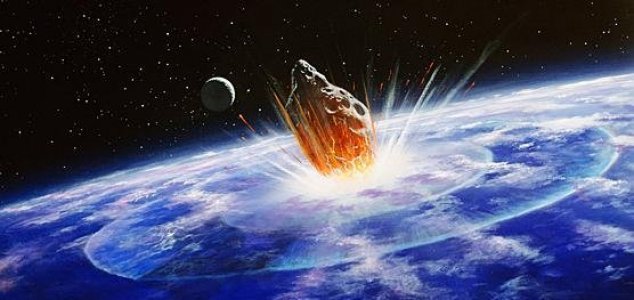
Visuals were key. Terrifying artist’s impressions of a city-sized rock searing through the sky became the face of the fear. They were shared millions of times, often without context, always with a dire warning.

This image, or ones just like it, became the stuff of nightmares for millions. It wasn’t data. It wasn’t proof. It was pure emotion. It was fear, distilled into a single, shareable jpeg.
The official denials began to roll in. But to the believers, that was just more proof. Of course they would deny it. They had to prevent mass panic.
The Watchers on the Wall: Enter NASA
While the internet buzzed with prophecy and panic, a group of very serious people in a very quiet office were watching the skies. They always are.
This is the job of NASA’s Planetary Defense Coordination Office (PDCO), which includes the Near-Earth Object (NEO) Observations Program. These aren’t conspiracy theorists; they are the planet’s actual guardians. They use a global network of telescopes, like Pan-STARRS in Hawaii and the Catalina Sky Survey in Arizona, to scan the heavens every single night. They are hunting for the real threats.
Their work is methodical. When a new object is spotted, its trajectory is calculated and run through a sophisticated monitoring system called Sentry. Sentry is an automated collision monitoring system that ceaselessly calculates the odds of any known asteroid hitting Earth over the next 100-plus years. The threats are then ranked on the Torino Scale, a 0-to-10 chart that assesses the risk.
So when the 2015 prophecy reached a fever pitch, the PDCO was put in the strange position of having to debunk a ghost.
Paul Chodas, then-manager of the NEO office, became the public face of reason. His statement was unequivocal. “If there were any object large enough to do that type of destruction in September, we would have seen something of it by now,” he stated. “In fact, not a single one of the known objects has any credible chance of hitting our planet over the next century.”
For the scientists, it was an open-and-shut case. But for the internet, his words were just fuel for the fire.
A Deep Dive: Why NASA Was So Confident
Why was Chodas so sure? Let’s break it down.
An asteroid big enough to cause a 1,000-foot tsunami and global earthquakes would need to be massive. We’re talking hundreds of meters, if not kilometers, in diameter. It would be a true “planet-killer” or at least a “civilization-ender.”
An object that big is not subtle. It reflects a lot of sunlight. We would have discovered it years, likely decades, before it came anywhere near us. Its orbit would be mapped with stunning precision. Astronomers, both professional and amateur, would have been tracking its every move. Hiding an object of that size is like trying to hide an aircraft carrier in a swimming pool. Impossible.
The cosmic game of billiards that is our solar system follows the strict laws of physics. We can predict the orbital paths of these objects with incredible accuracy for centuries into the future. The idea that one could just “sneak up” on us in a matter of weeks is pure fantasy.
Take a real, potentially hazardous asteroid like Apophis. Discovered in 2004, it was initially given a concerningly high probability of hitting Earth in 2029. But with years of further observation, we refined its trajectory and have now ruled out any impact risk for at least the next 100 years. That’s how it works. Science. Observation. Calculation. Not divine visions.
The Cover-Up Theory: Why Not Believe the Experts?
So if the science was so clear, why did the rumor persist? Why did a significant portion of the population choose to believe a prophet over the world’s premier space agency?
Because the prophecy was never really about the asteroid. It was about trust.
The core of the conspiracy was simple: NASA was lying. The governments of the world knew the impact was coming, and they were engaged in the biggest cover-up in human history. Why? To prevent the complete and total breakdown of society. If everyone knew the world was ending in a month, what would happen? Markets would vaporize. Power grids would fail. Law and order would cease to exist. It would be anarchy.
So, the theory went, the global elite were quietly preparing. They were retreating to their deep underground military bases (DUMBs), stocked with supplies to ride out the apocalypse. The rest of us? We were being left to our fate. The Jade Helm 15 exercises, the strange stockpiling of FEMA coffins… it was all part of the plan. The elites would survive, and the “useless eaters” would be wiped clean by God’s great rock.
This narrative is powerful because it taps into a deep-seated distrust of authority. It provides a simple answer to a complex world: “They” are lying to you. It makes those who believe feel special, like they are in possession of a secret, world-shattering truth.
September 28th, 2015: The Day the World… Kept Spinning
The dates came. September 15th passed. Then the 20th. The 25th.
The internet held its breath. Believers prayed. Skeptics refreshed news sites, half-expecting something, anything, to happen.
And then September 28th arrived. The fourth Blood Moon rose in the sky, a beautiful, eerie copper-red, just as predicted. It was a stunning celestial sight.
But there was no impact. No tsunami. No earthquakes beyond the usual rumblings of our planet.
The sun rose on September 29th on a world that was, much to the surprise of some, still very much intact. The Great Asteroid Prophecy had failed.
But a good conspiracy never really dies. It just adapts. The goalposts were moved. Some claimed the date was a misinterpretation, and the impact was still coming. Others argued that the collective prayers of the faithful had altered the asteroid’s path, a miracle that averted disaster. A more sophisticated explanation emerged: the “impact” was never meant to be physical, but spiritual or metaphorical—a great awakening or a shift in consciousness.
The prophecy failed, but the fear it generated left a permanent scar on the digital landscape.
The Ghost of Doomsday Past: Our Endless Fascination with the End
The 2015 asteroid scare was not an isolated incident. It stands in a long, proud line of doomsday predictions that have captured the public imagination.
We panicked over the Y2K bug in 1999, expecting planes to fall from the sky. We held our breath for the 2012 Mayan Apocalypse, the supposed end of a great cosmic cycle. Before that, there was Halley’s Comet, and before that, countless religious predictions stretching back centuries.
Why do we do this to ourselves? Why are we so drawn to the idea of our own demise?
Perhaps it’s a search for meaning. An apocalypse, for all its terror, provides a definitive ending. It’s a hard reset. It suggests that our chaotic, often confusing existence is part of a larger, more dramatic story. Believing you are living in the “end times” makes your own life feel monumentally important.
In many ways, the 2015 prophecy was a perfect storm, a prototype for the kind of viral misinformation that now defines our online world. It combined real-world events (the Blood Moons), a charismatic messenger, a distrust of institutions, and the frictionless sharing power of social media.
The skies are not empty. The threat of an asteroid impact is very real. Groups like NASA’s PDCO are not hunting ghosts; they are performing one of the most vital services for the continuation of our species. The real danger isn’t a prophet’s vision. It’s the millions of rocks, big and small, still orbiting silently in the dark, their paths not yet fully mapped.
The 2015 panic was a fire drill for our collective sanity. It was a test. And the questions it raised are more relevant today than ever. Who do we trust? How do we separate truth from fear? And when the real warning comes… will we be able to hear it over the noise?
Originally posted 2015-08-31 13:32:58. Republished by Blog Post Promoter