Teotihuacan: The Ghost City of the Gods That Baffles Everyone
They call it Teotihuacan. “The place where the gods were created.”
That’s not its real name. Its real name is gone. Wiped from history. The people who built this sprawling metropolis—a city larger and more meticulously planned than Imperial Rome—vanished without a trace, leaving behind a silent, stone testament that screams a million questions and whispers zero answers.
Imagine. A city of ghosts. For centuries it lay in ruins, a skeleton of stone in the Mexican highlands. So vast, so impossibly grand, that when the Aztecs stumbled upon it a thousand years after its fall, they refused to believe it was built by mortals. This, they concluded, could only be the work of giants. Or gods. They made pilgrimages to its eerie, silent avenues, convinced this was the very birthplace of the cosmos.
They weren’t entirely wrong. Something cosmic was definitely going on here. But who were the architects? What did they believe? And most importantly… where did they all go?
Forget what you think you know. We are about to walk the Avenue of the Dead, and the story it tells is more shocking and mysterious than you can possibly imagine.
A City That Shouldn’t Exist
Let’s get one thing straight. This was not some humble settlement. This was a monster. A titan. At its peak around 450 AD, Teotihuacan sprawled across 8 square miles, a throbbing heart of civilization with a population conservatively estimated at 100,000. Some archaeologists push that number closer to 200,000.
Think about that. At the same time, many of Europe’s greatest future cities were little more than muddy villages or Roman military outposts. Teotihuacan was one of the largest, most sophisticated urban centers on the entire planet.

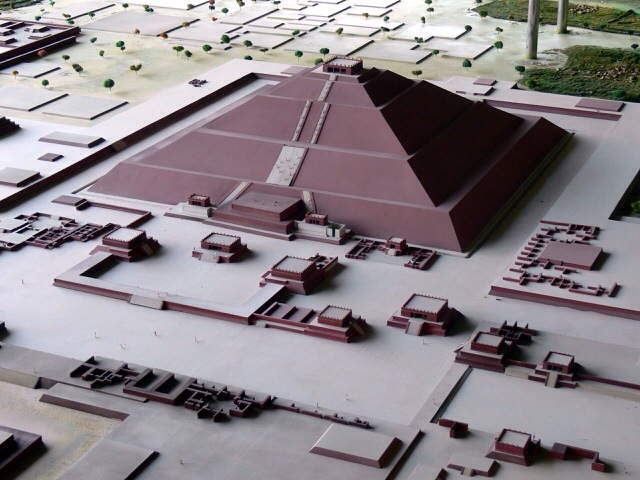
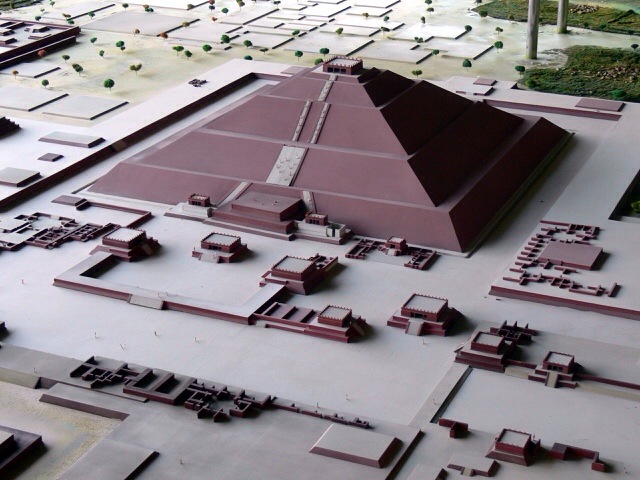
But it’s the design that truly boggles the mind. The city wasn’t a chaotic sprawl. It was a grid. A perfectly aligned, mathematically precise grid oriented 15.5 degrees east of true north. Everything—from the grand pyramids to the humble apartment compounds where thousands lived—snapped to this grid. Why? Why that specific, peculiar angle? The simplest answer is that it aligns with the point on the horizon where the sun sets on key dates in the Mesoamerican calendar. Simple, yet profoundly advanced. They were mapping their city to the movements of the stars.
Who Were the Ghost Builders?
So who were these master astronomers and city planners? Silence. Utter silence. They left behind no readable writing system that we’ve been able to crack. No statues of kings with boastful inscriptions. Nothing. It’s the ultimate archaeological cold case. The suspects?
- The Totonacs? An old theory, based on later accounts, but with little hard evidence.
- Refugees from a Volcano? Some suggest survivors of the Xitle volcano eruption fled to Teotihuacan, kickstarting its growth. Plausible, but doesn’t explain the genius of its inception.
- A Multi-Ethnic Powerhouse? This is the leading modern theory. Artifacts from all over Mesoamerica—from the Maya regions to the Zapotec lands—have been found here. It seems Teotihuacan wasn’t the capital of a single tribe, but a cosmopolitan melting pot, a New York City of the ancient world. But who was in charge? Who laid down the master plan? We still don’t know.
This lack of a cult of personality—no glorified kings, no monuments to individual rulers—is bizarre. It suggests a different kind of power structure. Perhaps a collective of elite families, a council of lords, or even a stern, faceless priestly caste. Whoever they were, they commanded the loyalty and labor of thousands to build a city for the gods, not for men.
The Avenue of the Dead: A Road to the Heavens
The city’s main artery is a breathtakingly wide boulevard, running for more than two miles. The Aztecs called it Miccaotli, the Avenue of the Dead, believing the mounds that flanked it were royal tombs. They were wrong—they were platforms for smaller temples and elite palaces—but the name stuck. And it’s fitting.
Walking this road is a profound experience. You feel small. Insignificant. It was designed that way. The entire street is an architectural masterpiece of forced perspective. As you walk north, toward the Pyramid of the Moon, the pyramid appears to stay the same distance away. It’s an optical illusion created by a series of rises and dips in the avenue, a psychological trick to make the journey feel eternal, the destination divine and unattainable.
This wasn’t just a street. It was an outdoor cathedral. A celestial diagram. A stage for rituals of unimaginable scale and, as we would discover, unimaginable horror.
The Pyramid of the Sun: A Man-Made Mountain of Secrets
Dominating the landscape is the Pyramid of the Sun. Don’t let the serene name fool you. This thing is a beast. Rising over 200 feet high with a base wider than a modern city block, it’s one of the largest structures ever built in the ancient Americas. It’s a solid mass of nearly 1.3 million cubic yards of sun-dried brick and earth, faced with stone. No internal chambers. Just pure, solid bulk. A man-made mountain.
It was built in a single, frantic construction phase around 200 AD. Imagine the effort. Tens of thousands of workers, toiling for decades without pack animals, without metal tools, without the wheel. How? What belief could possibly motivate such a herculean effort?
The Cave Beneath the Pyramid
The real secret isn’t the pyramid itself, but what it was built on top of. In 1971, archaeologists stumbled upon an entrance to a tunnel, hidden near the Avenue of the Dead. The tunnel ran over 300 feet directly under the center of the pyramid, ending in a cloverleaf-shaped chamber.
It was a natural lava tube, a sacred cave, modified by human hands. This was the heart of the pyramid. Its reason for being. In Mesoamerican belief, caves were portals to the underworld, the womb from which humanity emerged. By building their most massive monument directly over this sacred spot, the city’s founders were making a monumental statement. They were anchoring their city to the very center of the cosmos.
The chamber had been looted, probably centuries ago, even before the city fell. But what was once there? An oracle? The tomb of a founding ruler? We can only guess.
The Liquid Mercury Revelation
But the secrets didn’t end there. In recent years, deep within the tunnels beneath the *other* great structures, archaeologists have found something utterly baffling: large quantities of liquid mercury. Poured into bowls, representing underground rivers or lakes. The shimmering, toxic metal must have created an ethereal, otherworldly effect in the torchlit darkness. It speaks to a level of ritual sophistication, and a knowledge of chemistry and geology, that is frankly astounding. What were they doing with it? Was it purely symbolic, or did they believe it had some other, stranger properties?
Pyramid of the Moon: The City’s Ritual Heart
At the northern terminus of the Avenue of the Dead stands the Pyramid of the Moon. She is smaller than her brother, the Sun Pyramid, but in many ways, she is far more terrifying.
She was not built all at once, but in seven distinct layers, like a bloody onion. And with each new layer came a dedication. A horrific, ritualistic burial.
Archaeologists digging into its core have found tombs that are the stuff of nightmares. One burial contains a single man, bound and sacrificed, surrounded by the bodies of pumas, jaguars, wolves, and golden eagles—all apex predators, symbols of military might. Many of them appear to have been buried alive in cages.
Another tomb, for the pyramid’s fifth phase, is even more gruesome. It contains the bodies of 12 people, all with their hands tied behind their backs. Ten of them were decapitated, their heads tossed in a pile in the center of the tomb. The other two were lavishly adorned with greenstone beads and military gear. Were they captured enemies? Or the city’s own warriors, sacrificed to give the pyramid its power? The message is clear: the Pyramid of the Moon was fed by blood. Its power was rooted in death.
The Temple of the Feathered Serpent: A Palace of War
The original post didn’t even mention the third great pyramid of Teotihuacan. An incredible oversight, because it might hold the darkest key to the city’s nature. Located in the Citadel complex, it’s the Temple of the Feathered Serpent, Quetzalcoatl.
Its facade is breathtaking. Protruding from the stone are hundreds of snarling, magnificent heads. One is the famous feathered serpent. The other is a goggle-eyed, fanged being, likely a representation of a storm god, a precursor to the Aztec Tlaloc. It was a monument to creation and destruction. To life and violent death.
And beneath it, archaeologists found the proof. A mass grave. Directly under the pyramid’s center, the remains of more than 100 individuals were discovered. Possibly as many as 200. Almost all were young men, buried in military garb, with their hands tied behind their backs. Their necklaces were made of real human jawbones.
This wasn’t a normal cemetery. This was a single, massive sacrificial event. An entire company of elite warriors, perhaps the city’s own royal guard, slaughtered and interred to sanctify the temple. This is a level of state-sponsored brutality that is hard to comprehend. It reveals the iron fist inside Teotihuacan’s civilized glove.
The Great Collapse: How Does a Supercity Die?
And then… it ended. Around 550 AD, the center of Teotihuacan burned. Violently. But this was no accidental fire, and it likely wasn’t an outside invasion. The evidence points to something more chilling.
The fires were concentrated along the Avenue of the Dead. The great temples, the palaces of the elite—all were systematically torched and desecrated. But the apartment compounds, where the common people lived? Mostly untouched. This looks like an inside job. A furious, targeted revolution. The masses rising up against the priest-kings who had demanded their labor and their blood for centuries.
Did a drought push them over the edge? Did the system simply become too top-heavy and oppressive to sustain? After the burning, the people didn’t vanish overnight. They lingered. The city slowly bled out, its population dwindling over the next century until it was finally abandoned, left for the Aztecs to find and mythologize.
What If? The Orion Connection
Is there another layer to this story? A secret written in the stars? Many alternative researchers, looking at the city’s layout, think so.
The famous Orion Correlation Theory suggests the three pyramids of Giza in Egypt are a perfect terrestrial map of the three stars in Orion’s Belt. Could the same be true here? Some researchers point out that the positions of the Pyramid of the Sun, the Pyramid of the Moon, and the Temple of the Feathered Serpent seem to mirror the positions of Alnitak, Alnilam, and Mintaka—the three stars of Orion’s Belt.
Mainstream archaeology dismisses this. But can it be a coincidence? A city meticulously aligned to the heavens. Three major pyramid complexes. It’s a tantalizing thought. Were the builders of Teotihuacan, like those in ancient Egypt, trying to create a mirror of the heavens on Earth? A place where humans could interact with the patterns of the cosmos? A city built not just for people, but as an engine to connect with the gods of the stars?
The ghosts of Teotihuacan aren’t talking. Their magnificent, brutal city stands as a silent monument to their ambition and their mysterious fate. They reached for the sun, mapped the stars, and built a world of gods and monsters. And then they were gone. The stones remember, but they aren’t telling us their names. Perhaps the most important secrets are still buried deep beneath the Avenue of the Dead, waiting for the day they can finally be told.