The Google Earth Anomaly That Freaked Everyone Out
It starts with insomnia. You know the feeling. It’s 3:00 AM, you can’t sleep, so you open your laptop. You start scrolling through the globe on Google Earth. You look at your house. Then you look at the Pyramids. Then, you drift over to the vast, empty stretches of Asia.
specifically, the Gobi Desert.
You zoom in. The sand is brown, endless, and boring. Until it isn’t.
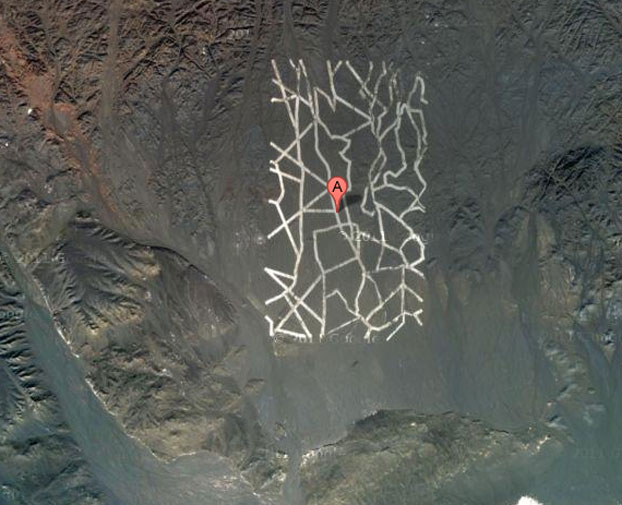
Suddenly, right in the middle of nowhere—and I mean nowhere—you see something that shouldn’t be there. It looks like a glitch. A jagged, chaotic mess of white lines scratched into the earth like a toddler scribbling on a wall. But this isn’t a scribble. This thing is massive. It’s a mile long. And it’s hiding in one of the most secretive regions on the planet.
This isn’t science fiction. This is Dunhuang, China. And for over a decade, these strange markings have driven the internet absolutely crazy.

The “Chaos Grid”: A Glitch in the Matrix?
Look at that image above. Seriously, look at it. What comes to mind? Broken glass? A shattered circuit board? When these images first hit the web, courtesy of eagle-eyed users on Gizmodo and obscure conspiracy forums, the reaction was instant panic.
The coordinates drop you into the borderlands of the Gansu province and Xinjiang. This is desolate territory. North of the Shule River. The Kumtag Desert. It is a place where people don’t go unless they have a very specific reason.
The initial reports were breathless. They described “titanic structures.” They asked if it was a military experiment gone wrong. The lines are thick. They look jagged, white, and reflective. Some early observers swore they were made of metal, buried deep in the sand. Others thought it was paint. Or maybe glass.
The scale is the part that messes with your head. This grid covers an area roughly one mile long and over 3,000 feet wide. That is huge. You don’t accidentally build something that big. You don’t “accidentally” create a perfectly chaotic geometric pattern visible from orbit.
The “Alien” Reflex
Whenever we see something weird from the sky, our brains go to one place. Aliens.
Remember the Nazca lines in Peru? Those ancient geoglyphs of spiders and monkeys etched into the Atacama Desert? For decades, “experts” (and by experts, I mean guys with wild hair on the History Channel) claimed those lines were landing strips for extraterrestrial spacecraft.
The logic was simple: “You can only see the full picture from the sky. Ancient humans didn’t have planes. Therefore, they built it for someone who could fly.”
People applied the same logic to the Dunhuang lines. “They seem designed to be seen from orbit,” the forums whispered. Is it a QR code for a UFO? A landing beacon?
Let’s burst that bubble real quick. I’ve been to the Nazca plains. I stood there in 2006. You know what? You don’t need a spaceship to see them. You just need a tall hill. You can see the spider from the ground if you stand in the right spot. The idea that “seen from space” means “built for aliens” is a jump. A big one.
But if it’s not for aliens, who is it for? That’s where things get darker.
Theory #1: The Weather Weapon (HAARP’s Cousin?)
Conspiracy theorists love a good weather weapon story. Some internet sleuths looked at the jagged, antenna-like patterns of the Dunhuang grid and shouted “HAARP!”
If you aren’t familiar, HAARP (High-frequency Active Auroral Research Program) is a real facility in Alaska that studies the ionosphere. But in the shadow corners of the web, it’s a mind-control device or a weather-controlling superweapon capable of causing earthquakes. The theory here was that China built a massive reflector grid in the desert to bounce signals off the atmosphere, maybe to steer typhoons or jam American communications.
Is it possible? Anything is possible. Is it likely? Probably not. Radio arrays usually look like antennas, not abstract art painted on the ground.
Theory #2: The Giant Eye Chart
Here is a theory that actually holds some water, but it’s still pretty spooky.
Think about how you calibrate a camera lens. You point it at a grid. A focus chart. You look for sharp lines and contrast to make sure your focus is razor-sharp.
Now, imagine your camera is a spy satellite hurtling through space at 17,000 miles per hour, hundreds of miles above the Earth. You need to make sure its lenses are focused perfectly. You can’t just twist a ring on the lens. You need a target down on Earth. A massive target.
Many experts believe the “Chaos Grid” is exactly that: an optical calibration target for Chinese reconnaissance satellites. The jagged lines, the high contrast of white material against the brown desert—it’s perfect for testing resolution. If the satellite can distinguish between those weird, sharp angles, the camera is working.
It’s boring, right? Wrong. It’s terrifying. Because if they are calibrating their cameras to be that precise, what else are they looking at? Your backyard? The license plate on your car?
The Scary Reality: “Area 51” of the East
Let’s stop guessing and look at the neighborhood. This isn’t just empty sand. This region is the heart of China’s military secret-keeping.
This is near the Lop Nur nuclear test site. It’s near major military bases. If the US has Area 51 in the Nevada desert, China has the Gobi. And they are hiding things there.
While the “Chaos Grid” gets all the attention, it’s what surrounds it that tells the real story. Zoom out a little bit on Google Maps. You start seeing other shapes. Less abstract. More… familiar.

Target Practice: Blowing Things Up for Science
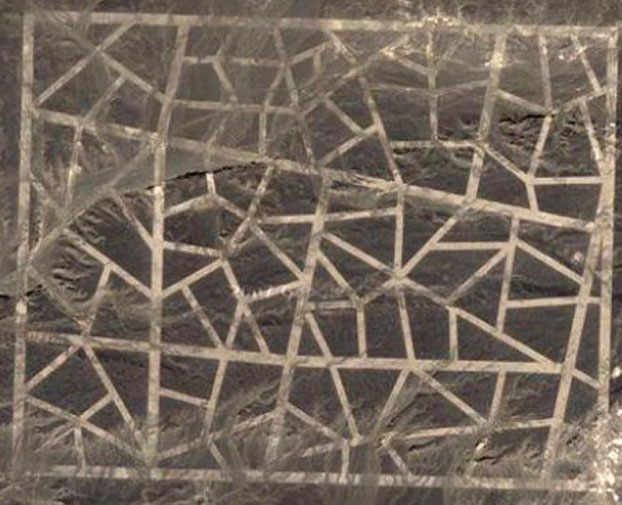
Look at the second image. This doesn’t look like art. It looks like a grid. It looks like streets. It looks like an airport.
But there are no houses. There are no terminals. There is just a blue-ish, fake runway and empty roads in the middle of a dust bowl.
Paul Marks from New Scientist cracked this wide open years ago. He noted, “Clearly, it is some kind of military target for airstrike or gunnery practice.”
He was right. If you look closely at the high-res satellite imagery, you can see craters. Not moon craters—bomb craters. Small ones. The kind made by artillery or air-to-ground missiles. Some of the structures in these grids have been blown to smithereens.
The “Runway” isn’t for landing planes. It’s for pilots to practice strafing runs. They are learning how to destroy runways so enemy planes can’t take off. And the “streets”? They are for sighting artillery.
The “Washington D.C. Invasion” Panic
Here is where the internet conspiracy engine went into overdrive. A few years back, another set of lines was discovered nearby. It wasn’t random. It looked specific.
People started overlaying maps of American cities on top of it. “It’s a map of Washington D.C.!” they screamed. “Look, there’s the Capitol! There’s the White House!”
The fear was palpable. Was China building a full-scale replica of downtown D.C. to practice a ground invasion? Were Chinese paratroopers training to drop onto Pennsylvania Avenue?
The reality is a little less “Red Dawn” and a little more tactical. While China does build mock-ups of targets (more on that in a second), the “D.C. Map” theory was mostly a stretch. The roads resembled city blocks, sure, but they were generic. They were likely a “Anytown, USA” grid used to train urban warfare tactics.
However, that doesn’t mean they aren’t practicing to hit American assets.
The Taiwan Connection: The Real Threat
Let’s get real for a second. Why does a military paint giant white lines in the desert? Why do they build fake airports?
They are training for war. And in this part of the world, there is one war that everyone is worried about: An invasion of Taiwan.
A former military analyst (who, naturally, stays anonymous) dropped a bombshell regarding these sites. He claimed that almost all training in this sector is geared toward one specific scenario: Taking Taiwan by force.
Taiwan has declared independence. China views it as a rogue province. Tensions are higher now than they have been in decades. When you see a fake airport in the Gobi Desert being bombed by Chinese jets, you aren’t watching a game. You are watching a rehearsal.
Recent satellite images—years after the original “white lines” discovery—have found even more disturbing things. Life-sized outlines of American aircraft carriers. Mock-ups of US Navy destroyers on railway tracks, moving across the desert so missiles can practice hitting a moving target.
So, the “Chaos Grid”? It might be boring calibration. But the “Fake Airport”? That is a promise.
Why The Mystery Still Matters
You might say, “Okay, so it’s just military drills. Case closed.”
Is it?
Think about the effort involved here. Think about the secrecy. We only know about this because Google launched a satellite that lets us snoop on them. Before Google Earth, these lines sat in the silence of the desert for who knows how long. The herdsmen knew. The locals knew. The rest of the world was blind.
It makes you wonder: What else is out there that we can’t see?
Google Maps updates its imagery every few years. Governments hide things underground. They use camouflage. The “White Lines of Dunhuang” are just the tip of the iceberg. They are the things China allowed to be seen, or simply didn’t care enough to hide.
The jagged lines might just be a focus chart. Or, as some stubborn theorists insist, they could be something far stranger. A map of underground bunkers? A schematic for a power grid? A message to someone—or something—watching from above?
We rational thinkers can say “Target Practice.” We can say “Calibration.” And we are probably 99% right. But standing in the digital shoes of an explorer looking down at that alien scribble in the sand, you can’t help but feel a little chill.
Someone drew a line in the sand. And they are daring us to cross it.
Originally posted 2016-02-29 12:27:55. Updated for the modern truth-seeker. Republished by Blog Post Promoter
Originally posted 2016-02-29 12:27:55. Republished by Blog Post Promoter
![lines1[1]](https://coolinterestingnews.com/wp-content/uploads/2016/02/lines11.webp)