They Lied About the Moon. Here’s the Terrifying Proof.
Forget the history books. Forget the grainy footage of a flag being planted and the sterile, scientific explanations about basaltic rock and impact craters. What you were told about the Moon is a carefully constructed fairy tale. A bedtime story to keep you from asking the real questions.
Questions like: Why did we stop going?
Think about it. We cracked the code. We achieved the impossible, strapping men to a controlled explosion and flinging them a quarter of a million miles through the void. It was humanity’s single greatest achievement. And then… we just stopped. For over fifty years. The official reason? Budget cuts. Lack of public interest. Seriously? We spent billions to get there, and then got bored? It doesn’t add up.
The truth is far more unsettling. We didn’t stop going because of money. We were warned away. We landed on the Moon only to find out we were late to the party. We discovered that our silent, desolate neighbor wasn’t so desolate after all. It was real estate. And it was already occupied.
The evidence has been hiding in plain sight for decades, tucked away in dusty NASA archives and official mission photographs. As more and more of these images become available online, a terrifying picture is emerging. A picture of impossible structures, shattered ruins, and a secret so profound it forced the most powerful nation on Earth to turn its back on its greatest triumph and never return.
The Apollo 10 Dress Rehearsal That Found a Graveyard
May, 1969. Just two months before Neil Armstrong would take his “one giant leap,” the crew of Apollo 10—Tom Stafford, John Young, and Eugene Cernan—were performing the final dress rehearsal. They flew their Lunar Module, nicknamed “Snoopy,” to within nine miles of the Moon’s surface, simulating everything but the landing itself. Officially, the mission was a flawless success. Unofficially, what they photographed would ignite one of the most explosive controversies in space history.
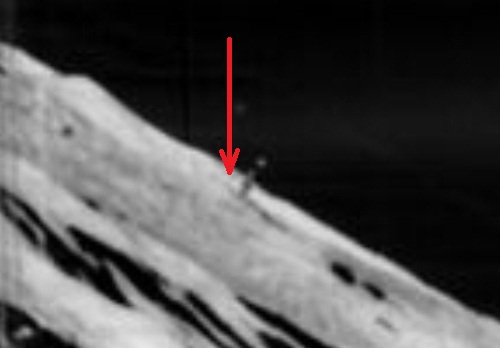
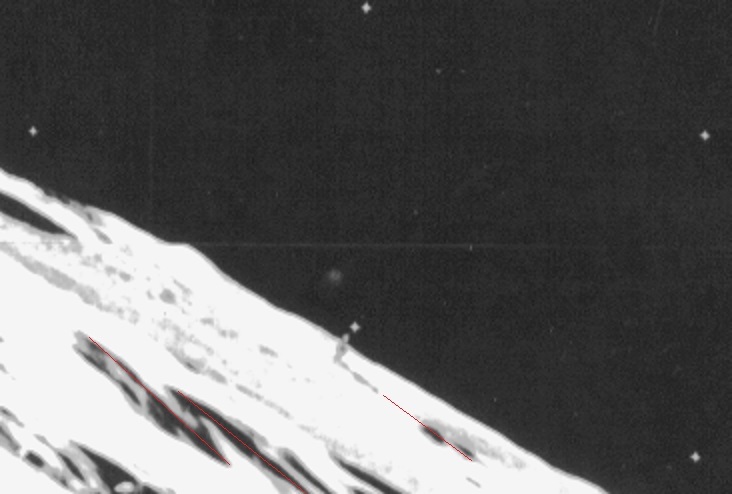
The key pieces of evidence are a series of photographs taken in the Sinus Medii region. Specifically, frames like AS10-32-4822 and the sequence from AS10-32-4854 to 4856. For years, these were just catalog numbers in an archive. Then, researchers like Richard C. Hoagland of the Enterprise Mission began to analyze them with modern technology. What they found wasn’t just rocks and craters. They found architecture.
Two titanic structures, so out of place they defy all natural explanation, dominate the landscape. They have been nicknamed “The Shard” and “The Tower.” And they are the smoking gun.
Deep Dive: The Shard – A Mile-High Glass Dagger
Let’s talk about the Shard. This isn’t some ambiguous blob or a trick of the light. This is a structure. It erupts from the lunar surface, soaring to an estimated height of more than a mile. A full mile.
Its shape is bizarre, almost organic, yet clearly artificial. Imagine a twisted, spindly needle with strange, swollen nodes along its length. It looks ancient, eroded, but unmistakably manufactured. No known geological process, not volcanic activity nor meteorite impacts, could create something like this. Nature doesn’t build like this. It’s a broken piece of something… colossal.
When image analysts applied computer enhancement, the Shard’s true nature leaped out. The way sunlight glints off its surfaces is profoundly strange. It’s not the dull, chalky reflection of lunar rock. No. Parts of it shine with a brilliant, almost wet-looking sheen. The composition is consistent with crystal, glass, or some kind of polished, metallic material. Think about that. A mile-high structure made of something like glass, sitting on the Moon.
Skeptics will scream “camera artifact!” or “emulsion scratch!” But how does a scratch appear from multiple angles, in multiple photographs, with consistent three-dimensional perspective? It doesn’t. The Shard is there. A silent, crystalline tombstone in the lunar dust.

The Tower: A Five-Mile Skyscraper from a Forgotten Age
If the Shard was shocking, the Tower is simply mind-bending. It stands near the Shard, but utterly dwarfs it. This is a megastructure on a scale we can barely comprehend. The analysis, based on shadows and photographic perspectives, places its height at an unbelievable five miles. Five. Miles. High.
That’s almost as tall as Mount Everest. But this is no mountain.
The Tower has been photographed from at least five different angles and two different orbital altitudes—once from 30 miles up, and again from 70 miles up. In every shot, its impossible form is visible. It appears to be a massive, impossibly thin column rising from the surface, connecting to a vast, cubic structure at its apex.
This “cube” at the top is what shatters any argument for a natural formation. It’s a collection of smaller, regular cubes, each seemingly the size of a city block, fused together into one enormous, geometric complex. The overall shape is startlingly ordered, even with apparent damage marring its surface. It looks like a celestial castle, the crumbling watchtower of a long-dead race of giants.
What could this have been? A docking station for ships that dwarfed our own? A power generation facility? A monument to an empire that rose and fell before humanity even learned to walk upright?
The distance from the Apollo 10 camera to the Tower is estimated to be around 200 miles. That’s how huge it has to be to show up with such clarity. The official explanation is silence. Utter, deafening silence. NASA has never formally addressed these anomalies. They just hope you don’t look too closely.

The Breadcrumb Trail: We Knew Before We Ever Landed
The strangest part? The Apollo 10 discovery wasn’t a discovery at all. It was a confirmation. The signs were there years earlier, captured by the cold, mechanical eyes of our first robotic probes. The cover-up had already begun.
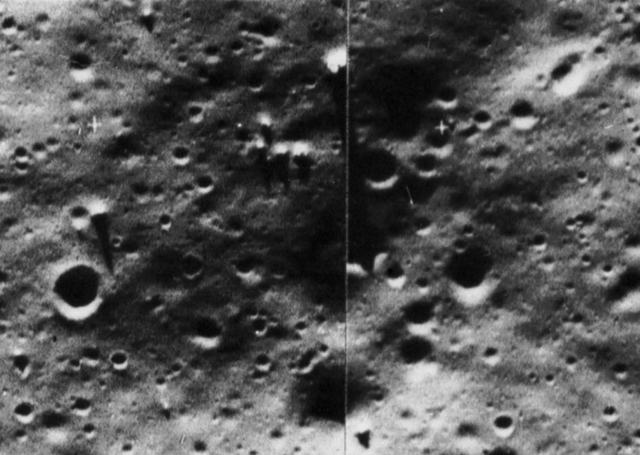
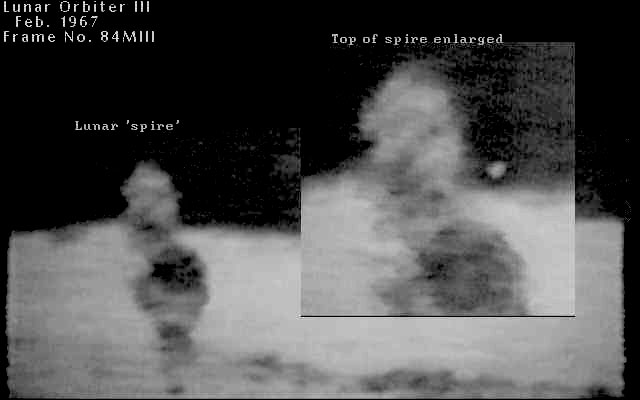
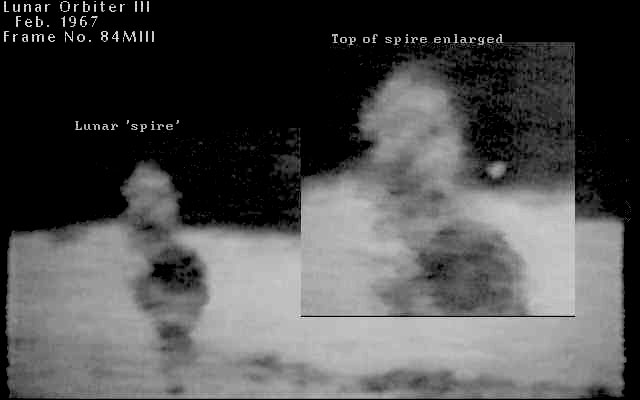
Back in November 1966, the front page of The Washington Post ran a story that should have changed the world. NASA’s Lunar Orbiter 2, while mapping potential landing sites, had photographed something deeply weird in the Sea of Tranquility. The images showed what appeared to be six or seven spires, or towers, arranged in a deliberate, almost perfect geometric pattern.
Their long, pointed shadows confirmed their three-dimensional nature. They weren’t just spots on the ground; they were tall. One of the structures was calculated to be over 200 meters high. Researchers who analyzed them at the time, like Dr. William Blair, dubbed them the “Blair Cuspids.” They were sharp, symmetrical, and completely alien to the surrounding landscape.
What was NASA’s response to this front-page news? They issued a statement declaring the photographs showed nothing of “any interest… whatsoever.”
Nothing to see here. Just tricks of light. Move along.
Does that sound like the response of a curious scientific organization? Or does it sound like damage control?
Even The Russians Saw It
The conspiracy isn’t just an American one. The Soviets were seeing things, too. In February 1966, nine months before the Lunar Orbiter photos, the Russian Luna 9 probe made the first-ever soft landing on the Moon. It immediately began transmitting pictures back to Earth.
According to the Russian magazine Argosy, Soviet space scientist Alexander Abromov was stunned by what he saw. The probe had landed near a series of structures that stood in a distinct pattern. They were not random rocks. Abromov stated that their tops had a profile strikingly similar to a pyramidion—the capstone of an Egyptian pyramid.
Two global superpowers, bitter Cold War rivals, were independently discovering the same impossible truth. That the Moon was home to pyramids and towers. And they both decided to keep it quiet.

What If? Unraveling the Scenarios
So, the evidence is on the table. Multiple photos, from multiple missions, from two different countries, all pointing to the same conclusion: there are artificial structures on the Moon. This leaves us with a few terrifying possibilities.
Scenario 1: The Ancient Graveyard
Perhaps the most likely, and most poignant, scenario is that we are stumbling through a cosmic cemetery. The structures are real, but they are unimaginably ancient. They are the ruins of a civilization that rose, conquered the stars, and vanished into dust eons before our own. Maybe they were destroyed by war. Maybe they were wiped out by a cosmic catastrophe. Or maybe they just moved on, leaving their silent monuments behind as the only proof they ever existed. In this scenario, we weren’t warned away. We were just humbled. Our “giant leap” was a toddler’s first step into a house once owned by gods.
Scenario 2: The ‘Keep Out’ Sign
This is the more chilling theory. What if the ruins aren’t ruins at all? What if the Moon is an active outpost, a listening post, or a territory belonging to someone else? In this version, the Apollo missions weren’t a scientific endeavor; they were a trespass. We landed, planted our flag, and were promptly told, in no uncertain terms, to leave and never come back. This would explain the sudden, inexplicable end to the Apollo program. It would explain the decades of silence. It explains why every plan to return gets bogged down in “budgetary issues.” The budget isn’t the problem. The problem is that we are not welcome.
Scenario 3: The Secret We’re Keeping From Ourselves
There’s a third door, and it’s perhaps the wildest of all. What if the structures *are* man-made? Not by the civilization we know, but by a hidden one. The “Secret Space Program” theory suggests a breakaway human civilization, funded by black-ops money, has been operating in space for decades, with technology far beyond what is publicly acknowledged. In this scenario, the Apollo missions were just a show for the public. The real action, the real bases, were already there. The Tower and The Shard aren’t alien; they’re ours. And that secret is far too big to ever let out.
The Question That Remains
The internet has supercharged this investigation. An army of digital archeologists now pores over every high-resolution scan released from the archives, finding new anomalies every day: strange tracks, geometric craters, objects that cast impossible shadows. The official story is wearing thin.
The photos are real. The government denials are a matter of public record. The sudden halt of lunar exploration is a historical fact.
You can call it pareidolia—the brain’s tendency to see patterns in randomness. You can dismiss it all as the work of crackpots and conspiracy theorists. Or you can look at the five-mile Tower, the crystalline Shard, and the geometric spires, and ask yourself a simple question.
What are they really hiding on the Moon?