The Lanzhou Stone: Is This 300-Million-Year-Old Screw Proof of a Lost Civilization?
What if our history books are wrong? Not just a little wrong. What if they are catastrophically, fundamentally, laughably wrong? What if the neat, clean timeline of human progress—from stone tools to smartphones—is a comforting lie we tell ourselves? A story to hide a much stranger, much older, and much more complicated truth.
Because sometimes, something is found. Something that just doesn’t fit. An object so baffling, so out of place, that it threatens to pull the entire thread of accepted history and unravel it into a pile of questions. They call them OOPArts. Out-of-Place-Artifacts. And this one might just be the king of them all.
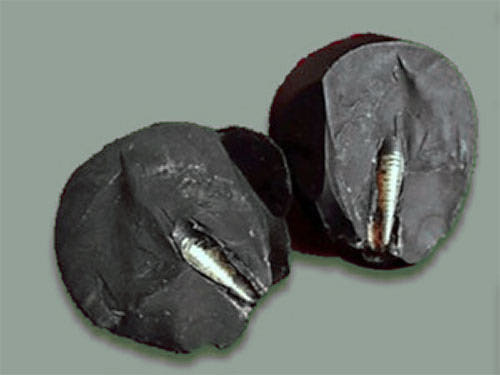
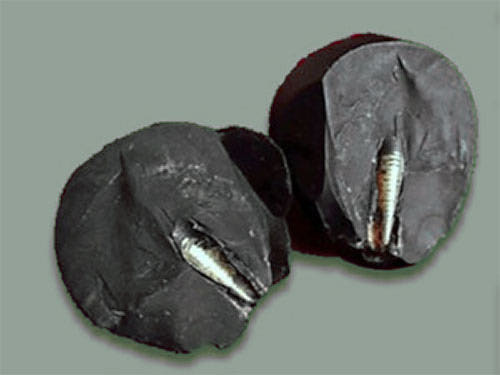
We’re going to the remote, windswept expanse of the Mazong Mountains in China. A place of stark beauty and deep time. Here, a rock collector named Zhilin Wang was doing what he did best. Searching for the unusual. But he could never have prepared for what he found.
A rock. A piece of hard, black, unidentified stone. But this was no ordinary rock. Because sticking out of it, fused into its very matrix as if it had been born there, was a metal object. A metal rod, about 6 centimeters long, with a feature so shocking it defies all logical explanation.
It had screw threads.
A Machine Part Older Than the Dinosaurs
Let that sink in. A metal rod. With perfect, machined, screw-like threads. Embedded inside solid rock. Not glued in. Not jammed in a crack. It was *part* of the rock, surrounded by the same ancient material on all sides. Geologists and collectors who examined the stone were stumped. This wasn’t a concretion, where minerals form around a modern object. The rock itself seemed impossibly old.
How old?
The initial estimates were staggering. The region’s geology, the type of rock, the sheer fact that it had fossilized around a metal object… it all pointed to an age that makes the mind reel. Millions of years. Some researchers from the National Land Resources Bureau of Gansu Province, Lanzhou University, and other Chinese institutions pushed the date back even further. Hundreds of millions of years. Before the dinosaurs. Long before the first hint of humanity was even a distant dream.
This is the central, terrifying paradox of the Lanzhou Stone, as it came to be known. We have an object that is clearly, undeniably manufactured. Humans make screws. Nature makes crystals and fossils. Nature does not make threaded metal rods. Yet this manufactured object is trapped in a geological prison that screams of an age when no manufacturing could have possibly existed. Not on this planet, anyway.
Who made it? What forgotten civilization possessed the technology to forge and thread metal 300 million years ago? And what happened to them?
The Extraterrestrial Hypothesis: A Bolt from a Crashed UFO?
When the timeline of Earth’s history fails to provide answers, where do we look? For some, the answer is obvious. We look up.
One of the most electrifying theories about the Lanzhou Stone is that the rock isn’t from Earth at all. What if it’s a meteorite? A chunk of an asteroid that plummeted through our atmosphere and slammed into the ancient Chinese landscape. If that’s true, then the metal rod inside it isn’t from a lost terrestrial civilization. It’s from somewhere else entirely.
Think about it. A piece of alien technology. A bolt from a spaceship. A component from a probe sent to survey a primitive, long-ago Earth. It travels for eons across the cold, dark void of space, encased in its rocky shell. It survives a fiery entry and impacts the ground, only to be buried and lost for ages, waiting for a curious rock collector to stumble upon it.
The composition of the rod itself only deepens the mystery. Initial analysis was inconclusive. It wasn’t iron. It wasn’t any commonly known alloy. Some reports claimed it was an unknown combination of elements, a material that simply shouldn’t exist. Was this the smoking gun? The final, irrefutable proof that we are not alone, and that they have been here before?
A Pattern of Impossibility: This Is Not an Isolated Case
If the Lanzhou Stone were a one-off event, it could perhaps be dismissed. A strange geological freak. A clever hoax. But it isn’t.
It’s part of a disturbing, global pattern. A collection of impossible artifacts that whisper the same forbidden story. The story that someone, or something, was here long before us.
The 300-Million-Year-Old Russian Screw
Travel from China to the suburbs of Moscow, Russia, in the late 1990s. A team of researchers is investigating the remnants of a meteorite impact. They pull up a rock from a depth of several meters. When they clean it and analyze it, they find something that makes their blood run cold. Embedded within the ancient rock is a perfectly formed metal screw. X-rays confirm it. It’s solid. It’s metallic. And geological dating puts the age of the surrounding rock at 300 to 320 million years old. Right in the Carboniferous period.
Scientists were baffled. Journalists were ecstatic. The so-called “Kaluga Screw” became an instant legend in the world of alternative history. The official explanation? It’s the fossilized remains of a sea creature called a Crinoid. Crinoid stems often have a screw-like appearance and can be found fossilized in rock.
Case closed? Not so fast.
The “believers” fire back with pointed questions. Do Crinoid fossils show up on X-rays as dense metal objects? Do they have the precise, uniform threading of a modern machine screw? The debate rages on, but for many, the Kaluga Screw is another piece of the same impossible puzzle.
The Mysterious Moscow Gears
The anomalies in Russia don’t stop there. In the early 2000s, another strange rock was discovered near Moscow. This time, it wasn’t one screw. It was two distinct screw-like objects. And then, another find. A rock that, under X-ray examination, was found to contain not one, not two, but *eight* screws, all arranged in a complex pattern.
What were they? Fasteners for a machine that operated when Earth was a swampy hothouse of giant insects and primitive amphibians? The mind struggles to even form the image.
Echoes in Time: The Global OOPArt Phenomenon
Once you start looking, you see them everywhere. These glitches in the historical matrix.
- The Coso Artifact: In 1961, rock hunters in California found a geode. When they cut it open, they found what looked for all the world like a 1920s-era spark plug inside. The geode was estimated to be 500,000 years old.
- The Dorchester Pot: In 1852, a blast in a Massachusetts quarry revealed a beautiful, intricate metal pot that had been embedded in solid rock 15 feet below the surface. The rock was dated to the Precambrian era—over 600 million years ago.
- The Antikythera Mechanism: A complex, bronze clockwork device recovered from a Roman-era shipwreck. Its complexity, featuring dozens of gears, was not seen again in human technology for another thousand years. It was an ancient analog computer. Who built it, and what other wonders did they create?
Each of these discoveries, on its own, is an anomaly. But when you look at them together? It stops being a collection of anomalies and starts looking like a body of evidence. Evidence that something is profoundly wrong with the story we’ve been told.
Debunking the Debunkers: The Official Story
Of course, mainstream science has an answer for everything. Or, at least, they try to.
They’ll tell you the Lanzhou Stone is a case of mistaken identity. It’s not a screw, it’s a fossil. Or maybe it’s just a normal, modern bolt that found its way into a fissure in a rock, and then minerals (a concretion) formed around it, making it *look* ancient.
This is their go-to explanation. It’s always a concretion. Or a fossil. Or a hoax.
But let’s apply some simple logic here. The experts who examined the Lanzhou Stone in China were geologists. They know what a concretion looks like. They know what a fossil is. They were the ones who were so stunned they couldn’t explain it. They noted the lack of any fissure or crack, and the homogenous nature of the rock surrounding the object. It didn’t look like a new object in an old rock. It looked like the rock itself had formed around it in the distant, primordial past.
And what about the unknown alloy? Crinoid fossils aren’t made of strange metals. What about the perfect threads? Natural formations can be weird, but they don’t mimic machine tooling with that level of precision. The official explanations often feel more flimsy, more desperate, than the extraordinary theories they’re trying to shut down. They ask us to believe in a series of unbelievable coincidences, all to avoid confronting one terrifying possibility.
What If It’s Real? The World-Shattering Implications
Let’s just stop. Let’s suspend our disbelief for one moment and ask the big question. What if it’s real? What if the Lanzhou Stone is exactly what it looks like: a manufactured, threaded metal rod from a period hundreds of millions of years in the past? What would that mean for us? The implications branch out into several mind-bending scenarios.
Scenario 1: The Lost Ancestors
Maybe we are not the first. Maybe humanity, or a species like us, rose to technological greatness in the deep past. They built cities, they forged metals, they created machines. And then, something happened. A cataclysm. A pole shift, a supervolcano, an asteroid impact. Something that wiped their world clean, burying all evidence of their existence under miles of rock and sediment, to be compressed over geological time. All that remains are these tiny, impossible fragments. A screw here. A pot there. Ghosts of a world we can’t even imagine.
Scenario 2: The Accidental Tourist
Time travel. It’s the stuff of science fiction, right? But what if it’s not? What if, in the distant future, humanity cracks the secret of moving through time? A researcher, a tourist, an explorer travels back to the Carboniferous period to see the giant dragonflies and swampy forests. And while there, they drop something. A piece of their equipment breaks. A single, unimportant bolt falls into the primordial mud, never to be seen again. Until Zhilin Wang picks it up 300 million years later. A single piece of litter, anachronistic and impossible, that proves the future has already visited the past.
Scenario 3: The Visitors
This is the big one. The one that excites and terrifies us the most. The Lanzhou Stone is alien. It’s the undeniable proof that extraterrestrial life not only exists but has visited our planet. They were here when Earth was a savage, primitive world. Were they exploring? Were they colonizing? Were they seeding life itself? The questions are as endless as the stars. This single threaded rod becomes more than an anomaly; it becomes a calling card left by our celestial neighbors. A message in a bottle that took 300 million years to wash ashore.
Whatever the truth may be, the Lanzhou Stone forces us to confront the limits of our knowledge. It sits in a display case, a silent testament to a history we do not know. It is a challenge, written in metal and stone. It asks us: Do you really think you have it all figured out?
Probably not. The universe is a much stranger place than our history books will admit. And the proof is out there, buried in the ground, just waiting for the next curious person to pick up a strange-looking rock and change the world forever.