Home Weird World Space Mars Rover memory glitch, are Aliens to blame?

Mars Rover memory glitch, are Aliens to blame?

0
50

NASA’s Nightmare on Mars: Was a Rover Glitch Really a Warning Shot From Aliens?

It’s a lonely existence on Mars. A silent, red desert stretching to an impossible horizon, under a thin, butterscotch sky. Here, our billion-dollar emissary, the Curiosity rover, dutifully carries out its mission. A robot geologist, 140 million miles from home.

Then, one day, the unthinkable happens.

The signal goes dead. Not a catastrophic failure, not an explosion. Something quieter. More sinister. The rover, in the middle of the most important analysis of its mission, simply… stopped. Its brain glitched. Its memory corrupted. NASA controllers watched in horror as their prized machine, their eyes and hands on another world, slipped into a protective coma known as ‘safe mode’.

The official story? A stray cosmic ray, a random particle from deep space, zapped the rover’s computer and flipped a digital switch. A one-in-a-trillion accident.

But what if it wasn’t an accident? What if it wasn’t random? What if something on Mars… saw our rover… and decided to send a message?

The Official Story: A Cosmic Sniper’s Bullet

Let’s break down what NASA told the public. On February 28, 2013, Curiosity was busy. It had just performed its first-ever drilling operation into a Martian rock, a slab of fine-grained mudstone designated “John Klein.” It had collected the precious grey powder and was in the middle of analyzing the sample. This was it. The moment of truth. The very reason we sent a car-sized nuclear-powered laboratory to another planet.

And that’s when the phone call from Mars stopped.

The rover’s main computer, its ‘A-side’ brain, experienced a flash memory corruption. Files went missing. Commands failed to write. The machine, sensing a critical failure, did exactly what it was programmed to do: it shut down all non-essential functions and switched to its backup computer, the ‘B-side’. It was the digital equivalent of a person suffering a stroke and their subconscious survival instincts kicking in.

For days, an anxious silence hung over the Jet Propulsion Laboratory (JPL). Engineers worked around the clock, sending careful, tentative commands across the vast emptiness of space to the hobbled rover. They slowly nursed the B-side computer back to full consciousness, a delicate and nerve-wracking process. Eventually, Curiosity woke up. It was alive. The mission was saved.

Deep Dive: What is a Cosmic Ray?

So, what is this invisible threat that NASA blames? Imagine subatomic particles—mostly protons and atomic nuclei—fired from exploding stars and galactic events millions of light-years away. They are cosmic bullets, ripping through space at nearly the speed of light.

Earth is lucky. We live inside a forcefield. Our planet’s powerful magnetic field deflects the vast majority of these high-energy particles, protecting our atmosphere, our biology, and our sensitive electronics. Mars isn’t so fortunate. Its global magnetic field died billions of years ago, leaving its surface exposed and naked to the constant hail of cosmic radiation.

When one of these particles strikes a computer chip, it can cause what’s called a “soft error.” The particle’s energy can be just enough to flip a bit of memory—changing a 1 to a 0, or a 0 to a 1. In most cases, it’s harmless. But if that bit is part of a critical command or a vital piece of system data? Disaster. Your file becomes corrupted. Your system crashes. Your multi-billion-dollar Mars rover goes silent.

It’s a plausible explanation. A perfectly scientific, perfectly logical, and perfectly… convenient explanation.

The Anomaly: The Timing is Everything

Here’s where the story gets weird. Think about the timing. Curiosity had been on Mars for over 200 days. It had driven across the landscape, zapped rocks with its laser, and taken thousands of pictures. It had endured the harsh radiation environment without a single, mission-threatening computer error.

So why now? Why did this one-in-a-trillion cosmic ray just happen to strike at the exact moment the rover was analyzing the contents of its *very first drill sample*?

The rock, “John Klein,” wasn’t just any rock. It was chosen because it represented a place where water once flowed. A place that could have harbored life. Curiosity’s instruments were designed to find the chemical building blocks of life. Carbon. Hydrogen. Oxygen. Nitrogen.

What if it found something else? Something it wasn’t supposed to find.

Could it be that the act of drilling into the Martian soil was a line that was crossed? A trespass? Was the glitch not a random act of the universe, but a deliberate, targeted response?

A digital tap on the shoulder. Or a warning shot across the bow.

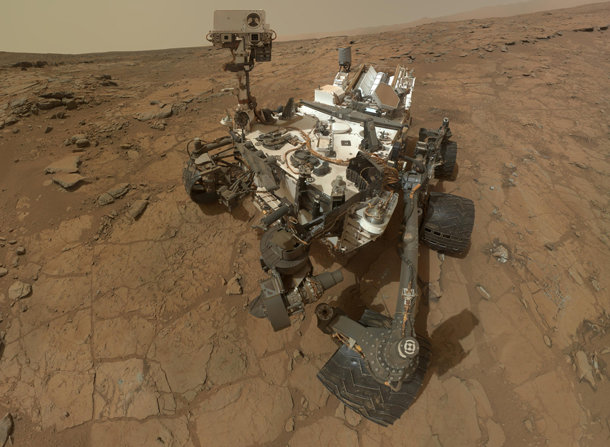
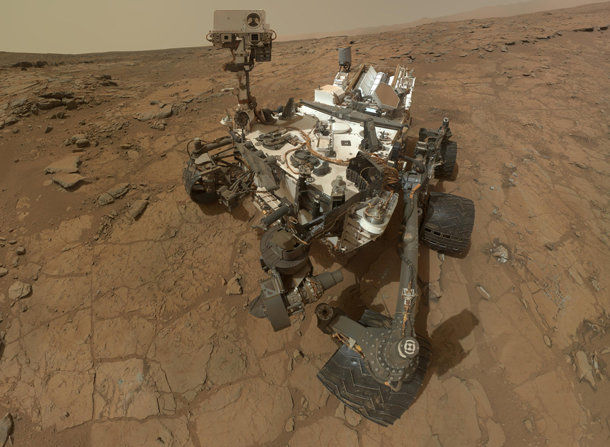
self shot picture
Curiosity takes a self-portrait on the red planet, a silent witness in an ancient mystery.

A Pattern of Failure: The Curse of the Red Planet

If this were an isolated incident, we could dismiss it. But Mars has a reputation. It’s a machine graveyard. Over half of all missions sent to Mars have failed. The Russians called it the “Mars Curse.” Probes have vanished on arrival, crashed into the surface, or simply gone silent without explanation.

  • The Soviet Phobos 2 probe reached Mars in 1989. Just before deploying a lander, it took a strange infrared image of an object on the surface. Moments later, the probe began spinning out of control and all contact was lost. The final, garbled image appeared to show an elliptical shadow on the surface that couldn’t be explained.
  • NASA’s Mars Observer disappeared without a trace just three days before it was scheduled to enter orbit in 1993. No final message. No telemetry. Just… gone.
  • The Mars Polar Lander in 1999 is presumed to have crashed after a suspected software error caused the landing engines to shut off prematurely. We never heard a single beep from it after it entered the atmosphere.

Is Mars just hard? Or is something actively defending the planet from our technological intrusions? The list goes on and on. It’s a pattern of bizarre, last-minute failures that defies simple explanation. Perhaps Curiosity’s “glitch” wasn’t a failure at all, but another entry in the long history of Martian interference.

What If It Was a Digital Handshake?

Let’s explore a different path. What if the event wasn’t hostile? What if it was the exact opposite?

Imagine an ancient, dormant intelligence on Mars. Perhaps it’s not biological, but a machine intelligence left behind by a long-dead civilization. It lies sleeping beneath the red sands, silent for eons. Then, it detects something new. A machine, similar in concept to itself, drilling into the ground above. A probe from another world.

It decides to communicate.

How would a hyper-advanced intelligence talk to our primitive 2011-era computer technology? It wouldn’t send a radio message in English. It might try to interface directly. A direct data probe. A digital “ping” to see what we are.

To Curiosity’s systems, this alien handshake would be incomprehensible. An unexpected flood of data. A series of commands it doesn’t recognize. The only thing the rover’s computer could do is interpret it as a corruption. A fatal error. It would be like trying to explain quantum physics to an ant by yelling at it. The ant wouldn’t understand; it would just panic and run.

We may have just received the first “Hello” from an extraterrestrial intelligence, and our technology was so basic that it registered the greeting as a computer crash.

Recent Theories From the Web

The internet, of course, has its own ideas. Forum threads and YouTube channels have analyzed the public data from the Curiosity mission with a fine-toothed comb. Some claim that in the raw images taken just before the shutdown, strange energy fluctuations or light anomalies can be seen near the drill site. Others point to a momentary spike in radiation detected not by Curiosity, but by the Mars Reconnaissance Orbiter high above—a spike that doesn’t fit the profile of a typical cosmic ray shower.

Is this proof? No. But it is a collection of nagging questions that the simple “cosmic ray” theory fails to satisfy completely. It feels too neat. Too tidy.

The Ultimate “What If” Scenarios

When you peel back the official explanation, you’re left with a universe of mind-bending possibilities. What really happened to Curiosity in the silence of Gale Crater?

Scenario A: The Ancient Guardian

The drilling at John Klein didn’t just disturb rock. It disturbed something else. An automated defense system, an ancient “No Trespassing” sign left by a civilization that disappeared millions of years ago. The system detected the intrusion and fired a low-power, non-lethal energy pulse to disable the threat. Just enough to fry a memory chip. It was the planetary equivalent of a bug zapper, and our rover flew right into it.

Scenario B: The Covert Observers

We are not alone on Mars. But the inhabitants, whoever or whatever they are, are not interested in open contact. They are watching, perhaps from underground cities or from bases hidden in the deep canyons. Our rover got too close to something interesting. Maybe it was an artifact, an entrance, or a resource they value. So, they performed the most subtle act of sabotage imaginable: a targeted, remote memory wipe. They didn’t destroy the rover; that would be too obvious. They just made it forget what it was doing, forcing NASA to reboot and, hopefully, drive in another direction.

Scenario C: The NASA Blackout

This is perhaps the most chilling theory of all. The glitch wasn’t alien. It wasn’t a cosmic ray. The glitch was a lie. In this scenario, Curiosity *did* find something in that rock sample. Something undeniable. Fossilized microbes? An exotic bio-signature? Proof. Proof that life existed on Mars. And the powers that be decided humanity was not ready for that revelation. They feigned a “computer malfunction” to buy time, wiped the rover’s memory of the discovery themselves, and then rebooted the mission with new, secret directives. The rover is fine. It’s the data that was quarantined.

The Silence Remains

In the end, Curiosity recovered. The B-side computer took over, and the mission continued. NASA later managed to repair the A-side computer from millions of miles away, and the rover drives on, a testament to human ingenuity.

But the questions linger in the thin Martian air. Was it really just a stray particle from a dying star that almost ended one of humanity’s greatest adventures? Or was it something more? A warning? A greeting? A cover-up?

Curiosity continues to roam the Red Planet, alone under a silent sky. But after that strange, unexplained moment of digital darkness, we have to ask ourselves a new question.

Is it really alone?

Originally posted 2016-05-01 20:27:52. Republished by Blog Post Promoter