Home Unexplained Mysteries UFO Mysteries Mars Rover – Curiosity investigates strange unexplained iron

Mars Rover – Curiosity investigates strange unexplained iron

0
69

Mars Rover – Curiosity investigates strange unexplained iron

Something Doesn’t Belong Here

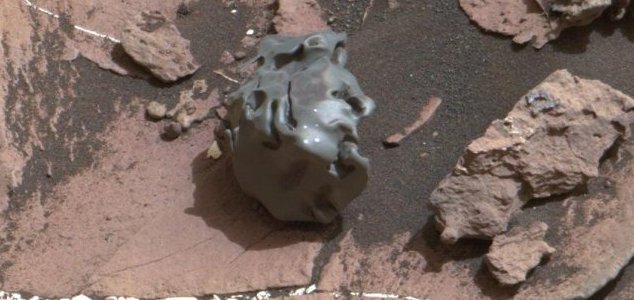
Look at it. Just look at the image above. In the middle of a desolate, dusty, rust-colored wasteland, something is shining.

It’s smooth. It’s globular. It looks… manufactured.

Mars is a planet of jagged rocks, razor-sharp dust, and sedimentary layers that have been crushed by billions of years of wind and neglect. Nothing on the surface should look like a polished golf ball. Yet, there it sits. A strange, metallic lump defying the landscape around it.

NASA calls it “Egg Rock.” A cute name for something that feels completely alien. And I know what you’re thinking—isn’t Mars already alien? Yes. But this object is alien to Mars itself.

When the Curiosity rover rolled up to this thing on October 27th (Sol 1505 of the mission), the mission controllers back on Earth froze. The feed from the Mast Camera (Mastcam) showed endless red dirt, cracked bedrock, and then this. A dark, lustrous anomaly.

It didn’t fit.

The immediate reaction from the mainstream science community was predictable. “It’s a meteorite,” they said. Case closed. Move along. Nothing to see here. But for those of us who track the anomalies, the weird coincidences, and the forgotten history of our solar system, “Egg Rock” is a trigger. It opens a door to questions that most textbooks are too scared to ask.

Is it really just a rock falling from the sky? Or is it evidence of something much, much older? Something violent?

Let’s dig in.

The Official Narrative: What NASA Wants You to Know

Before we go off the deep end—and trust me, we’re going there—we have to look at the official story. The “safe” explanation.

According to the scientists at the Mars Science Laboratory (MSL), this object is an iron-nickel meteorite. They claim it fell from the Red Planet’s sky sometime in the past and managed to survive the impact without shattering. The rover team, spotting the oddity, decided to do something incredibly cool: they shot it with a laser.

Curiosity is equipped with the Chemistry and Camera (ChemCam) instrument. It doesn’t just take pictures; it vaporizes tiny bits of matter. By firing intense pulses of laser light at a target, the rover creates a spark of plasma. The camera then analyzes the spectrum of light emitted by that plasma to figure out what the rock is made of.

This was the first time Curiosity had ever used its laser on a target like this. They zapped “Egg Rock” at nine different points.

The results? Iron. Nickel. Phosphorus.

Pierre-Yves Meslin, a member of the ChemCam team from France’s National Center for Scientific Research (CNRS), stated: “The dark, smooth and lustrous aspect of this target, and its sort of spherical shape attracted the attention of some MSL scientists when we received the Mastcam images at the new location.”

He noted that the specific mix of elements points to an iron-nickel-phosphide mineral. This is rare. You don’t find it just walking down the street. It’s usually found in the cores of asteroids. The theory is that this rock came from the shattered core of a planetary embryo—a baby planet that was destroyed billions of years ago in the violent asteroid belt.

Sounds plausible, right? Maybe.

The “Deep Dive”: Why This Rock is Weird

Let’s stop nodding along with the press release and actually think about this. Mars has an atmosphere. It’s thin—about 1% as thick as Earth’s—but it’s there. When space rocks hit Mars, they don’t usually land softly. They burn. They explode. They create craters.

Where is the crater for Egg Rock?

Look at the image again. It is sitting right on top of the surface. It’s not buried. It’s not in a pit. It’s just… sitting there. Like someone placed it.

If this thing came screaming through the atmosphere at thousands of miles per hour, hitting the ground with the force of a bomb, why is it intact? Why is it so incredibly smooth? Iron meteorites found on Earth often have a characteristic “regmaglypt” texture—thumbprint-like indentations caused by melting during atmospheric entry. Egg Rock has some of that, sure. But it also looks melted. Like it was liquid, and then it wasn’t.

The “Melted City” Theory

Here is where things get interesting. There is a controversial theory proposed by physicist Dr. John Brandenburg. He suggests that Mars wasn’t always a dead planet. He argues that Mars was once home to a civilization—the Cydonians—and that they were wiped out.

How?

Nuclear war.

Brandenburg points to massive isotopes of Xenon-129 in the Martian atmosphere, a signature that, on Earth, is only associated with nuclear explosions. He believes two massive airbursts occurred in the past, effectively sterilizing the planet.

Now, look at Egg Rock. If you were standing in a city made of metal and steel, and a nuclear weapon went off above your head, what would happen to the metal? It would melt instantly. It would turn into liquid droplets. Those droplets would fly through the air, cooling rapidly as they fell, forming smooth, spherical, metallic globs.

Is Egg Rock a meteorite? Or is it a piece of a melted skyscraper? Is it shrapnel from a war that happened millions of years ago?

The Phosphorus Connection

The laser analysis found phosphorus. NASA glosses over this, calling it a standard ingredient in meteorites. But let’s pause.

Phosphorus is the backbone of life. DNA. RNA. ATP (the energy currency of cells). It all requires phosphorus. Finding a concentrated lump of iron, nickel, and phosphorus on the surface of Mars is suggestive. If we entertain the idea of a lost civilization, or even just ancient biology, the presence of phosphorus locked inside a metallic casing is fascinating.

Could this object be technology? We use alloys of iron and nickel in aerospace engineering today. We use phosphorus in semiconductors and electronics. If you took a modern satellite, melted it down in a furnace, and let it cool into a ball, the chemical signature might look suspiciously similar to what ChemCam found.

Comparison: The Oumuamua Effect

We are living in an era of space anomalies. Remember ‘Oumuamua? The “interstellar object” that passed through our solar system in 2017? It was long, cigar-shaped, and tumbled strangely. It accelerated when it shouldn’t have. Many serious scientists, including Avi Loeb from Harvard, suggested it might be a light sail or a probe.

We are quick to dismiss things as “rocks.” It’s the safe bet. If you call it a rock, you keep your funding. If you call it a probe, you get laughed at.

But Curiosity is finding these things constantly. Smooth spheres. Geometric shapes. “Blueberries” (hematite spheres) that litter the ground like ball bearings. Egg Rock is just the latest in a long line of objects that suggest Mars isn’t just a random pile of geology. It’s a graveyard.

The Electric Universe Theory

There’s another angle here. The Electric Universe theory posits that electricity plays a much bigger role in the cosmos than gravity. Proponents argue that craters on Mars aren’t from impacts, but from massive interplanetary lightning strikes—cosmic thunderbolts caused by planets getting too close to each other.

If a massive electrical arc struck the surface of Mars, it would vaporize rock and metal instantly. It creates “fulgurites”—fused, glassy, metallic lumps. The smoothness of Egg Rock could be explained not by atmospheric friction, but by electrical machining.

Imagine a bolt of lightning the size of a mountain hitting an iron deposit. It pulls the material up, melts it, and reforms it into a sphere due to magnetic fields. It drops to the ground, cooling into the shiny, grey object we see today. This would explain why there’s no impact crater. It was formed right there, or nearby, by a force we barely understand.

Why the “Lustrous” Surface Matters

The ChemCam team specifically mentioned the “lustrous” (shiny) aspect. Mars is dusty. Everything gets covered in red dust eventually. The storms there are legendary; global dust storms can hide the surface for months.

So, why is Egg Rock so clean?

If it fell millions of years ago, it should be buried. It should be coated in red grime. But it gleams. It reflects the weak Martian sunlight.

This suggests one of two things:

1. It arrived very recently. Like, last week. This brings us back to the meteorite theory, but implies we are constantly under bombardment. Or, perhaps, it was dropped.

2. It resists the dust. Is it possible the object has properties that repel the static-charged dust of Mars? Some sort of magnetic resonance? If it’s a natural meteorite, it shouldn’t do that. If it’s a piece of advanced technology, maybe it still has a faint charge.

What If It’s Not From Space?

Let’s get really wild. What if it didn’t fall from the sky at all? What if it came from underground?

Mars has a crust. We know there are lava tubes. We suspect there are liquid water aquifers deep down. Curiosity is scratching the surface, quite literally. If there is, or was, a subterranean mechanism—a machine, a bunker, a core—could geological pressure have pushed this “egg” up to the surface?

It sits on the flat ground like a pebble on a beach. But in geology, heavy things sink. They don’t float. The positioning of this object is just… wrong. It feels staged. It feels like a marker.

The Psychological Impact

Why do we care? Why does a picture of a rock go viral?

Because we are lonely. As a species, we are desperate to find a friend, or an enemy, or just a neighbor. We stare at these high-definition photos from millions of miles away, hunting for patterns. We see faces in the shadows. We see pyramids in the mountains.

Egg Rock stands out because it breaks the pattern. It is the circle in a world of squares. It is the metal in a world of stone.

When the laser zapped it, we reached out and touched it. A robot, built by humans, fired a beam of light at a piece of the cosmos on another world. That connection is powerful. It confirms that we are capable of exploring, but it also highlights how little we know.

We analyzed the smoke, but we don’t know the story. We know it has nickel. We don’t know where it really came from.

The Verdict

Mainstream science will tell you Egg Rock is a generic iron-nickel meteorite. They will cite the Widmanstätten patterns found in similar rocks on Earth. They will tell you it likely came from the asteroid belt between Mars and Jupiter.

And they are probably right. Probably.

But the probability isn’t 100%. There is that sliver of doubt. The lack of a crater. The smoothness. The strange isolation on the surface. The “melted artifact” aesthetic.

Mars is a crime scene. We are the detectives showing up millions of years late. The bodies are gone. The weapons have rusted away. The buildings have turned to dust. All we have are the clues left behind—the isotopes in the air, the scars on the surface, and the strange, melted lumps of metal that sit quietly in the sand.

Curiosity continues to roll. It continues to zap. What will it find next? A gear? A bone? A microchip?

Or just more “rocks”?

Keep your eyes on the raw feed. The truth is usually hidden in the background, waiting for someone to notice that it doesn’t belong.

Summary of the Anomaly

  • Object Name: Egg Rock
  • Location: Murray Formation, Mars (Gale Crater)
  • Discovery Date: Sol 1505 (Oct 27, 2016)
  • Composition: Iron, Nickel, Phosphorus
  • Official Explanation: Iron-Nickel Meteorite
  • Alternative Theories: Melted ancient technology, nuclear fallout debris, electrical discharge formation (fulgurite), subterranean artifact.

Next time you look up at the red dot in the night sky, remember: It’s not just a planet. It’s a mystery waiting to be solved. And “Egg Rock” might be the key to unlocking a history we aren’t ready to accept.

Originally posted 2016-11-14 14:22:04. Republished by Blog Post Promoter