Friday, April 17, 2026
HomeWeird WorldStrange StoriesMars - Iguana spotted on Mars!

Mars – Iguana spotted on Mars!

They Found Life on Mars… And It Looks Like an Iguana?

Forget what they told you. Forget the sterile press releases and the condescending explanations from scientists in lab coats. They tell you Mars is a dead world. A wasteland of rust-colored dust and cold, silent rocks. They show you endless panoramas of nothing. But every now and then, the camera pans just a little too far. The rover snaps a picture it wasn’t supposed to take. And we see something that doesn’t belong.

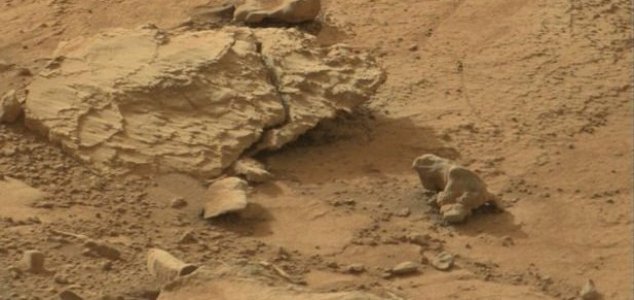
Something like this.

In 2013, an image quietly uploaded to NASA’s public servers sent a shockwave through the online world of anomaly hunters and digital archaeologists. It came from the Curiosity rover, a billion-dollar robotic geologist trundling through the Gale Crater. The mission? To search for signs of ancient microbial life. The result? Potentially something much, much bigger.

Because there, sitting nonchalantly amongst the Martian regolith, was what looked for all the world like a lizard.

An iguana, to be specific. Clear as day. A head. A neck. A defined body and maybe even the hint of a tail. It wasn’t just a vague shape; it was an animal. A reptile, sunning itself under a faint alien sun, millions of miles from home. The internet exploded. The story went viral. And for a moment, the entire world was asking the same question: What in the hell is an iguana doing on Mars?

The Shot Heard ‘Round the World (Wide Web)

Let’s set the scene. The Curiosity rover is a masterpiece of engineering. It’s a rolling laboratory the size of a small car, bristling with cameras, drills, and lasers. Its job is to be our eyes and ears on the Red Planet, meticulously documenting every rock, every grain of sand, every feature of the landscape. It sends back thousands of high-resolution images. So many, in fact, that the small army of analysts at NASA’s Jet Propulsion Laboratory can’t possibly scrutinize every single pixel in real-time.

That’s where the public comes in. People like Scott C. Waring, editor of the famous “UFO Sightings Daily” website, spend countless hours poring over these raw image feeds. They are the digital prospectors of the 21st century, sifting through mountains of data for that one nugget of gold. And in November 2013, Waring hit the motherlode.

He spotted it. A small, light-colored object in the foreground of an otherwise unremarkable photo of the Martian surface. But this object was different. It had form. Structure. A biological symmetry that stood in stark contrast to the random, jagged rocks around it. He circled it, blew it up, and posted his findings. The headline was electric. The evidence, at first glance, was undeniable.

Up Close with the Martian Reptile

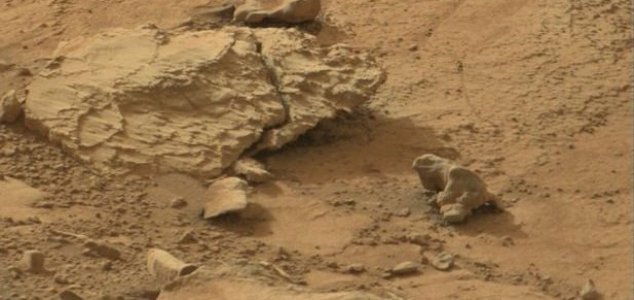
Look at the image. Really look at it.

news-mars-iguana

Don’t just glance. Stare. Let your eyes adjust. What do you see? The official story, the one they want you to believe, is that it’s a rock. Just a rock. A completely random geological formation shaped by eons of wind erosion.

But that’s not what your brain is telling you, is it?

You can see the rounded snout. You can see the distinct shape of a head, held slightly aloft. There’s a visible neck that connects to a thicker body. You can almost make out the texture of scales on its back. The object seems to be casting a small shadow, giving it a sense of three-dimensional reality. It’s not flat. It has volume. It has the distinct posture of a living creature.

The color is right, too. Many terrestrial lizards have a sandy, light-brown camouflage to blend in with their desert environments. This Martian “creature” fits that profile perfectly. It’s a stunningly familiar shape in a profoundly alien landscape. Too familiar, perhaps.

The Official Explanation: A Trick of the Mind

Of course, the scientific establishment was quick to dismiss the finding. They didn’t even bother issuing a formal press release. The explanation was simple, they said. It’s a classic case of pareidolia.

What’s pareidolia? It’s a psychological phenomenon. It’s your brain’s built-in pattern-recognition software going into overdrive. It’s the reason you see a face in the moon, a rabbit in the clouds, or the Virgin Mary on a piece of burnt toast. Our brains are hardwired from birth to find familiar shapes, especially faces and figures, in random patterns. It was an evolutionary survival mechanism. Seeing the vague shape of a predator in the bushes, even if it was just a bunch of leaves, was better than not seeing it at all.

On Mars, a planet with no familiar frames of reference, our brains are desperate to find something they recognize. So when we see a rock with a few lizard-like features, our mind fills in the blanks. It connects the dots and screams “Iguana!”

It’s the perfect explanation. It’s neat, tidy, and requires no rewriting of the textbooks. It allows science to pat us on the head, say “what a silly thing to think,” and get back to their work. Case closed. Move along, nothing to see here.

But… is it always that simple? Is every single anomaly, every strangely shaped rock, every object that doesn’t fit, just a trick of the mind? Or is “pareidolia” the most convenient word in the skeptic’s dictionary? A catch-all excuse to avoid looking at the evidence with an open mind?

What If It’s NOT a Rock? Diving Down the Rabbit Hole

Let’s suspend our disbelief for a moment. Let’s entertain the fantastic. Let’s ask the question the mainstream is terrified of: What if it’s real? If that object in the photograph is not a rock, what could it possibly be? The theories branch out into some mind-bending territory.

Theory 1: The Fossil

This is perhaps the most plausible of the “fringe” ideas. We know Mars wasn’t always the frozen desert it is today. Evidence points to a distant past where the planet was warmer and wetter. It had a thicker atmosphere, flowing rivers, vast lakes, and maybe even oceans. If Earth could spawn life in its primordial soup, why not Mars?

What if life on Mars evolved beyond the microbial stage? What if it developed into complex organisms, including reptiles perfectly adapted to the Martian environment? And what if some cataclysmic event—the loss of its magnetic field, a massive asteroid impact—killed everything off and flash-froze the planet?

In this scenario, the “iguana” isn’t alive. It’s a fossil. A perfectly preserved petrified creature, sitting exactly where it died millions of years ago. The fine Martian dust and thin atmosphere could have preserved it with stunning clarity, like the volcanic ash that entombed Pompeii. A silent, stony testament to a world that once was. If this is true, the Curiosity rover didn’t just find a weird rock; it stumbled upon the single greatest paleontological discovery in human history.

Theory 2: The Statue

Let’s push it a step further. If complex life evolved, could it have evolved intelligence? This idea brings us into the realm of ancient Martian civilizations. It’s a theory fueled by other anomalies, most famously the “Face on Mars” in the Cydonia region, a massive, mile-long formation that looked uncannily like a humanoid face in early images from the 1970s.

Could the Martian Iguana be an artifact? A small statue or carving left behind by a long-extinct race? Perhaps it was a religious idol, a child’s toy, or a simple decorative object. The idea of a lost civilization on Mars is a cornerstone of alternative history. We see pyramids and structures in blurry satellite photos and wonder if we’re seeing the ruins of a once-great society. The iguana, in this context, becomes another piece of the puzzle. A small, but profoundly important clue.

Theory 3: The Stowaway (Or Native Survivor?)

Now we enter the Twilight Zone. This is the theory that truly keeps people up at night. What if it’s alive?

Could a small creature from Earth have hitched a ride on the rover? We sterilize our spacecraft meticulously, but life is tenacious. Extremophiles—hardy microorganisms—have been known to survive the vacuum of space. Could a tiny lizard egg have somehow survived the journey and hatched on Mars? It seems almost impossible. The journey is long, the radiation is intense, and the landing is violent.

So, what about the other option? What if it’s a native? What if some form of life on Mars didn’t die out? What if it just… adapted? Could small, hardy creatures have evolved to survive in the thin atmosphere and brutal temperatures, perhaps living in underground burrows and coming out to bask in the weak sunlight? We are constantly discovering life in the most extreme environments on Earth—from volcanic vents at the bottom of the ocean to the frozen deserts of Antarctica. Are we so arrogant as to assume it couldn’t happen on Mars?

The idea of a living, breathing animal on Mars right now is staggering. It would change everything we know about biology, our place in the universe, and the prevalence of life itself. And maybe, just maybe, one of them got caught on camera.

A Pattern of Strangeness

If the Mars Iguana were a single, isolated incident, it would be easy to dismiss as pareidolia. But it’s not. It’s part of a much larger, and much weirder, pattern. For as long as we’ve been sending probes to Mars, anomaly hunters have been finding things that shouldn’t be there.

  • The Face on Mars: The original anomaly. Later, higher-resolution images showed it to be a natural mesa, but for many, the case is far from closed. They argue the new images were deliberately taken from a poor angle to debunk the original.
  • The Mars “Rat”: Another Curiosity rover image appeared to show a rodent, complete with nose, whiskers, and an eye, nestled between two rocks.
  • The Floating Spoon: A bizarre, long object that seemed to be hovering above the ground, casting a shadow below it. Geologists say it’s a ventifact—a rock carved by wind—but its shape is uncannily artificial.
  • The Martian “Woman”: A figure that looks remarkably like a cloaked woman with her arm outstretched, seemingly watching the rover from a rocky ledge.
  • The Thigh Bone: An object that looks identical to a fossilized femur, lying on the surface. NASA quickly called it a rock.

One or two of these? Coincidence. A trick of the light. Pareidolia. But when you line them all up—the iguana, the rat, the spoon, the woman, the bone—the official explanation starts to feel a little thin. It starts to feel like a pattern of denial. Are these all just rocks? Or are we looking at the scattered, wind-swept debris of a lost world? A world that NASA, for whatever reason, doesn’t want us to know about.

The Brookings Report: A Reason to Lie?

Why would they hide it? Why would NASA, an organization dedicated to exploration and discovery, actively cover up the most important finding in history?

The answer might lie in a dusty old document from 1960. Commissioned by NASA, the Brookings Report was a study that looked at the potential “implications of peaceful space activities for human affairs.” Buried deep within its pages is a section that considers the potential outcome of discovering intelligent extraterrestrial life.

The report’s conclusion was chilling. It suggested that such a discovery could lead to the complete collapse of human society. It could shatter religious beliefs, upend our social structures, and cause widespread panic. The report speculated that humanity might not be psychologically prepared for the reality that we are not alone. It even suggested that, under certain circumstances, it might be better to withhold the information from the public.

Is that what’s happening? Is NASA operating under a decades-old directive to “protect” us from a truth they believe we can’t handle? Is every strange rock dismissed as “pareidolia” not because it’s the scientific truth, but because it’s the official policy?

The Rock, The Reptile, and The Question That Won’t Go Away

So, where does that leave us? On one hand, we have the logical, rational explanation. It’s a rock. The Mars Iguana is a fantastic illusion, a product of light, shadow, and our own overactive imaginations. It’s a fun curiosity, but nothing more.

On the other hand, we have the tantalizing possibility that it’s something else. A fossil. A statue. A survivor. A single, grainy clue in the biggest mystery of all time. A breadcrumb leading us toward a revolutionary new understanding of the universe.

The truth is, we don’t know for sure. And that is the most exciting part. The mystery remains. The official story is just that—a story. It’s up to each of us to look at the evidence and decide for ourselves.

So, the next time you see a new image from the surface of Mars, don’t just see what they tell you to see. Look closer. Look between the rocks. Look in the shadows. Ask yourself: Is it just a dead, dusty world? Or is something looking back?

Amit Ghosh
Amit Ghoshhttps://coolinterestingnews.com
Aloha, I'm Amit Ghosh, a web entrepreneur and avid blogger. Bitten by entrepreneurial bug, I got kicked out from college and ended up being millionaire and running a digital media company named Aeron7 headquartered at Lithuania.
RELATED ARTICLES
- Advertisment -

Most Popular

Recent Comments

Warren Pan Abbott on The legend of the Devil Monkey !
chris davies on The McPherson Tape Mystery
Reed Reedly on ET has Internet!
Bea Houseoffashion on Proof Of Time Travellers – Gallery
Marcus2012 on ET has Internet!
Reed Reedly on ET has Internet!
LaughsAtConspiracyNuts on The 9/11 Conspiracy – Myths and Facts
Alex Sliverman on Did the ancients fly?
Doctor Wholigan on Time Traveler in 1938 film
chris davies on The McPherson Tape Mystery
Archie1954 on 10 secret UFO hideouts
chris davies on Ghosts of flight 401
Marcus2012 on ET has Internet!
jason Macdonald on Proof of Time Travel? – China
chris davies on Long-Lost Pyramids Found?
Reed Reedly on ET has Internet!
Milkman on Connected Universe
Tenmiles on Baigong Pipes Mystery
Simon Foster on Sirius – The Documentary
From the 1st April on 2013 – Alien Contact date ?
SkyWatcher on Is ET ignoring us?
I Come From The Future on Obama to make UFO Alien disclouser soon ?
ÛñK?øWn on 2013 – Alien Contact date ?
Just another person on 2013 – Alien Contact date ?
Malcolm Windowcleaner on The strange case of Rudolph Fentz
Mason Servio on Strange Things on Mars
Marke Wisdom Seeker on What will we find as arctic melts?
Andrea A Elisabeth Levyne on Aliens Captured in Varginha, Brazil
Mitch Grouyeki on Amazing Space Shuttle pictures