
Monday, August 10, 2026
HomeSpace & ScienceSpaceMars: ‘Catastrophic’ Collision Killed Life on Red Planet

Mars: ‘Catastrophic’ Collision Killed Life on Red Planet

Look at that image. Really look at it. Dusty. Barren. Cold. A graveyard of rust stretching out under a thin, poisonous sky. But what if I told you that wasn’t always the case? What if I told you that the image above isn’t just a picture of a planet, but a crime scene photo?

There is a theory bubbling up from the data streams of NASA’s rovers that is so terrifying, so earth-shattering, that it forces us to rewrite the entire history of our solar system. We aren’t just talking about microbes dying out because the water dried up. We are talking about violence. Planetary violence.

A catastrophic event wiped out the Red Planet. It didn’t just hurt it; it killed it. Murdered it. And recent findings suggest that before this apocalypse, Mars might have been home to a thriving alien biosphere. Maybe even a civilization.

The Day The Sky Burned

Four billion years ago. That’s the timestamp on the death certificate. Before that moment, Mars was a twin to Earth. It wasn’t the little brother; it was the equal. We are talking about blue oceans that went on for thousands of miles. Thick, white, fluffy clouds drifting through a dense atmosphere. Rain. Rivers. Maybe even forests. It was a paradise.

Then, something hit it.

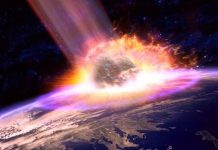
NASA scientists have been poring over data sent back by the Curiosity rover, and the story they are piecing together is the stuff of nightmares. The prevailing theory? A collision. But not just a stray asteroid. We are talking about a planet-killer. A body the size of Pluto—a massive, rogue object screaming through the dark—slammed into Mars with the force of a trillion nuclear bombs.

Imagine looking up at the sky. One minute, it’s a sunny Martian afternoon. The next, a shadow blots out the sun, and the atmosphere literally ignites.

The Atmosphere Did Not Just “Drift Away”

Textbooks used to tell us that Mars lost its air because its gravity was too weak. That’s the safe, boring answer. But the new data suggests something much more violent. The collision didn’t just crack the crust; it stripped the sky.

Dr. Chris Webster at NASA’s Jet Propulsion Laboratory dropped a bombshell. He explained that as the magma ocean from the planet’s birth was trying to solidify, a massive impact event, combined with relentless solar winds, ripped the atmosphere apart. It was a one-two punch.

Think about a candle in a hurricane. That was Mars. The impact heated the gas so much that it just blew out into space. The protective shield was gone. Without that blanket of air, the water boiled off or froze underground. The planet suffocated.

The Smoking Gun: What Curiosity Actually Found

You might be asking, “How do they know?” It’s been four billion years. Surely the evidence is gone? Wrong. The evidence is trapped in the rocks. It’s been waiting for us.

The Curiosity rover drilled into the Martian sedimentary bedrock. It pulled out a sample that shocked the control room back on Earth. This wasn’t just dead rock. It was a time capsule.

The drill sample contained clay minerals. Why does that matter? Because clay only forms in water. Lots of it. But not just any water—fresh water. Neutral pH water. The kind of water you could cup in your hands and drink. The sample also contained sulfates and other chemicals that act as a chemical fingerprint for a life-sustaining environment.

But here is the kicker.

The rover found the “Big Three”: Hydrogen. Carbon. Oxygen. These are the building blocks of life. They were sitting right there in the dirt, just beneath the surface, preserved for eons. NASA’s Michael Meyer put it bluntly: “A fundamental question for this mission is whether Mars could have supported a habitable environment. From what we know now, the answer is yes.”

It’s not a “maybe” anymore. It’s a “yes.” The stage was set. The lights were on. The actors were present. So, who—or what—was living there before the curtain fell?

The “Nuclear War” Hypothesis

Here is where things get really strange. And if you are a fan of alternative history, pull up a chair. While the official NASA line is “big rock hit planet,” there are other physicists who look at the isotopic data and see something else entirely.

Have you heard of Xenon-129?

It’s an isotope. A specific type of gas. In nature, it’s rare. But do you know where it is common? The aftermath of a nuclear explosion. We see spikes of Xenon-129 on Earth after atomic bomb tests. It is a signature of nuclear fission.

Mars is covered in it.

Some rogue researchers, including Dr. John Brandenburg, have suggested that the “catastrophic event” wasn’t a natural asteroid. He argues that the concentration of Xenon-129 in the Martian atmosphere is identical to what you’d see after a massive thermonuclear exchange. He calls it a “planetary nuclear massacre.”

Could the “collision” NASA describes actually be a cover-up—or perhaps a misinterpretation—of an ancient, high-tech war? Did a civilization on Mars destroy itself? Or even scarier… did someone else destroy them?

It sounds like science fiction. But when you look at the scars on the planet, the massive cratering, the sudden stripping of the atmosphere, and the radioactive signatures, the line between geology and archaeology starts to blur.

The Methane Mystery: Is Someone Still Home?

Just when you think the story is over, Mars throws another curveball. The planet should be dead. Biologically inert. A frozen rock.

So why does it keep burping?

Telescopes on Earth and sensors on the rovers have detected massive, unexplained spikes of methane gas in the Western Hemisphere. On Earth, 90% of methane comes from living things. Cows. Termites. Rotting plants. Swamp bacteria. It is the exhaust pipe of biology.

On Mars, this gas shouldn’t be there. Sunlight breaks methane down effectively. If you find methane, it means something produced it recently. Like, today. Right now.

NASA admits this is unexpected. They say it could be “non-biological processes,” like rocks reacting with underground water. Sure. That’s possible. But it’s also the exact excuse you would use if you weren’t ready to tell the public that microbial life—or something bigger—is hiding in the lava tubes underground.

The Underground Bunkers

If the surface was wiped clean by a Pluto-sized impactor (or a weapon), where would life go? It would go down. Deep down.

We know Mars has massive lava tubes—caves big enough to fit entire cities inside. If life existed there four billion years ago, and the sky started to burn, evolution would favor the things that could dig. The methane spikes might be the breathing of a deep-biosphere that survived the apocalypse.

The Great Filter: A Warning for Earth?

This brings us to the most chilling part of this entire deep dive. The Fermi Paradox.

We look out into the universe and ask, “Where is everybody?” There should be aliens everywhere. But we hear silence. One theory is the “Great Filter.” The idea is that all civilizations hit a wall. A disaster so big it wipes them out before they can travel the stars.

What if Mars is our warning?

What if the Martians didn’t just “die out”? What if they were just like us? They built cities, they fought wars, they polluted their air, and then… snap. One bad day. One collision. One mistake. And now their home is a rust bucket and we are sending robots to drive over their graves.

The “building blocks of life” found by Curiosity are the same blocks that make up you and me. Carbon. Hydrogen. Oxygen. We are made of the same stuff. We are neighbors. And looking at Mars is like looking into a dark mirror.

Connecting the Dots

Let’s recap the timeline that is emerging from the shadows:

  • 4 Billion Years Ago: Mars is wet, warm, and has a thick atmosphere. Life is potentially flourishing.
  • The Event: A massive body (or event) impacts the planet. The heat is unimaginable. The atmosphere is stripped away by solar winds and catastrophic outgassing.
  • The Aftermath: The oceans boil off. The surface sterilizes. The planet turns red from oxidation (rust).
  • The Remnants: Chemical fingerprints remain in the rocks. Methane continues to vent from the underground, hinting that the story isn’t quite over.

Dr. Webster said, “The atmosphere has developed as a balance between volcanic injection and loss to space.” It’s a polite way of saying the planet is bleeding air faster than it can make it.

Why This Matters Now

Why should you care about dead rocks? Because we are trying to go there. Elon Musk, NASA, China—everyone is racing to put boots on the Red Planet. We are obsessed with colonizing it.

But we need to understand what killed it first.

If it was a random asteroid, that’s bad luck. We can watch the skies. But if it was something inherent to the planet’s core, or a result of a civilization gone wrong, we are walking into a haunted house without knowing the history of the ghosts.

The Curiosity rover didn’t just find clay. It found a lost era. It found the ruins of a world that might have been our twin. Every time that rover drills a hole, it’s not just doing geology. It’s performing an autopsy.

The water was there. The chemistry was there. The conditions were perfect. And then, silence.

As we gaze up at that red dot in the night sky, remember: It wasn’t always a wasteland. It was a world. And whatever happened to them, we need to make sure it doesn’t happen to us.

Amit Ghosh
Amit Ghoshhttps://coolinterestingnews.com
Aloha, I'm Amit Ghosh, a web entrepreneur and avid blogger. Bitten by entrepreneurial bug, I got kicked out from college and ended up being millionaire and running a digital media company named Aeron7 headquartered at Lithuania.
RELATED ARTICLES
- Advertisment -

Most Popular

Recent Comments

Warren Pan Abbott on The legend of the Devil Monkey !
chris davies on The McPherson Tape Mystery
Reed Reedly on ET has Internet!
Bea Houseoffashion on Proof Of Time Travellers – Gallery
Marcus2012 on ET has Internet!
Reed Reedly on ET has Internet!
LaughsAtConspiracyNuts on The 9/11 Conspiracy – Myths and Facts
Alex Sliverman on Did the ancients fly?
Doctor Wholigan on Time Traveler in 1938 film
chris davies on The McPherson Tape Mystery
Archie1954 on 10 secret UFO hideouts
chris davies on Ghosts of flight 401
Marcus2012 on ET has Internet!
jason Macdonald on Proof of Time Travel? – China
chris davies on Long-Lost Pyramids Found?
Reed Reedly on ET has Internet!
Milkman on Connected Universe
Tenmiles on Baigong Pipes Mystery
Simon Foster on Sirius – The Documentary
From the 1st April on 2013 – Alien Contact date ?
SkyWatcher on Is ET ignoring us?
I Come From The Future on Obama to make UFO Alien disclouser soon ?
Just another person on 2013 – Alien Contact date ?
Malcolm Windowcleaner on The strange case of Rudolph Fentz
Mason Servio on Strange Things on Mars
Marke Wisdom Seeker on What will we find as arctic melts?
Andrea A Elisabeth Levyne on Aliens Captured in Varginha, Brazil
Mitch Grouyeki on Amazing Space Shuttle pictures