Home Unexplained Mysteries Historical Mysteries Lost Treasure – The Lost Crown Jewels of King John of England

Lost Treasure – The Lost Crown Jewels of King John of England

0
63

The $70 Million Royal Ghost: England’s Greatest Lost Treasure

It’s a story that sounds ripped from a Hollywood script. A greedy, despised king. A nation torn by civil war. And a king’s ransom in gold, silver, and priceless jewels swallowed by the earth in a single, catastrophic moment.

Gone. Vanished for over 800 years.

We’re talking about the legendary lost treasure of King John of England. The official story is a tidy tale of bad luck and bad weather. A simple, tragic accident. But the official story is almost never the whole story, is it? When you start digging, when you look past the textbook version, the neat little narrative falls apart. What you find instead is a web of secrets, betrayal, and a mystery that has haunted treasure hunters for centuries.

The estimated value today? A cool $70 million. At least. But its historical worth is beyond calculation. This wasn’t just gold. This was the heritage of a kingdom. And it’s still out there. Somewhere. Buried deep beneath the shifting muds of eastern England, waiting.

So, was it really just an accident? Or was it the perfect crime?

Who Was King “Bad” John?

You can’t understand the mystery of the treasure without understanding the man who lost it. And King John was a piece of work.

History has not been kind to him, and for good reason. He’s the villain in every Robin Hood story. The younger brother of the heroic Richard the Lionheart. The king who was so universally hated by his own powerful barons that they forced him to sign the Magna Carta in 1215, a document that basically said, “You have to follow the rules, too.”

He was paranoid. He was cruel. He was phenomenally greedy.

John’s entire reign was a chaotic mess of high taxes, lost wars, and epic arguments. He lost Normandy, the jewel of the English crown in France. He got into a feud with the Pope so bad that all of England was excommunicated. Churches were closed. The dead lay unburied. It was a PR nightmare.

To fund his failures, he squeezed every penny he could from the populace. He taxed his barons into oblivion. He seized land. And he collected… things. John had a dragon-like obsession with wealth. He didn’t just have a treasury; he had a mobile treasure hoard. Gold goblets, silver plates, sacks of coins, and the Crown Jewels themselves traveled with him wherever he went. This wasn’t just for show. It was his power. It was his war chest, his payroll for the thousands of mercenaries he relied on because his own people couldn’t stand him.

This is the man at the center of our story. A king on the run, his kingdom in open rebellion, clinging to the only thing he had left: his treasure.

The Final, Fatal Journey

The year is 1216. It’s a dark time for John. The ink on the Magna Carta is barely dry, and he’s already ignored it. The country has exploded into a full-blown civil war, known as the First Barons’ War. The rebel barons have done the unthinkable: they’ve invited a French prince, Louis, to invade England and take the throne.

And he did.

John is scrambling, racing across the country to fight off invaders and rebels. In October 1216, he finds himself in Norfolk, at the port of Bishop’s Lynn (today known as King’s Lynn). The town is perched on the edge of a vast, treacherous estuary called The Wash.

Think of The Wash not as a bay, but as a geographical trap. It’s a huge, shallow indentation in the coastline where four rivers empty into the North Sea. At low tide, it’s a bewildering maze of quicksand, slick mudflats, and hidden channels. At high tide, the sea rushes in with terrifying speed, erasing the landscape and drowning everything in its path. It’s a liquid graveyard, and people in the 13th century knew it.

While in Bishop’s Lynn, John comes down with a nasty case of dysentery. Sick, exhausted, and paranoid, he decides he needs to get to his castle at Newark, in the Midlands. This is where he makes a fateful decision.

20131214-150109.webp

Disaster in The Wash: The Official Story

The king, being ill, chose the smart path. He would travel on a longer, safer, inland route. But his baggage train—the slow, heavy procession of wagons carrying everything he owned—was a different story. It was massive. Carts piled high with furniture, royal documents, and, of course, the treasure.

Inside the King’s Baggage Train

What exactly was in those wagons? The chroniclers of the day give us a glimpse, and it is staggering.

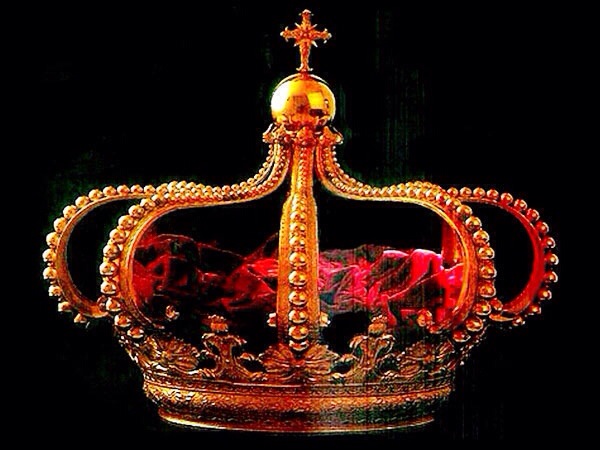
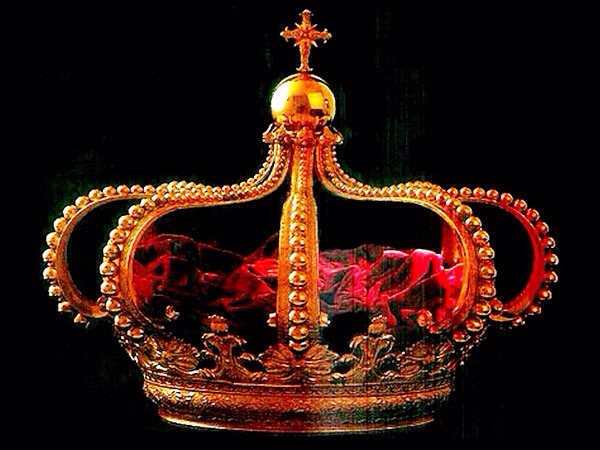
  • The Crown Jewels of England: This wasn’t just one crown. It included the priceless regalia inherited from his grandmother, Empress Matilda. We’re talking crowns, scepters, and orbs heavy with jewels.
  • Gold and Silver Plate: A vast collection of goblets, plates, and cutlery. Basically, the entire royal dining set, all made of precious metal.
  • Religious Relics: Holy artifacts housed in jewel-encrusted containers.
  • Legendary Artifacts: The manifest supposedly included items of mythic status, like the sword of the legendary knight Tristram.
  • Coinage: A massive chest of silver coins to pay his army of ruthless mercenaries.

To save time, this entire lumbering convoy, guarded by soldiers, was ordered to take a shortcut. A dangerous path straight across the mouth of the Wellstream estuary, a route only passable at low tide.

They misjudged it. Horribly.

Maybe they started too late. Maybe a sudden fog rolled in, confusing the guides. Or maybe the tide simply came in faster than they anticipated. The chronicles describe a scene of pure chaos. The heavy wagons, their wheels sinking into the greedy mud, became hopelessly stuck. The horses panicked. The soldiers screamed. And then the water came. A churning, relentless wall of seawater surged into the estuary, swallowing the wagons, the men, and the entire treasure of a kingdom.

It was all gone in a matter of minutes. King John, arriving safely at Newark Castle, received the news. His entire portable wealth had vanished into the sea. Already sick, the shock supposedly broke him. He died just a few days later, on October 18th, 1216. A miserable end for a miserable king.

And that’s the story you’ll read in the history books. Case closed, right?

Not even close.

The Whispers Behind the Official Story

The “accident” narrative is just too convenient. A king known for his cunning and treachery, locked in a desperate war, suddenly loses everything he owns in a freak accident and then promptly dies? It feels… wrong. And for 800 years, people have been asking the big question: what if it wasn’t an accident at all?

Modern Theory 1: The Ultimate Betrayal

Let’s look at the facts. John was surrounded by enemies. The rebel barons hated his guts. The French were invading. Even his own mercenaries were loyal only to the coin he paid them. What if someone arranged for the “accident” to happen?

It would have been disturbingly easy. A local guide, paid off by the rebels, could have led the baggage train into a known patch of quicksand. Or deliberately delayed them just long enough to be caught by the tide. The treasure is captured, the mercenaries guarding it are either killed or bought off, and John is left with nothing. His war effort collapses overnight.

Consider the timing. Losing his treasure didn’t just make John poor; it made him powerless. Without his gold, he couldn’t pay his army. His last line of defense was gone. For his enemies, it was a strategic masterstroke. A single act of sabotage that won the war without a major battle. Was the treasure swallowed by the sea? Or was it spirited away by John’s enemies, melted down, and used to fund the rebellion against him?

Modern Theory 2: The Royal Insurance Scam

This theory flips the script entirely. What if the mastermind wasn’t John’s enemies, but John himself?

Think about his situation. He was sick, possibly dying. He was losing the war. He knew his nine-year-old son, Henry, would inherit a broken and bankrupt kingdom. What if John staged the entire disaster?

The story goes like this: John, knowing the end was near, ordered a small, trusted group of loyalists to take the *real* treasure on a different, secret route. They buried it, hiding it deep in the English countryside, creating a secret royal slush fund for his heir. The “lost” baggage train that went into The Wash? It could have been a decoy, filled with rocks and lead to give it weight, with only a few chests of lesser valuables to make the loss look convincing.

He creates a public story of catastrophic loss. It explains why the royal treasury is empty. It garners a sliver of sympathy. Most importantly, it protects his family’s wealth from his enemies, who would have seized it the moment he died. His sudden death a few days later was just a tragic coincidence that turned a clever plan into a permanent mystery. The secret of the treasure’s true location died with him.

Modern Theory 3: It Was Never Really Lost

Here’s a simpler, more cynical take. What if some of it *was* lost, but not all of it? Imagine the chaos. The tide is rushing in, wagons are sinking. The guards and drivers aren’t thinking about the King’s silver plates; they’re thinking about saving their own skins.

But in the aftermath, a few enterprising locals—or even some of the surviving guards—came back at the next low tide. They find a few wagons that are only partially submerged. They break open the chests, grab sacks of coins, a few goblets, whatever they can carry, and vanish into the night. They tell no one.

The legend of the “great lost treasure” grows over the years, but in reality, it was picked apart piece by piece in the days and weeks after the disaster. There is no single hoard to find because it was scattered across Norfolk and Lincolnshire, melted down by village blacksmiths, and absorbed back into the medieval economy.

800 Years of Searching. 800 Years of Failure.

The lure of $70 million in buried treasure is a powerful thing. The search for King John’s hoard began almost immediately and has never really stopped.

For centuries, the primary challenge has been the landscape itself. The Wash is not a static place. It’s a living, breathing entity. Over 800 years, silt and sediment have been deposited by the rivers, fundamentally changing the coastline. Land that was once a tidal mudflat in 1216 could now be fertile farmland, miles from the sea, with the original medieval ground buried under 20 or 30 feet of earth.

Treasure hunters have pored over ancient maps and chronicles, trying to pinpoint the exact location of the crossing. Was it near Sutton Bridge? Or closer to Wisbech? The records are vague, the names of places have changed, and the landscape is unrecognizable.

In the 20th and 21st centuries, technology entered the picture. Teams with metal detectors, magnetometers, and even ground-penetrating radar have scanned the suspected areas. Hopes have been raised. A few medieval coins here, a piece of old harness there. But nothing. No wagon wheels. No treasure chests. Not a single gold coin definitively linked to John’s lost hoard has ever been officially declared.

The consistent failure has only deepened the mystery. If it was a simple accident, shouldn’t we have found *something* by now? A piece of a wagon? A single silver goblet? The complete lack of evidence is deafening. It’s what gives the conspiracy theories so much power. It’s easier to believe we can’t find it because it’s not there to be found—at least, not where everyone has been looking.

Could We Find It Today?

So, is the hunt over? Not a chance.

Modern archaeological technology is more powerful than ever. LIDAR (Light Detection and Ranging) can be used from aircraft to map the ground in incredible detail, potentially revealing the faint outlines of old roadways or river channels hidden beneath centuries of soil. New advances in soil analysis could detect concentrations of metals deep underground.

The search has become a data game. Historians and amateur sleuths on the internet cross-reference ancient texts with geological surveys and tidal models from the 13th century. They are building a new kind of treasure map, one made of data points and probabilities.

But the question remains. What are we looking for? A pile of rotted wood and a mound of gold slowly dissolving in the salty earth? Or an empty patch of mud where a brilliant betrayal took place? Or perhaps a clue that points us somewhere else entirely—to a quiet field or hidden crypt where a desperate king made his last, secret gamble.

The treasure of King John is more than just a fortune. It’s a perfect storm of history, mystery, and human greed. It’s the final secret of one of England’s most notorious monarchs. A ghost of gold and jewels, still out there, waiting in the dark. An accident? A heist? Or the most successful royal cover-up in history?

The Wash isn’t talking. Not yet.

Originally posted 2013-12-14 14:02:43. Republished by Blog Post Promoter