Home Unexplained Mysteries Modern Mysteries Lost Treasure – The Confederate Treasury

Lost Treasure – The Confederate Treasury

0
59

The Lost Confederate Gold: A Vanished Fortune and the Last Secret of the Civil War

Richmond was burning.

April 2nd, 1865. The air, thick with the smoke of burning documents and dying hopes, carried the death rattle of the Confederacy. For four long, brutal years, this city had been the heart of a rebellion. Now, its pulse was fading.

General Robert E. Lee, his army of Northern Virginia a phantom of its former self, sent the chilling message that President Jefferson Davis had dreaded for months: The lines were broken. The capital would fall. The government had to run. Now.

What followed was one of the most chaotic and desperate evacuations in American history. But amid the scramble of politicians and fleeing families, a second, more secret exodus was underway. An exodus of wealth. A king’s ransom in gold, silver, and jewels—the entire hard currency reserves of a would-be nation—was packed onto a train and spirited away into the night.

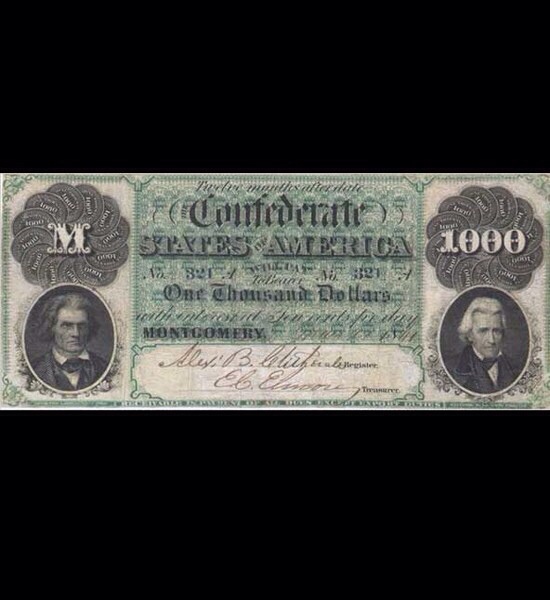
Just six weeks later, when Union cavalry cornered a haggard Jefferson Davis in the backwoods of Georgia, he had nothing. A few worthless Confederate banknotes in his pockets were all that remained.

So what happened to the money? What happened to millions of dollars worth of gold and silver? It didn’t just evaporate. It went somewhere. And the search for that *somewhere* has become one of the most obsessive and enduring treasure hunts of all time, a story tangled with secret societies, cryptic maps, and the tantalizing possibility that a fortune is still out there, waiting.

What Was *Actually* on the Treasure Train?

Forget the image of a single, overflowing treasure chest. The reality was far more complex and, frankly, much heavier. When Confederate Treasurer George Trenholm gave the order to liquidate everything, he wasn’t just emptying a single vault. He was gathering the last tangible assets of a collapsed economy.

The Mexican Silver: 9,000 Pounds of Mystery

The centerpiece of the legend is the silver. Specifically, 39 kegs of Mexican silver dollars. We’re talking about more than 9,000 pounds of solid wealth. Four and a half tons. Imagine the logistics. Imagine the sheer effort of moving that much weight, secretly, through a warzone crawling with enemy soldiers.

20131219-011246.webp

Why Mexican silver? Because the Union blockade had strangled the South. The Confederacy’s only real lifeline was through Mexico, trading cotton for hard currency and supplies. These silver “ocho reales” coins were the lifeblood of that trade. They were real. They were spendable anywhere in the world. And they formed the bulk of the treasure.

The Richmond Bank Gold

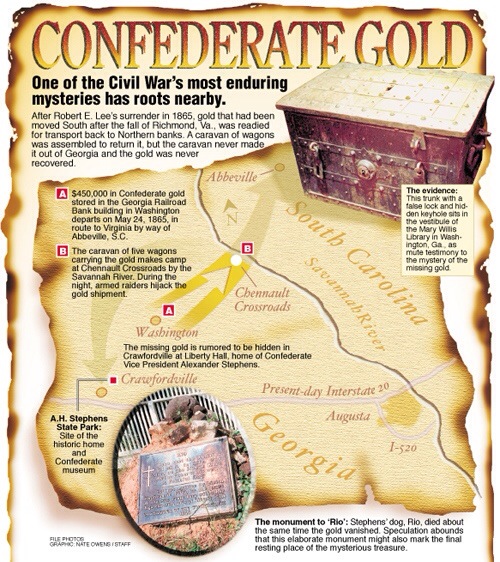
Panic wasn’t just in the government; it was in the streets. The banks of Richmond knew what was coming. Rather than let their gold reserves—estimated at a staggering $450,000 at the time (tens of millions in today’s money)—fall into Union hands, they “loaned” it to the fleeing Confederate government for safekeeping. It was a desperate gamble, loaded onto the same train with the government’s own assets.

The People’s Treasure

But there was another component, one that adds a layer of tragedy to the mystery. Throughout the war, Southern women had donated their most prized possessions to “The Cause.” Wedding rings, family heirlooms, silver tea sets, precious jewels. These weren’t just objects; they were symbols of sacrifice. They were melted down into bullion or kept as-is, adding an unquantifiable amount of sentimental and real value to the hoard. This wasn’t just the government’s money; it was the people’s last hope.

The Flight: A Trail of Coin and Chaos

Two trains slithered out of Richmond that night. The first carried Davis and his cabinet. The second, following shortly after midnight, was the prize. Guarded by a contingent of young, battle-hardened Confederate Navy midshipmen, it carried the entire treasury.

Their journey south was not a straight line. It was a panicked, meandering retreat.

First stop: Danville, Virginia. Here, Davis tried to set up a new capital, but the news of Lee’s surrender at Appomattox shattered that dream. The government was no longer a government. It was a band of fugitives.

From Danville, they moved to Greensboro, North Carolina. Then Charlotte. With every mile, the convoy shrank. The situation grew more desperate. Soldiers who hadn’t been paid in months were on the verge of mutiny. Accounts from the time describe tense meetings where portions of the treasure were used to pay these men, just to keep them from turning on their leaders. Small payments. A few gold coins here, a handful of silver there.

Was the treasure simply bled dry, paid out to desperate men on the long road south? It’s the simplest explanation. But it hardly accounts for the sheer bulk of it. You can’t just hand out 9,000 pounds of silver coins like pocket change.

Enter the Knights of the Golden Circle

And this is where the story pivots. From a simple story of retreat into a deep, dark conspiracy. The original reports mention a shadowy group tasked with hiding the treasure. A group called the Knights of the Golden Circle.

Who were they? The KGC wasn’t some myth. It was a very real, very dangerous secret society that existed years before the Civil War. Their original goal was insane: to carve out a massive, slave-holding empire that would annex Mexico, Central America, and the Caribbean. A “Golden Circle” of power.

When the war broke out, they went underground, becoming the Confederacy’s secret weapon. They were spies, saboteurs, and assassins operating behind Union lines. They had secret networks, codes, and ruthless members across the country. If you needed something to disappear, if you needed a secret to be kept, the KGC were the ones you called.

20131219-011435.webp

The theory is chillingly logical. As the end neared, Treasurer Trenholm and other high-ranking officials activated the KGC network. The mission: Don’t just save the money. *Hide it*. Disperse it in hundreds of small, secret caches across the South. Bury it. Sink it. Conceal it in caves. Create a war chest that could be used to fund a second rebellion. The South would rise again, and this hidden fortune would be its fuel.

Suddenly, the story of Jefferson Davis being captured with empty pockets makes sense. He didn’t need the money on him. It was already in the ground, guarded by a secret society sworn to protect it until the time was right.

The Top 4 Theories: Where Did a Nation’s Fortune Go?

For over 150 years, treasure hunters, historians, and conspiracy theorists have bled ink and sweat trying to answer the ultimate question. The trail goes cold around Washington, Georgia, in early May 1865. It was there that the last official meeting of the Confederate cabinet took place, and where the remaining treasure was last seen as a whole. After that… nothing.

Theory 1: The Washington, Georgia Pay-Off

Local legend in Washington is strong. The story goes that a portion of the treasure was stored in the town bank’s vault, and the rest was hidden at a nearby plantation. At a final, frantic meeting, the remaining officials essentially divided up what was left. Some took their share and fled. Others, fearing capture with bags of gold, buried their portions nearby. It is said that over $100,000 in gold was buried in and around Wilkes County, Georgia. Treasure hunters have been scouring the area for generations, with some small, unsubstantiated finds fueling the fire.

Theory 2: Sunk to the Bottom of the Savannah River

Another persistent legend claims that a significant amount of the gold was intended for Europe to buy arms and support. It was loaded onto a barge or boat to be taken down the Savannah River to the sea. But with Union patrols closing in, the guardians of the treasure made a choice: better the river have it than the Yankees. They scuttled the vessel, sending chests of gold to a muddy grave. Is there a fortune in gold bullion sitting at the bottom of the Savannah River? People have certainly looked.

Theory 3: The Great Western Escape

Some believe a portion of the treasure never stopped moving. It was entrusted to KGC members who took it west, beyond the Mississippi. Legends connect the Confederate gold to famous outlaws like Jesse James, suggesting his infamous robberies were not for personal gain, but to further fund the “Lost Cause.” This theory suggests the money was laundered and funneled through sympathetic groups for decades after the war, a shadow fund for a rebellion that never came.

Theory 4: The KGC Master Plan – A Thousand Hidden Caches

This is the grand conspiracy. The one that keeps people awake at night. It suggests the treasure wasn’t hidden in one place, but in hundreds. A distributed network of wealth. A few kegs of silver buried in a Virginia cave. A box of gold bullion dropped down a well in North Carolina. Jewels hidden in the walls of a Georgia plantation home. Each location was marked with cryptic symbols known only to KGC initiates—symbols carved on trees, rocks, and in caves.

Modern internet forums are filled with people trying to decode these supposed KGC markers. They analyze old maps, share stories passed down through families, and launch expeditions into the wilderness. They believe it wasn’t just lost; it was strategically hidden. A financial time bomb waiting to be rediscovered.

The Hunt in the 21st Century

This isn’t just some dusty historical footnote. The hunt for the lost Confederate treasury is alive and well. Equipped with ground-penetrating radar, magnetometers, and advanced metal detectors, modern treasure hunters are more capable than ever.

Every few years, a story surfaces. A family in Georgia finds unusual coins while renovating their home. A diver in a Florida river discovers a Civil War-era pistol next to a rotten chest. Most turn out to be nothing, but each one rekindles the flame. Each story whispers the same tantalizing question: *What if this is it? What if this is the one?*

The internet has given the legend new life. Communities share research, overlay old maps with satellite imagery, and debate the meaning of strange carvings found in the woods. It has become a crowd-sourced historical mystery of epic proportions.

But What If… It’s All a Myth?

There is, of course, a more mundane and disappointing possibility. What if the “great treasure” was a great exaggeration?

By 1865, the Confederate economy was a smoldering ruin. Its paper money was famously worthless. Perhaps the legends of “millions” were just propaganda, a story told to keep Southern morale from completely collapsing. It’s possible the amount of actual hard currency was much smaller than the myths claim.

Maybe, just maybe, the truth is boring. Maybe the money really was just paid out to soldiers. Maybe officials, seeing the end, simply lined their own pockets and fled the country. Maybe there is no master conspiracy, no secret caches, no sunken gold. Just a sad story of a failed nation’s last few dollars disappearing in the fog of war.

But where’s the fun in that?

The truth is, we don’t know. The historical record is a mess of conflicting accounts, deathbed confessions, and outright lies. And in that uncertainty, the legend grows. The story of the Lost Confederate Treasure is more than a hunt for gold; it’s a search for answers at the fractured end of America’s most painful chapter.

Was a nation’s wealth paid out, stolen, or sunk? Or was it meticulously hidden by a secret society, a seed for a second civil war, still lying dormant in the American soil? The answer, like the treasure itself, remains buried.

Originally posted 2013-12-19 00:15:43. Republished by Blog Post Promoter