The Sands Are Hiding Something Massive
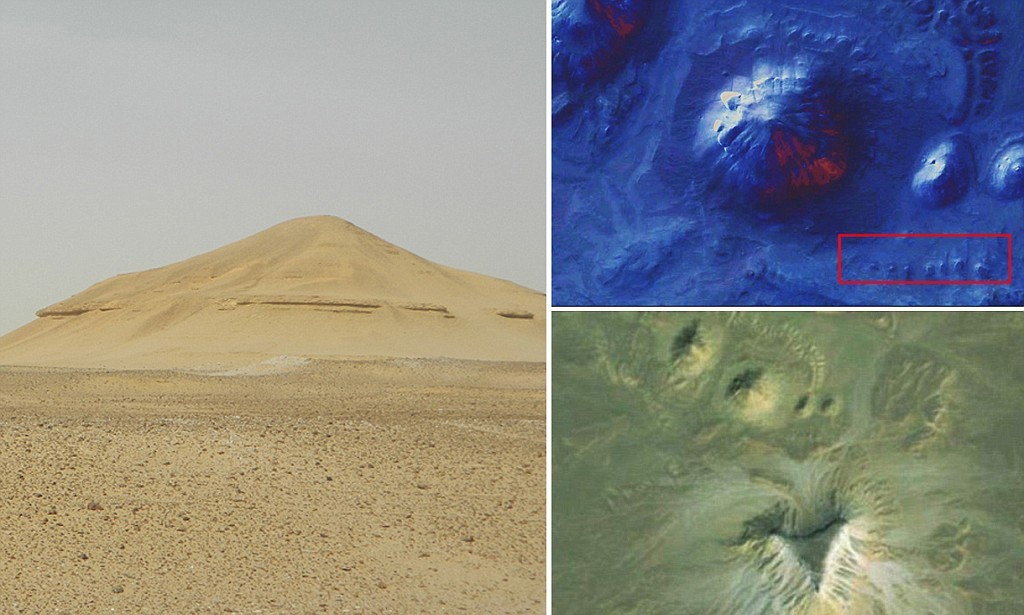
Look at the image above. Really look at it. To the untrained eye, it might look like a smudge of heat signatures or a glitch in the matrix of satellite data. But to those who hunt for the lost chapters of human history, that image screams one thing: Cover-up.
We are told that the Age of Discovery is over. They tell us every inch of the Earth has been mapped, cataloged, and conquered. They are wrong.
The Egyptian desert is a beast. It swallows cities whole. It erases timelines. And right now, beneath the shifting dunes, something colossal is waiting to be found. We aren’t talking about a few pottery shards or a forgotten outpost. We are talking about potential pyramid complexes that could dwarf Giza in significance. And the craziest part? They weren’t found by a fedora-wearing archaeologist in a dusty jeep.
They were found by a woman in North Carolina. Sitting at her computer.
The Wi-Fi Indiana Jones
Meet Angela Micol. She is a “satellite archaeologist.” That’s a title that didn’t even exist twenty years ago. While the gatekeepers of mainstream Egyptology were busy brushing sand off the same three statues they’ve been studying for decades, Micol was scanning the surface of the planet from 5,000 miles away. Using Google Earth.
What she found has sent shockwaves through the alternative history community.
Located about 90 miles apart, two distinct sites popped up on her screen. These weren’t random piles of rubble. They were geometric. Organized. Deliberate. In the chaotic, organic shapes of nature, straight lines and perfect angles stand out like a flare in the night sky.
Site One: The Abu Sidhum Anomaly
Let’s zoom in. The first site is in Upper Egypt, roughly 12 miles from the city of Abu Sidhum. This isn’t the tourist-trap Egypt you see on postcards. This is the deep desert.
Micol identified a cluster of four mounds. But “mounds” is a weak word for what these might be. They possess a footprint that demands attention. Two of the smaller mounds are roughly 250 feet wide, while two larger ones are approximately 600 feet wide.
Stop and think about that scale. 600 feet.
For comparison, the Great Pyramid of Giza is about 750 feet wide at the base. We are looking at structures that rival the greatest wonders of the ancient world, sitting there, ignored, gathering dust. The arrangement is curious. It doesn’t follow the flow of wind erosion. Wind creates chaos; it creates drifts. It does not create distinct, separated, massive formations with flat tops.
The Fayum Connection
Ninety miles north, near the legendary Fayum Oasis, lies the second site. This one is even more mind-bending. The Fayum Oasis has always been a hotspot for high strangeness and ancient activity. It was the breadbasket of old Egypt, a place of immense power during the Middle Kingdom.
Here, Micol spotted a four-sided, truncated mound. It’s about 150 feet wide.
But it gets better. Flanking this main structure are three smaller mounds. They are aligned diagonally. Does that sound familiar? It should. The diagonal alignment mimics the layout of the Giza Plateau (aligned with Orion’s Belt, if you believe the star correlation theories). Nature rarely builds in diagonal lines with repeating distinct structures.
“The images speak for themselves,” Micol stated when the news first broke. “It’s very obvious what the sites may contain.”
The “Expert” backlash
You know what happened next. It’s the same script we see every time someone challenges the status quo.
The academic elite scoffed. Discovery News reported the findings, and the backlash was instant. Geo-archaeologists and authoritative geologists rolled their eyes. They didn’t pack their bags to go look. They didn’t run ground-penetrating radar. They just looked at the JPEGs and said, “Nope.”
Their explanation? Buttes.
They claimed these were just windswept natural rock formations. Common phenomena. Nothing to see here, folks. Move along. It’s the classic dismissal tactic used to protect the approved timeline of history. If it’s not in the textbooks, it can’t be real.
But here is where the story takes a turn that reads like a thriller novel.

The Smoking Gun: The Lost Maps
Just when the skeptics thought they had buried Micol’s discovery under a pile of academic jargon, the phone rang.
“After the buzz simmered down, I was contacted by an Egyptian couple who claimed to have important historical references for both sites,” Micol revealed.
This wasn’t just any couple. This was Medhat Kamal El-Kady and his wife, Haidy Farouk Abdel-Hamid. These people are heavy hitters. We are talking about a former ambassador to the Sultanate of Oman and a lawyer who served as a counselor to the Egyptian presidency on border issues and sovereignty. They aren’t internet trolls. They are collectors of the rarest documents in Egypt.
They told Micol: You are right. And we have the paper trail to prove it.
Vindication from the Past
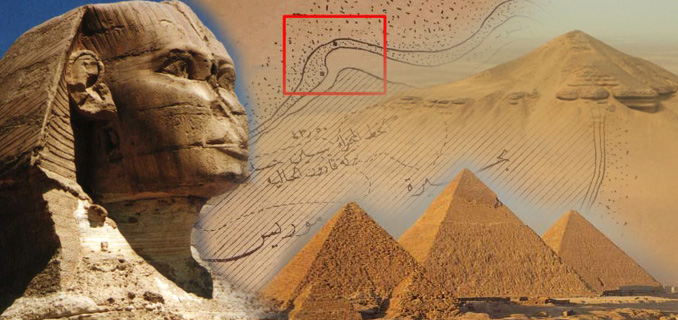
The couple owns a vast collection of old maps, manuscripts, and historical documents that have largely been forgotten by modern scholars. They pulled out rare maps that date back centuries. And what did those maps show at the exact coordinates Micol identified?
Pyramids.
Labeled. Documented. Known. These weren’t “buttes” to the people who walked these lands hundreds of years ago. They were recognized structures. The maps explicitly labeled the formations as pyramid complexes. This completely destroys the “natural formation” argument. Unless natural rocks can morph into pyramids and then back into rocks over the course of a few centuries, the geologists are dead wrong.
Deep Dive: What Lies Beneath?
The plot thickened during a “ground proofing” expedition. This is where the rubber meets the road. Micol’s team didn’t just stare at the satellite photos; they went to the dirt.
Preliminary investigations revealed features that nature simply does not produce. We are talking about cavities. Shafts. There are voids under the ground.
If these are natural hills, why do they have shafts? Why are there hollow spaces suggesting chambers?
Local villagers, the people who actually live on this land and know its secrets better than any Cairo professor, have admitted to finding “ancient things” near these mounds. There are whispers of tunnels. Hints of buried walls. The locals have known for generations that these hills are not just hills.
The “Lost Civilization” Theory
Why is this important? Why should you care about mounds of dirt in 2024?
Because it suggests our map of Ancient Egypt is woefully incomplete. We assume we found all the pyramids. We assume the Pharaonic dynasties are fully accounted for. But what if there is an entire era missing?
Some alternative historians propose that these could be “Pre-Dynastic” structures. Remnants of a civilization that existed before the Pharaohs we know—perhaps the same civilization that built the Sphinx (which water erosion evidence suggests is thousands of years older than stated). If these mounds near Abu Sidhum are pyramids, they are heavily eroded. That implies immense age.
Could they be 10,000 years old? 12,000?
The Technology of Discovery
This story highlights a massive shift in how we understand our planet. We used to rely on written records and lucky shovel strikes. Now, we have LiDAR (Light Detection and Ranging). We have ground-penetrating radar. We have high-resolution satellite imagery.
We are stripping away the vegetation and the sand virtually. In South America, LiDAR recently revealed massive cities hiding under the Amazon canopy—cities that “experts” said couldn’t exist. Millions of people lived there. Complex roads. Pyramids.
Why would Egypt be any different?
The desert is a preserving fluid. It keeps secrets well. But technology is the key that opens the lock. Angela Micol is just the tip of the spear. There are thousands of “anomalies” on Google Earth waiting to be checked.
The Resistance to Truth
So, why isn’t the Egyptian Ministry of Antiquities rushing to dig these up?
Politics. Money. Ego.
If you confirm these are pyramids, you have to rewrite the textbooks. You have to admit that the “amateurs” were right and the professionals were asleep at the wheel. That is a bitter pill to swallow. Plus, excavation is expensive. And frankly, some secrets are kept hidden on purpose.
What If They Open Them?
Let’s play a game of “What If.”
What if a team breaks the seal on the Fayum mound tomorrow? What would they find? In the Great Pyramid, we found empty coffers. But these sites are obscure. They haven’t been looted by tourists or Victorian explorers.
- The Hall of Records: Edgar Cayce predicted a stash of Atlantean knowledge buried in Egypt. Could it be here?
- Lost Technology: Precision tools used to cut granite like butter?
- Biological Anomalies: Mummies that don’t fit the human genetic baseline?
The possibilities are terrifying and exhilarating. The shafts detected by the ground team suggest ventilation or star alignment. That means these were machines of the spirit, designed for a function we barely grasp.
The Verdict
Angela Micol did not back down. The evidence from the old maps provided by El-Kady and Abdel-Hamid is the ultimate vindication. It bridges the gap between modern technology and ancient memory.
The maps say “Pyramids.” The satellite data says “Pyramids.” The ground-penetrating radar suggests “Chambers.”
The only people saying “Rocks” are the ones terrified of being wrong.
History is not set in stone. It is a puzzle, and we are missing half the pieces. So the next time you browse Google Earth, don’t just look for your own house. Look at the deserts. Look at the jungles. Look at the oceans.
You might just find a lost world.
Stay curious. Stay skeptical. And keep your eyes on the ground.