It shouldn’t exist. Period.
Imagine digging up a tomb in ancient Egypt, brushing away the sand, and finding a jet engine. Or cracking open a sealed Roman vault and discovering a digital watch ticking away in the darkness. That sounds like science fiction, right? It sounds like the plot of a bad movie.
But it actually happened.
We are talking about the Antikythera Mechanism. It is the single most baffling, out-of-place object ever recovered from the ancient world. It is a device so advanced, so complex, and so mathematically perfect that it destroys everything we thought we knew about human history. For decades, scientists looked at it and said, “No. That’s impossible.” They thought it was a fake. They thought it was a mistake.
They were wrong.

The Impossible Machine Beneath the Waves
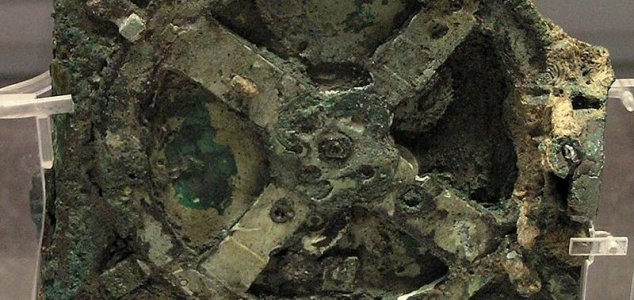
A new expedition in Greece is hoping to discover more fragments of the mysterious Antikythera mechanism. But before we get to the new hunt, you have to understand why this matters. Generally considered to be one of the most important archaeological discoveries of all time, the remarkable 2,000-year-old device is believed to be a form of early astronomical computer.
Let that sink in. A computer. From 2,000 years ago.
While the rest of the world was fighting with swords and scratching symbols into clay, someone—some forgotten genius—was building a gear-driven analogue processor capable of predicting the cosmos with terrifying accuracy. It tracked the sun. It tracked the moon. It predicted eclipses decades in advance. It even tracked the four-year cycle of the Olympic Games.
And then? The technology vanished. Poof. Gone.
Humanity wouldn’t see anything this complex again for another thousand years. Think about the mechanical clocks of the medieval cathedrals. This thing was better. And it was older. It’s like a gap in the timeline of human evolution, a piece of the future that fell into the past.
The Day the Sea Gave Up Its Dead
To understand the new mission, we have to go back to the start. The year was 1900. It was right before Easter. A group of Greek sponge divers, led by Captain Dimitrios Kondos, were sailing home to Symi. They weren’t looking for treasure. They were just trying to survive a brutal storm that hammered the Aegean Sea.
They took shelter near a tiny, desolate rock of an island called Antikythera. The storm raged. Bored and waiting for the winds to die down, they decided to try their luck diving for sponges off the coast. One of the divers, Elias Stadiatis, put on his heavy canvas suit and copper helmet. He sank into the dark water.
Minutes later, he signaled frantically to be pulled up.
When they hauled him onto the deck, Elias wasn’t holding a sponge. He was shaking. He couldn’t speak. He claimed he had seen a “heap of dead naked women” rotting on the sea floor. Horses, too. A graveyard of giants.
He hadn’t found bodies. He had found art. Discovered within a shipwreck off the Greek island of Antikythera, the mechanism was found alongside a number of other artefacts including coins, jewelry, pottery and statue fragments. The “dead women” were beautiful marble statues, corroded by centuries of salt water. It was the richest shipwreck ever found.
But the real treasure wasn’t the gold. It wasn’t the marble. It was a lump of corroded bronze and wood, about the size of a shoebox. Nobody cared about it. They threw it in a box at the National Archaeological Museum in Athens. It sat there for two years, unnoticed, drying out.
Then, in 1902, it cracked open.
Archaeologist Valerios Stais noticed something embedded in the rock. A gear wheel. A precision-cut, toothed gear wheel. In ancient Greek wreckage. It was an impossibility. It sent shockwaves through the scientific community that are still being felt today.
The Hunt Resumes: A Return to the Abyss
We thought we had found it all. But the ocean is vast, and it keeps its secrets well. Now, in the hope of finding more pieces of the mechanism, a team of archaeologists is preparing to return to the shipwreck for the first time since bad weather thwarted their efforts last year.
This isn’t just a casual dive. This is a high-tech invasion of the deep. The site is dangerous. It sits on a steep slope, sliding down into the abyss. The currents are treacherous. The depth—55 meters and deeper—limits how long human divers can stay down without risking the bends or death.
But the technology has changed. We aren’t just using copper helmets anymore. We have the “Exosuit.” Imagine a wearable submarine. An Iron Man suit for marine biologists. It allows divers to stay down for hours, pinching, grabbing, and vacuuming up the silt that has hidden these secrets for two millennia.
The “Titanic” of the Ancient World
Why is there so much stuff down there? That’s the question that haunts the researchers. This wasn’t a fishing boat. This was a leviathan.
“We were shocked to discover the wreck was much larger than earlier work had indicated – 30 to 50 meters long,” said expedition leader Brendan Foley.
Fifty meters. Do you realize how big that is for a wooden ship built before the birth of Christ? That is a monster. A floating fortress.
“The hull timbers were 11cm thick,” Foley continued, clearly amazed by the data. “This would make the wreck bigger than the pleasure barges Caligula built for his artificial lake and they were the largest Roman era ships known.”

This changes the narrative. This ship was carrying a massive hoard of loot. Some theories suggest it was a Roman ship, headed back to Rome from the conquered Greek cities, stripped of their art and culture. It was likely Julius Caesar’s victory parade supplies. But the sea doesn’t care about Caesar. The sea smashed the ship against the cliffs of Antikythera and dragged the greatest technological achievement of the ancient world down into the dark.
The “Twin” Theory: Is There Another One?
Here is where it gets truly wild. The fragments we have? They are incomplete. We have the gears, the front dial, part of the back. But pieces are missing. Key pieces.
It has even been speculated that the ship could have been carrying not one but two separate mechanisms that were used together to help ancient seafarers predict the motion of the planets.
Think about it. If you have a computer, you have peripherals. You have inputs. You have outputs. Some researchers believe the Antikythera Mechanism wasn’t a solo act. It might have been the “Master Clock,” driving a second display device. Or perhaps it was part of a set—one for the captain, one for the navigator.
If there is a second device down there, buried under five feet of sand and crushed amphorae, finding it would be the archaeological equivalent of the moon landing. It would prove that mass production of high-tech gear was possible in ancient Greece.
Whether the expedition divers will be able to find the second one however remains to be seen.
Cracking the Code: What Did It Actually Do?
For decades, we stared at X-rays of the device. We saw the gears, but we didn’t know how they fit. Then came high-resolution tomography—basically, a super-powered CAT scan.
What they found inside the corrosion was mind-bending.
It contained a differential gear. Engineers will tell you that the differential gear wasn’t invented until the 16th or 17th century. Yet, here it was. In 100 BC. This gear allowed the device to subtract the motion of the sun from the motion of the moon to determine the phases of the moon. It’s genius.
But wait, it gets crazier.
The moon doesn’t move at a constant speed around the Earth. It speeds up when it’s closer and slows down when it’s further away. This is called the “lunar anomaly.” It’s a nightmare to calculate mechanically. The builder of this machine solved it. They used a pin-and-slot mechanism—two gears, one slightly off-center, connected by a pin that slid back and forth. It mimicked the variable speed of the moon perfectly.
Who figured this out? Was it Archimedes? Was it Hipparchus? The math required to build this didn’t just require a genius; it required a workshop, a tradition of engineering, and tools we haven’t found yet.
The User Manual Written in Bronze
The most chilling part of the discovery wasn’t the gears. It was the writing. As the scanning technology improved, we realized the device was covered in text. Tiny, microscopic Greek letters engraved on the bronze plates.
It was an instruction manual.
The device literally tells the user what it is seeing. It labels the pointers. It explains the eclipse cycles. It mentions the planets: Mars, Jupiter, Saturn. It speaks to us from the past, a voice of reason and logic trying to explain the universe.
And then, silence.
Why Did the Technology Die?
This is the question that keeps historians awake at night. If the Greeks had this technology in 100 BC, why didn’t we have steam engines by 200 AD? Why didn’t we have an industrial revolution in Rome?
If you can build the Antikythera Mechanism, you can build a mechanical clock. If you can build a clock, you can build automation. You can navigate the open oceans with perfect precision. You can rule the world.
But the knowledge was lost. Maybe it was too expensive. Maybe it was a trade secret, guarded by a jealous guild of astronomers who refused to write down their methods. Or maybe the Romans, pragmatic and brutal, didn’t care about the delicate movements of the stars—they only cared about road building and warfare.
When the ship went down off Antikythera, it might have taken the last of its kind with it. A singular masterpiece, drowning in the dark.
The Deep Dive Continues
The team led by Brendan Foley is down there right now, or preparing to go. They are scanning the seabed with metal detectors that can discriminate between gold, bronze, and iron. They are mapping every square inch of the “Titanic of the Ancient World.”
They are looking for the rest of the puzzle.
Imagine if they find the missing planetary gearing. Imagine if they find the tools used to cut the teeth of the gears. Imagine if they find the skeleton of the passenger who was carrying it.
Every dive is a gamble. Every time they descend, they are fighting the pressure, the currents, and the weight of history. But the reward? The reward is rewriting the story of us.
The Antikythera Mechanism proves that our ancestors weren’t just superstitious farmers. They were scientists. They were engineers. They were dreamers who built a machine to hold the sky in their hands.
What else is down there? What other impossible things are waiting in the mud? We are about to find out.
Originally posted 2015-09-25 14:09:18. Republished by Blog Post Promoter