The Ghost Comet: Is a Rogue Killer Object Aiming for Earth?
It began as a celebration. The final moments of the year ticking away. Across New Zealand, people gathered, faces turned to the sky, not for fireworks, but for a celestial show nobody ordered and nobody could explain. A silent, ghostly cascade of light. A meteor shower from a constellation that shouldn’t have one.
They called it the Volantids.
But it wasn’t a celebration for everyone. In quiet, darkened rooms, far from the cheering crowds, astronomers stared at their screens with a growing sense of dread. This wasn’t just another light show. This was a breadcrumb trail. A cosmic warning sign. And the monster that left it was nowhere to be found.
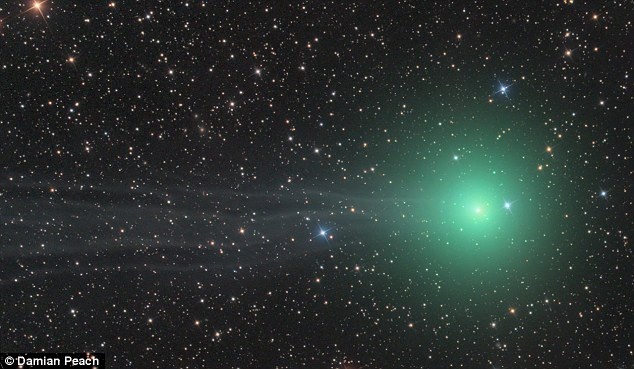
Now, a chilling question echoes through the halls of our most advanced observatories: Was this strange, never-before-seen meteor shower the calling card of a massive, unseen comet? A rogue object on a wild, unpredictable path that could intersect with our own?
A “potentially dangerous” comet, as they say in their understated scientific jargon.
What they really mean is a civilization-ender.

The SETI Connection: Why Are the Alien Hunters Staring at Rocks?
Here’s where the story gets weird. Really weird.
The team that jumped on this mystery wasn’t just any astronomical department. It was the SETI Institute. Yes, *that* SETI. The Search for Extraterrestrial Intelligence. Their entire mission is to scan the void for alien signals, for messages in a bottle from distant star systems. They look for patterns. For intelligence. Not for dumb rocks and ice.
So why, when a mysterious meteor shower appeared, did the alien-hunting crew suddenly pivot their attention? Why are they desperately trying to track the source of this debris field?
Think about it. Meteor showers are simple. A known comet, like Halley’s or Swift-Tuttle, swings through our neighborhood. It leaves a trail of dust and ice, like a truck shedding gravel on the highway. Once a year, Earth plows through that trail, and the tiny bits burn up in our atmosphere. We call it the Perseids or the Leonids. It’s predictable. It’s safe. It’s cosmic history.
But the Volantids shower was different. It was an orphan. There was no known parent comet. It was a trail of cosmic breadcrumbs leading to… nothing. A ghost ship’s wake with no ship in sight.
This has led internet sleuths and fringe researchers to ask a disturbing question. Is SETI tracking a “comet” because it’s not a comet at all? Are they using their powerful arrays to track something that intentionally shed this debris? A probe? An alien vessel announcing its arrival? Is “comet” just the public-facing codeword for something they can’t, or won’t, tell us about?
The official line is that any unknown comet in our solar system is a potential threat. But the unofficial chatter, the whispers on encrypted forums, suggest something far more profound is at play. SETI looks for intelligence. Maybe they found it. And it’s heading our way.
Jupiter: The Solar System’s Bouncer Just Went Off-Duty
To understand how terrifying this situation is, you need to understand Jupiter. Jupiter isn’t just a planet. It’s our bodyguard. Our bouncer. Our cosmic big brother.
Its sheer size—more than twice the mass of all other planets in the solar system combined—gives it a gravitational pull of unimaginable power. For billions of years, Jupiter has been our shield. It patrols the outer solar system like a guard dog, using its gravity to capture or violently eject comets and asteroids that would otherwise be on a collision course with Earth. It is the sole reason life on this planet was allowed to flourish in relative peace.
Most of the comets we see are what’s known as “Jupiter-family comets.” They are effectively prisoners, locked in orbits controlled by the gas giant’s immense power. They are held in a gravitational cage, prevented from causing chaos in the inner solar system.
The evidence pointed to the Volantids’ parent comet being one of these. It *should* have been under Jupiter’s control.
But it wasn’t. It broke free.
Somehow, this phantom object escaped its gravitational prison. It slipped past the bouncer. And the first sign we had of this cosmic jailbreak was the debris it scattered as it screamed past our planet’s orbital path.
Deep Dive: The Shoemaker-Levy 9 Cataclysm
If you want a visceral demonstration of Jupiter’s power—and what happens when a comet gets on its bad side—look no further than Comet Shoemaker-Levy 9 in 1994.
This wasn’t a single comet. Jupiter’s gravity had found it, captured it, and then brutally ripped it apart. It became a “string of pearls,” more than 20 city-sized fragments of ice and rock flying in a perfect, deadly line.
And then, Jupiter pulled them in for the kill.
One by one, over several days, the fragments slammed into the gas giant’s southern hemisphere. The world’s astronomers watched, absolutely stunned. The impact of just one of the larger fragments, Fragment G, released an energy equivalent to 6,000,000 megatons of TNT. That is 600 times the explosive power of every single nuclear weapon on Earth detonated at the same instant. The impact scar it left behind was a dark, bruised splotch *larger than the entire planet Earth.*
That is the power that is supposed to keep us safe. That is the force that our Ghost Comet has somehow defied. The question is, how? What kind of object has an orbit so strange, so energetic, that it can thumb its nose at the most powerful gravitational force in our solar system besides the Sun itself? What kind of trajectory is it on now that it’s off its leash?
Hunting the Ghost: Where is the Killer Comet Hiding?
So, we have a trail of debris, but the object that made it is invisible. A celestial hit-and-run. Astronomers are now scrambling, pointing every telescope they can at the southern sky, desperately hunting for this phantom. But it’s not there. This has given rise to several terrifying theories.
Theory 1: The “Stealth” Comet
Not all comets are bright, shiny snowballs. Some are dark. Incredibly dark. Over eons, a comet can accumulate a crust of cosmic dust and organic molecules, forming a black, tar-like shell. This shell makes it non-reflective. It absorbs light instead of reflecting it, rendering it almost invisible to our telescopes. It’s a stealth bomber in a black night. We wouldn’t see it until it was practically on top of us—a dark shape blotting out the stars behind it. The only reason we know about the Volantids is because the comet must have had a recent fracture or outgassing event, venting a cloud of fresh, reflective ice and dust into space. A temporary puff of smoke from a stealthy killer.
Theory 2: The Interstellar Gatecrasher
This is where things get even more unsettling. In recent years, we’ve confirmed the existence of interstellar objects—visitors from other star systems, just passing through. ‘Oumuamua in 2017 was the first, a bizarre, cigar-shaped object that accelerated away from the sun in a way we couldn’t explain. Then came Borisov in 2019, which looked more like a traditional comet.
What if the Volantid’s parent isn’t from around here? What if it’s an interstellar visitor on a hyperbolic trajectory, moving at speeds far greater than our own solar system’s comets? That would explain its bizarre orbit and its ability to escape Jupiter’s influence. It wouldn’t be captured because it’s moving too fast. It’s just blasting through our solar system, and we happened to fly through its exhaust fumes. If this is the case, its path is almost totally unpredictable. We have no history for it. No past observations. It came from the dark, and it’s heading… well, that’s the billion-dollar question.
Theory 3: The Shattered Remnant
Perhaps there is no parent comet left to find. Not anymore. Another possibility is that the original object, a truly colossal comet, disintegrated. Maybe it had a close encounter with an unknown object in the Kuiper Belt. Maybe its own internal pressures caused it to violently explode. What we saw in the Volantids shower wasn’t just a normal debris trail, but the shrapnel from a cosmic explosion. The danger here is that we aren’t tracking one big object. We’re now in the path of a shotgun blast of continent-sized chunks of ice and rock, a minefield of debris that we can’t see and can’t predict.
The Billion-Megaton Question: What If It’s Coming for Us?
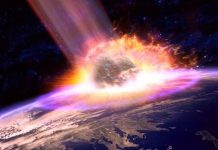
Let’s cut to the chase. The only reason this matters is the terrifying possibility that this Ghost Comet, whatever it is, is on an impact trajectory with Earth.
The SETI Institute’s cautious statement was that “any unknown comet would be ‘potentially dangerous’.” They also added that, for now, no scenarios “seem to call for any sort of collision.”
Seem to. A very carefully chosen word.
It means they can’t find it. And if you can’t find it, you can’t calculate its orbit. And if you can’t calculate its orbit, you have absolutely no idea where it’s going.
Deep Dive: The Gravitational Keyhole Nightmare
In orbital mechanics, there’s a concept that keeps astronomers awake at night. It’s called a “gravitational keyhole.”
Imagine a tiny, specific spot in space near a planet, like Earth. If a passing asteroid or comet flies through this exact spot—this “keyhole”—the planet’s gravity will bend its trajectory in a very precise way. It’s not enough to cause a collision on *this* pass. Instead, it’s a perfect little nudge that guarantees that on its *next* trip around the sun, it will slam directly into the planet. It’s like threading a cosmic needle that guarantees a bullseye years or decades down the line.
Could the Volantids meteor shower have been evidence of exactly that? Was the Ghost Comet making a close pass at Earth, flying through one of these keyholes? The debris we saw might have been shed by the gravitational stress of the maneuver. We thought it was a miss. But it could have been the universe lining up its sights for a future shot.
The ultimate terror of the Ghost Comet isn’t that it might hit us tomorrow. It’s that it might have already sealed our fate for a collision in 20, 50, or 100 years, and we are blissfully, ignorantly unaware. The countdown clock may have already started, and we can’t even see it.
The official reports have gone quiet. The story has faded from the headlines, replaced by more immediate, terrestrial concerns. But the mystery remains. The Volantid shower came and went, a fleeting, ghostly warning. The scientists at SETI and other observatories continue their silent watch, their search for the invisible object that haunts our skies.
What did they really see? And what are they not telling us? We look up at the night sky for beauty and wonder. Maybe we should be looking for a shadow. The shadow of the Ghost Comet.
Originally posted 2016-03-07 12:26:16. Republished by Blog Post Promoter