You think you know history? You think the timeline of human civilization is a straight line, moving from primitive cave dwellers to city builders? Think again. There is a massive anomaly hiding in plain sight. It is etched into the very skin of the Earth, and for thousands of years, we walked right over it without noticing.
We aren’t talking about the Pyramids of Giza. We aren’t even talking about Stonehenge. We are talking about something older. Something bigger. Something that forces us to rip up the textbooks and start over.
Welcome to the Turgai Trough in northern Kazakhstan.
Here, spread across a desolate, wind-swept landscape, lies a mystery that has baffled scientists, agitated conspiracy theorists, and attracted the attention of the heavy hitters at NASA.

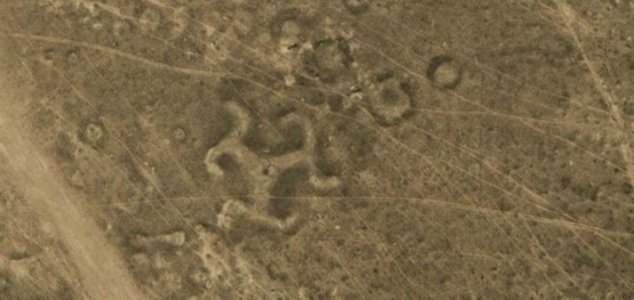
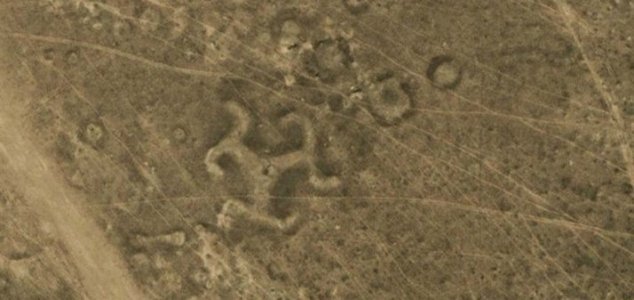
One of the more prominent geoglyphs is shaped a bit like a swastika, or more accurately, a three-armed triskelion. But this isn’t political. It’s ancient. It is a symbol of power and the sun that predates modern history by millennia.
The Discovery That Broke the Internet
Let’s rewind. How did we miss this?
For centuries, locals walked these steppes. They saw bumps in the ground. Maybe a strange hill here, a ridge there. From the ground, they look like nothing. Just mounds of dirt. Erosion. Nature doing its thing.
But perspective is everything.
In 2007, a Kazakh economist and amateur archaeology enthusiast named Dmitriy Dey was sitting at his computer. He wasn’t out in the field with a shovel. He was watching a documentary on pyramids and got curious. He opened Google Earth. He started scanning his home country.
He was looking for pyramids. Instead, he found something that shouldn’t be there.
He spotted a massive square. A perfect geometric shape. Then a cross. Then a ring. These weren’t pixel glitches. These were megastructures.
Archaeologists have long struggled to explain the nature and origins of the ancient Steppe Geoglyphs because, quite frankly, they defy the logic of the Stone Age.
The Impossible Timeline
Let’s talk numbers because they are staggering. These earthworks date back up to 8,000 years. Let that sink in. That makes the oldest of them significantly older than the Great Pyramid of Egypt. They are older than the civilization of Sumer.
Dating back up to 8,000 years and sprawled across vast areas of northern Kazakhstan, these remarkable earthworks remain one of the most enduring archaeological mysteries of recent times.
But here is the kicker. Here is the part that keeps historians awake at night.
According to mainstream history, 8,000 years ago, this region was populated by the Mahandzhar culture. These people were nomads. They were Stone Age hunters and gatherers. They followed the herds. They lived in yurts or temporary shelters. They did not build cities. They did not stay in one place.
Building a geoglyph requires massive resources. It requires feeding hundreds, maybe thousands of workers. It requires engineers. It requires a settled society with a surplus of food.
Nomads don’t do that. They can’t do that.
Yet, the dirt proves they did.
NASA Enters the Chat
This isn’t just some internet rumor. This is verified, high-level science. The discovery was so baffling that it got the attention of the United States space agency.
Even with the help of NASA, which has been aiding in the investigation by making it possible to take high resolution satellite images of the region, researchers still don’t know who constructed them, how they were built or what their original purpose was.
NASA released satellite photography from 430 miles up. Why? Because you cannot understand these shapes from the ground. They were designed to be seen from the sky.
This brings up the inevitable, chilling question: If humans couldn’t fly 8,000 years ago, who were these signs for?
The “Nazca” Connection
You have heard of the Nazca Lines in Peru. Giant spiders and monkeys drawn in the sand. Everyone loves Nazca. But the Kazakhstan geoglyphs (often called the Steppe Geoglyphs) are different.
The Nazca lines are “negative” geoglyphs—made by scraping away the topsoil to reveal white rock underneath. They are fragile.
The Steppe Geoglyphs are “positive” structures. They are built up. They consist of mounds of earth, stones, and packed dirt. Some mounds are 30 to 40 feet across and up to 6 to 10 feet tall. And there are thousands of them, arranged to create these shapes.
The first of the geoglyphs was identified back in 2007 and since then a total of 260 have been found scattered across the country. Some of the formations look a bit like crop circles while others consist of complex patterns and shapes – some even covering an area of over 810,000 square feet.
That is not a typo. 810,000 square feet. That is larger than several aircraft carriers laid end-to-end.
A Deep Dive Into the Shapes
What are they drawing? It isn’t random. It is specific, sacred geometry.
1. The Ushtogaysky Square
This was the first one Dey found. It sits near the village of Ushtogaysky. It is a giant square composed of 101 mounds. It is crossed by two diagonal lines forming an “X”. It is massive. The precision is terrifying. How do you align mounds perfectly over hundreds of meters without advanced surveying tools?
2. The Turgai Swastika
Look at the image above again. This is a three-limbed swastika (triskelion). In ancient times, long before the 20th century twisted the symbol, the swastika represented the sun, prosperity, and eternal motion. Finding this shape here connects the ancient people of Kazakhstan to Indo-European traditions stretching all the way to India and Europe.
3. The Bestamskoe Ring
A circle. Simple? Maybe. But circles in ancient culture usually mean unity, the cycle of life, or a boundary for ritual. Some researchers believe these rings were not just art, but functional.
The “Nomad Paradox”
Let’s get back to the people. This is where the mainstream narrative falls apart.
Thousands of years ago the region was home to nomadic Stone Age tribes who were unlikely to have built the geoglyphs because they had never stayed in one place long enough to do so.
Think about the logistics. To build the Ushtogaysky Square, you need to move tons of earth. You need to chop down trees for tools (in a place with very few trees). You need to feed the workers. If you are a hunter-gatherer, you spend your day hunting for dinner. You don’t have time to stack dirt for a shape you can’t even see.
This raises the question therefore of who could have gathered enough people together at such an early time in history to undertake such an ambitious construction project.
Could it be that we are wrong about the nomads?
Maybe they weren’t just wandering aimlessly. Maybe they had a sophisticated, seasonal civilization that gathered once a year for a massive ritual. A sort of Stone Age “Burning Man,” but with years of construction involved.
“The idea that foragers could amass the numbers of people necessary to undertake large-scale projects – like creating the Kazakhstan geoglyphs – has caused archaeologists to deeply rethink the nature and timing of sophisticated large-scale human organization as one that predates settled and civilized societies,” said University of Winnipeg archaeologist Persis B. Clarkson.
Clarkson is being polite. What she means is: We might be wrong about everything.
Theories: Gods, Giants, or Aliens?
When science hits a wall, theories run wild. And with the Steppe Geoglyphs, the theories are fascinating.
Theory 1: The Solar Observatories
Dmitriy Dey suspects these were observatories. He compares them to Stonehenge. The mounds might mark the rising of the sun at the solstices. If you stand in the center of the square, do the diagonals point to the sunrise on the longest day of the year? It is a strong possibility. This would mean these “primitive” nomads understood astronomy and mathematics.
Theory 2: The Sky Gods
Why build something that can only be seen from the clouds? Unless your gods live in the clouds. This is the most common anthropological explanation. The tribes were signaling to their deities. “We are here. Look at our work. Send rain. Send buffalo.”
Theory 3: The Ancient Acoustics
Newer fringe theories suggest that earthworks like these interact with the Earth’s natural magnetic or acoustic frequencies. Were these giant shapes designed to harness energy? It sounds like sci-fi, but we see similar claims made about the pyramids in Bosnia and Egypt.
Theory 4: The “Lost Civilization”
This is the Graham Hancock angle. Could these be the remnants of a civilization that was wiped out? A culture that existed before the last Ice Age ended, or one that rose and fell without leaving written records? The sheer scale suggests a level of organization that matches the great empires, yet we find no cities nearby. Just the lines.
The Gobekli Tepe Connection
We cannot talk about Kazakhstan without mentioning Turkey. In the 1990s, the discovery of Göbekli Tepe shattered archaeology. It was a massive stone temple complex built 11,000 years ago—by hunter-gatherers.
Before Göbekli Tepe, we thought religion came after farming. We thought you settled down, grew wheat, and then built temples. Göbekli Tepe proved that religion came first. People came together to build the temple, and then learned to farm to feed the workers.
The Kazakhstan Geoglyphs reinforce this revolutionary idea. The drive to build, to create, to mark the Earth is primal. It isn’t a byproduct of civilization. It is the spark that creates civilization.
Why Is This Area So Secretive?
Despite the NASA photos and the Google Earth coordinates, the Turgai region is hard to reach. It is remote. It is protected. And honestly, there isn’t enough funding digging into the dirt.
Much of the area was used for Soviet military testing in the past, which kept outsiders away. Now, it is open, but the mystery remains deep. The soil of Kazakhstan is hiding something.
Is there a burial chamber under the mounds? Some excavations suggest yes, but nothing grand has been found yet. Just hints. Fragments.
The Final Verdict?
We are looking at a giant puzzle piece. It doesn’t fit the picture on the box.
The Steppe Geoglyphs are a message. They are a shout across the millennia. They tell us that our ancestors were not just surviving. They were dreaming. They were looking at the stars. They were organized, capable, and driven by a purpose we have forgotten.
Next time you open Google Earth, scroll over to Northern Kazakhstan. Zoom in. Look at the lines. And ask yourself: Who was looking back?
The investigation continues.