Ghostship Found

1
94

The ocean is a graveyard. Usually, it keeps its secrets buried deep in the crushing dark. But sometimes? Sometimes the dead refuse to stay down.

article-2125742-127CBB1C000005DC-400_964x641

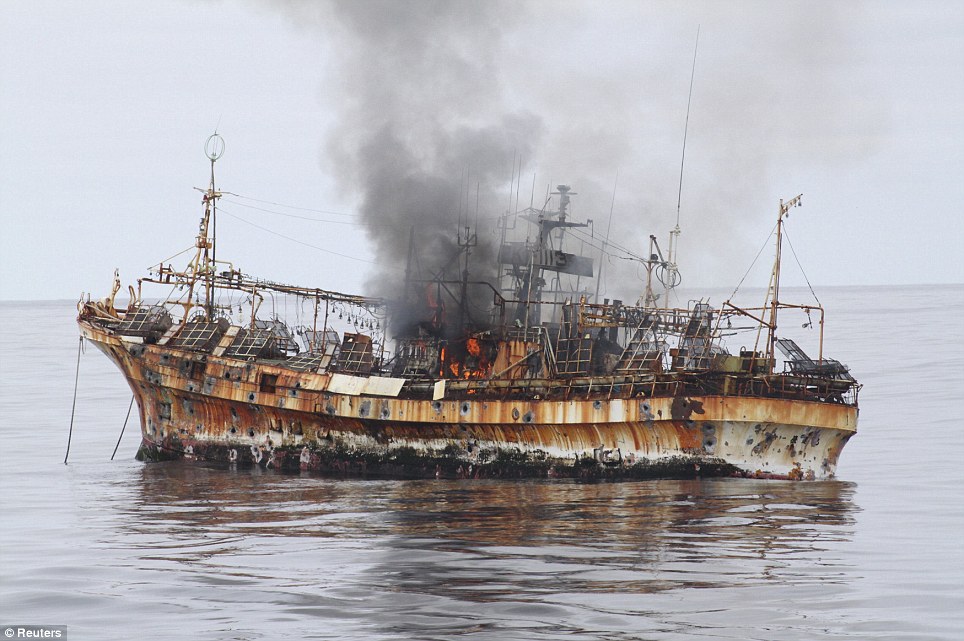
Imagine looking out over the grey, choppy waters of the Gulf of Alaska. You expect to see fishing trawlers. Maybe a whale breach. What you don’t expect—what you never expect—is a rusted, unmanned leviathan drifting silently out of the fog like a bad memory. This wasn’t just garbage. This was the Ryou-Un Maru. A ghost ship.

For over a year, this 164-foot steel beast wandered the Pacific Ocean alone. No captain. No crew. No lights. Just a hollow shell carried by the currents, a floating tombstone marking one of the worst disasters in human history.

It sounds like the plot of a horror movie. But in April 2012, the U.S. Coast Guard had to make a choice. They couldn’t let it land. They couldn’t tow it. So they did the only thing left to do.

They opened fire.

The Birth of a Ghost

To understand the end of the Ryou-Un Maru, we have to go back to the beginning. The date is burned into the collective consciousness of the world: March 11, 2011.

Japan. The ground shook with a magnitude-9.0 fury. The Earth actually shifted on its axis. Then came the water. A black wall of destruction that swallowed entire towns, erased coastlines, and dragged millions of tons of debris out into the open ocean.

The Ryou-Un Maru was a squid fishing vessel. It wasn’t even in service. It was docked in Hokkaido, waiting to be scrapped. Its life was supposed to be over. It was supposed to be cut up into metal sheets and melted down. But nature had other plans.

When the tsunami hit, the mooring lines snapped like thread. The ocean grabbed the ship and pulled it away from the shore, away from the chaos, and out into the silent, vast Pacific. The owners assumed it sank immediately. They wrote it off. It was gone.

Or so they thought.

The Long, Silent Drift

How does a 50-meter ship hide for an entire year? The Pacific Ocean is big. Bigger than your brain can really process. It covers 63 million square miles. You could drop all the landmasses of Earth into it and still have room to swim. In that kind of emptiness, even a 164-foot ship is just a speck of dust.

For months, the Ryou-Un Maru rode the currents. It bobbed through storms that would have terrified a seasoned crew. It drifted under the blazing sun and the freezing moon. It became a traveler in the “Great Pacific Garbage Patch,” moving slowly eastward toward North America at about 1 mph.

Think about the eerie silence on that deck. Rust spreading like a virus. Sea birds maybe landing on the railing, then taking off again, realizing there was no food, no life. Just steel and salt.

It wasn’t until it entered the busy shipping lanes of the Gulf of Alaska that it was spotted. A Canadian air patrol saw it. No radar signature. No radio response. Just a dark shape moving against the waves.

This is where the story gets crazy. It wasn’t just a curiosity anymore. It was a missile. A 50-meter steel missile drifting blindly into the path of oil tankers and container ships.

The High-Stakes Salvage Gamble

Before the guns started blazing, there was a moment of greed. Or maybe hope. Maritime law is weird. It’s old. And it says, basically, if you find an abandoned ship in international waters, and you can secure it, it’s yours.

Enter the Bernice C, a Canadian fishing vessel. The captain saw the Ryou-Un Maru and didn’t see a ghost; he saw a payday. Scrap metal is worth money. Engines are worth money.

The Coast Guard actually paused their plans to sink the ship. They gave the Canadians a shot. “Go ahead,” they said. “Try to catch the ghost.”

Imagine being on the deck of the Bernice C. You’re bobbing in the freezing Alaskan waters. You have to get a line onto a drifting, rusted hulk that is heaving up and down in the swell. It’s dangerous. It’s terrifying.

They tried. They really tried. But the Ryou-Un Maru didn’t want to be caught. The Bernice C couldn’t tow it. Maybe the lines snapped. Maybe the ghost ship was too heavy, waterlogged from a year at sea. A Canadian official later admitted defeat. The salvage rights were abandoned.

The ship belonged to the bottom now.

Target Practice

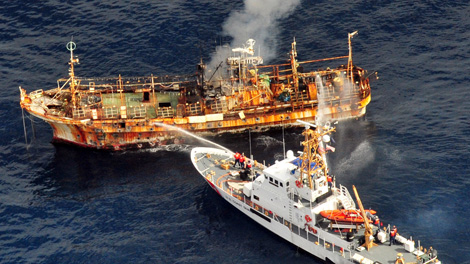
The U.S. Coast Guard cutter Anacapa moved into position. This wasn’t a rescue mission anymore. It was an execution.

Why sink it? Why not let it wash up?

Too risky. If it hit the shore, it could spill fuel onto the pristine Alaskan coastline. If it hit another ship at night? Catastrophe. The EPA and NOAA crunched the numbers. Sinking it deep—thousands of feet down—was the safest option. Any remaining fuel would evaporate or dissipate before it could do major damage.

The order was given.

The Anacapa didn’t use a torpedo. They used a 25mm chain gun. This isn’t a weapon that blows a ship up in one hit like in the movies. It punches holes. Lots of holes. It’s violent and visceral.

Pop-pop-pop-pop.

High-explosive ammunition slammed into the rusted hull. The steel shrieked. Explosions rocked the deck. The Ryou-Un Maru, which had survived a magnitude-9 earthquake and a tsunami, finally shuddered.

The Fire

It didn’t sink right away. It fought back. The rounds ignited something on board—maybe old fuel, maybe insulation. The ghost ship burst into flames. A massive column of black smoke rose into the grey sky, visible for miles. It was a Viking funeral for a machine that refused to die.

For four hours, the Anacapa watched. The ship listed. It took on water through the jagged holes torn in its side. The fire raged, consuming the bridge, the deck, the memories of the fishermen who used to work there.

Chief Petty Officer Kip Wadlow, watching from Juneau, confirmed the timeline. Four hours. That’s a long time to watch a ship die.

maxresdefault

The Radiation Conspiracy: Was It Dangerous?

As the ship slipped beneath the waves, the internet lit up. 2011 wasn’t just the year of the tsunami; it was the year of the Fukushima Daiichi nuclear disaster. The meltdown.

People started asking questions. “Was the ship radioactive?”

It’s a fair question. Debris from the disaster zone was washing up everywhere. The fear was palpable. Was the U.S. Coast Guard blowing up a dirty bomb in the ocean?

State health officials and environmental experts scrambled to calm the panic. They insisted there was little need to worry. The ship had left port before the worst of the radioactive plume spread. The water it drifted through diluted any contamination. Scientists tested debris landing in Alaska—buoys, styrofoam, soccer balls—and found the radiation levels were negligible.

But for conspiracy theorists? It was red meat. Why sink it so fast? Why not tow it in and test it? The official line is safety and navigation. The alternative view? Maybe they didn’t want to know what was glowing in that hull.

We’ll never know for sure. The evidence is now resting at the bottom of the Gulf of Alaska, under thousands of feet of crushing pressure.

The Legacy of the Debris Field

The sinking of the Ryou-Un Maru was just one violent chapter in a much longer story. The 2011 tsunami washed 5 million tons of debris into the ocean. Five. Million. Tons.

Houses. Cars. Toys. shoes. Photo albums. And ships.

Most of it sank near Japan. But about 1.5 million tons stayed afloat. It created a slow-motion wave of garbage headed for North America. A few months before the ghost ship appeared, huge buoys from Japanese oyster farms started washing up in Alaska. A Harley Davidson motorcycle in a crate washed up on a beach in British Columbia (the owner was tracked down, but he didn’t want it back—too many bad memories).

The ocean is still spitting these things out. Years later, pieces of the tragedy still find their way to shore.

An Invasive Species Nightmare?

There was another fear, one more grounded in biology than radiation. Bio-fouling.

When a ship drifts from Japan to Alaska, it doesn’t travel alone. Barnacles, algae, crabs, and other marine life attach themselves to the hull. These are Japanese species. If the ship had crashed into the Alaskan coast, those organisms could have jumped ship.

Invasive species can destroy local ecosystems. They out-eat and out-breed the locals. By sinking the Ryou-Un Maru in the open ocean, the Coast Guard wasn’t just stopping a collision; they were preventing a biological invasion. The fire and the deep water killed the hitchhikers.

The Final Descent

The Ryou-Un Maru is gone. But the image of it remains.

There is something profoundly sad about it. A ship built to work, destined for the scrap yard, liberated by a disaster, and sent on one final, lonely voyage across the world. It traveled 4,000 miles without a soul on board.

When the 25mm rounds tore through its skin, it was a mercy killing. The ghost ship vanished into the water, taking its mysteries with it. The smoke cleared. The Coast Guard cutter turned around.

The shipping lanes were safe again. But for those who saw it—the dark, rusting hulk emerging from the mist—it was a reminder. The ocean is powerful. It takes what it wants. And sometimes, it gives it back when we least expect it.

Originally posted 2016-02-26 08:28:19. Republished by Blog Post Promoter

Originally posted 2016-02-26 08:28:19. Republished by Blog Post Promoter