The King of Planets is Waking Up: What Hubble Really Saw on Jupiter
Something strange is happening in our solar system. We tend to think of the planets as static, unchanging marbles hanging in the void, spinning the same way they have for billions of years. We are wrong. Dead wrong. The solar system is alive, it is violent, and right now, the King is restless.
I’m talking about Jupiter.
For decades, we’ve looked at that swirling, gas-giant monster and seen the same thing: the stripes, the bands, and that angry, unblinking red eye staring back at us. But new data, deep dives into Hubble Space Telescope imaging, and modern updates from the Juno probe are painting a different, much more unsettling picture.
The atmosphere of Jupiter isn’t just “weather.” It’s chaos theory in motion. And back in 2015, Hubble spent 10 intense hours staring unblinkingly at the planet. The map it produced was spectacular. It was beautiful. But it also revealed anomalies that scientists are still struggling to explain today.

The 10-Hour Stare
Imagine staring at a hurricane for ten hours straight. Now imagine that hurricane is bigger than three Earths combined. That is what Hubble did. This wasn’t a casual snapshot. This was a dedicated interrogation of the Jovian atmosphere.
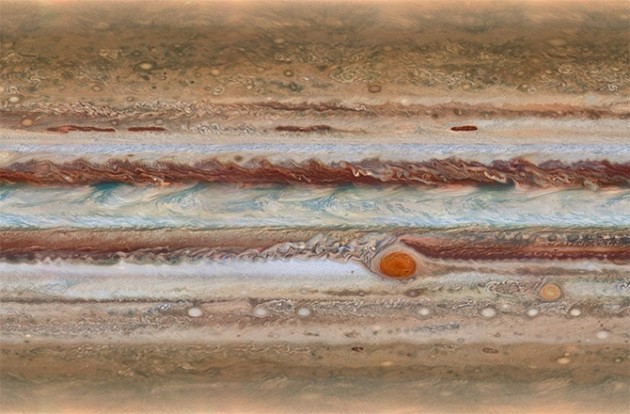
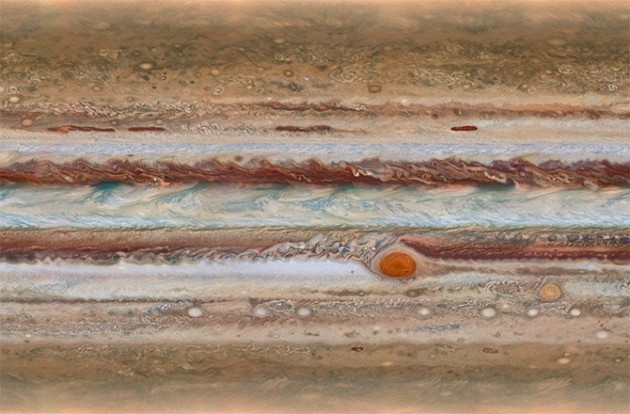
The resulting 4K imagery allowed astronomers to create a massive, flat map of the entire planet. But when they started zooming in on the details, the “wow” factor quickly turned into a “what is that?” moment.
They saw structures that shouldn’t be there. They saw the Great Red Spot—the most famous storm in the history of astronomy—doing something unprecedented. It was shrinking. And not just shrinking. It was changing color. It was mutating.
The Eye is Closing
Let’s talk about the Great Red Spot. This isn’t just a storm. In the alternative history communities, some call it the “Scar of the Sol.” It’s been raging for at least 300 years. Cassini saw it. Voyager saw it. It’s a fixture. A permanent warning sign in the sky.
But nothing lasts forever. Not even on Jupiter.
The data from this deep-field observation confirmed a suspicion that had been bubbling up in the astronomical community: The Spot is dying. It is rumbling south of the planet’s equator, spinning counter-clockwise, screaming with winds that would strip the flesh from your bones in a microsecond.
However, the storm is weakening. The engine is running out of fuel.
Look at the numbers. They are staggering. A century ago, this storm was roughly 40,000 kilometers wide. That’s 25,000 miles. You could fit three or four Earths inside it comfortably. It was a gaping maw ready to swallow worlds.
Today? It’s less than half that width.
In the single year leading up to this specific map, the spot shrank by another 240 kilometers (150 miles). That might not sound like much when you’re talking about a gas giant, but in planetary terms, that is a rapid collapse. The rate of shrinkage has slowed down slightly, but the trend is terrifyingly clear. The Great Red Spot is vanishing.
The Anemic Storm
It’s not just the size. It’s the blood. The deep, rich crimson that gave the spot its name is fading. The Hubble observations showed the color becoming “anemic.” It’s turning orange. Sometimes even a pale salmon color. It’s losing its intensity.
Why does this matter?
Because color in astronomy equals chemical composition. It equals energy. If the color is changing, the chemicals churning up from the deep—sulfur, phosphorus, perhaps organic compounds we don’t even have names for yet—are changing. The pump that brings material from the deep, hot interior of Jupiter up to the cloud tops is faltering.
Or maybe, something else is interfering with it.
The Ghost Filament
Here is where things get really weird. Zoom in on the core of the Great Red Spot in these high-resolution maps. Do you see it?
A strange, wispy filament. A twisted thread of cloud that wasn’t there before. This isn’t a normal cloud formation. It looks warped, stretched, almost like a foreign object caught in a drain.
The winds here are clocked at 540 kilometers (335 miles) per hour. Nothing should be able to hold a complex shape in that kind of blender. Yet, there it is. A structure. A “feature.”
Astronomers admitted they had “little explanation” for what this wispy structure was or where it came from. Is it a new type of atmospheric eddy? Is it the storm beginning to unravel from the inside out?
Some theorists on the fringe suggest that the Great Red Spot acts as a sort of collection point for space debris, or perhaps something stranger. Seeing a defined structure appear inside the chaotic eye raises questions. Is the storm natural? Or is it a reaction to something happening deep, deep below the metallic hydrogen ocean?
The Mystery Waves: Baroclinic or Something Else?
While the Red Spot grabs all the headlines, the real mystery might be hiding just north of the equator. The Hubble maps revealed a series of strange, repeating structures. A wave pattern.
These aren’t random puffs of gas. These are organized. They are spaced evenly. They look almost… artificial in their precision.
The mainstream scientific explanation is “baroclinic waves.”
On Earth, baroclinic waves are associated with the formation of cyclones. They happen in our atmosphere when temperature differences clash with the rotation of the planet. It’s weather physics. Fair enough.
But on Jupiter, these waves were spotted in a chaotic region packed with cyclones and anticyclones. The theory goes that these waves are originating low down and “propagating upward” into the upper cloud deck. Think of it like ripples in a pond, but the ripples are the size of continents and they are made of ammonia ice and death.

Why haven’t we seen them like this before? According to the researchers, these structures had been seen once, decades ago, by the Voyager probe (1979). But they hadn’t been seen since. Why did they vanish for 35 years? Why did they suddenly reappear in 2015?
Are they cyclical? Or did something trigger them?
Deep Dive: The Electric Universe Theory
Let’s step away from the NASA press release for a second and look at this through the lens of Alternative Physics. Have you heard of the Electric Universe theory?
Mainstream astronomy treats gravity as the only force that matters. Planets orbit because of gravity. Gas swirls because of heat and gravity.
But plasma physicists and alternative historians argue that electricity plays a massive role in the cosmos. They suggest that gas giants like Jupiter aren’t just balls of wind. They are massive electrical capacitors. The “storms” we see might not be wind at all—they might be gigantic plasma discharges. Rotating electrical storms.
If you view the Great Red Spot as an electrical phenomenon—a massive, centuries-long lightning storm anchor—then its shrinking makes sense in a different way. The electrical current feeding the planet is changing. The solar wind is changing. The circuit is powering down.
And those “baroclinic waves” north of the equator? In an electric model, repeating wave patterns often indicate frequency modulation. A vibration in the plasma field.
I’m not saying it’s aliens. But I am saying that describing these things as just “wind” feels like calling a nuclear explosion a “breeze.”
What Lies Beneath?
Since these Hubble images were taken, the Juno probe arrived at Jupiter. And what Juno found makes the 2015 mystery even deeper.
Juno used microwaves to look under the clouds. It found that the Great Red Spot isn’t a surface scar. It has roots. Deep roots. The storm extends hundreds of miles down into the planet. It is a funnel of heat and force that connects the cold upper atmosphere to the boiling depths.
If the surface spot is shrinking, does that mean the roots are dying? Or are they retracting?
We also learned that the magnetic field of Jupiter is lumpy and uneven. It doesn’t look like a standard bar magnet. It looks like a torn web. This chaotic magnetic environment creates “sounds”—eerie radio emissions that sound like screams and whistles when converted to audio.
The “Protector” Hypothesis
Why should you care if a storm on Jupiter shrinks? Who cares about wispy filaments millions of miles away?
You should care because Jupiter is the bodyguard of Earth.
This is standard celestial mechanics. Jupiter’s massive gravity well acts as a vacuum cleaner for the solar system. It pulls in comets and asteroids that might otherwise head toward the inner solar system. Toward us.
Remember Shoemaker-Levy 9 in 1994? That comet was ripped apart and slammed into Jupiter with the force of millions of nuclear bombs. If Jupiter hadn’t been there, or if its gravity was different, that rock could have ended civilization on Earth.
The atmosphere of Jupiter is the visible manifestation of its mass and energy. If the atmosphere is undergoing a radical change—if the Great Red Spot disappears and the band structures shift—it indicates a shift in the planet’s internal dynamics.
Does a change in Jupiter’s internal dynamo affect its magnetic field? Does it affect its gravitational influence? These are the “What If” scenarios that keep sleepless astronomers up at night.
A Warning from the Void
The Hubble map was a snapshot in time. A portrait of a changing face. The “weird structures” and the shrinking eye are reminders that the universe is volatile.
We rely on stability. We need the sun to rise, the tides to roll, and the planets to stay in their lanes. But the data shows us that stability is an illusion. The Great Red Spot was the most constant thing in the solar system for 300 years. And now, it is fading away.
Those wispy filaments inside the eye? They are the fraying edges of a mystery we have barely begun to solve.
So, the next time you look up at the night sky and see that bright, wandering star we call Jupiter, remember: It’s not a peaceful marble. It is a churning, screaming ocean of gas, electricity, and mystery. And right now, it is changing faster than ever before.
Keep your eyes open. The show is just getting started.