Home Weird World Space Juno spacecraft to reach Jupiter next year

Juno spacecraft to reach Jupiter next year

0
63

The Juno Conspiracy: Why Did NASA Really Send a Probe on a One-Way Trip to Hell?

Forget what you learned in school. Forget the sanitized NASA press releases and the glossy photos of a serene, striped giant. The planet Jupiter is not your friend. It’s a monster. A seething, chaotic ball of violence churning with storms larger than our entire world and wrapped in invisible belts of radiation so intense they could fry a human in seconds.

And we sent a probe there.

On purpose.

They called it Juno. A name pulled from Roman mythology. Juno was the wife of Jupiter, the one goddess who could peer through the clouds he used to hide his misdeeds. A fitting name. Or maybe, a revealing one. What “misdeeds” is the real Jupiter hiding? What secrets are churning beneath its impenetrable cloud tops, secrets so profound that NASA built a billion-dollar, armored spacecraft to go take a look?

The official story, the one they fed us back in 2011 when Juno began its lonely five-year trek across the void, was about science. It was about discovery. It was about understanding our solar system’s origins. But the more you look at the mission, the more you scrutinize the bizarre data it has sent back, the more you realize the official story is just the cloud layer. And the real truth lies deep, deep below.

The “Official” Mission: A Perfect Cover Story

Let’s start with what they tell us. Back in 2015, just a year before its harrowing arrival, NASA was all optimism. They talked about a solar-powered probe, a marvel of engineering, preparing for its grand entrance. The plan was simple, elegant, and perfectly logical on the surface.

Juno’s stated goals were to:

  • Map Jupiter’s powerful magnetic and gravitational fields to an unprecedented degree.
  • Determine if Jupiter has a solid, rocky core, or if it’s just gas all the way down.
  • Measure the amount of water and ammonia deep in the atmosphere.
  • Observe the planet’s brilliant auroras.
  • Take the first-ever detailed images of the planet’s poles.

Sounds like good science, right? It’s the kind of stuff that wins awards and gets published in prestigious journals. But read between the lines. Mapping a magnetic field isn’t just about magnetism; it’s about understanding the planet’s engine. Its dynamo. Looking for a “solid core” isn’t just geology; it’s a hunt for the very heart of the beast. And the poles? No one had ever seen them. An entire hemisphere of the solar system’s largest planet was a complete blank slate. A terra incognita of cosmic proportions.

A Suicide Run Into a Blender of Radiation

Here’s where the official story starts to fray. To get this data, Juno couldn’t just orbit from a safe distance like previous probes. No. It had to get close. Dangerously close. It was designed to swing into a long, looping polar orbit that would bring it screaming just a few thousand miles above the cloud tops—a maneuver no spacecraft had ever dared attempt.

Why is that a big deal? Because Jupiter is a radiological nightmare.

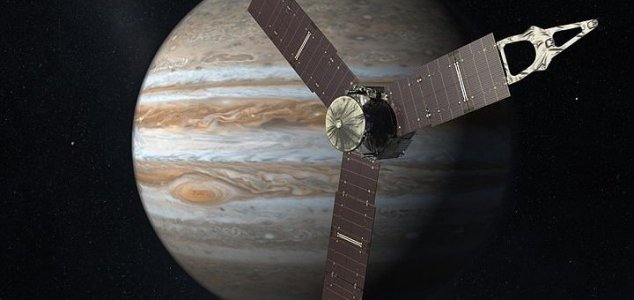
An artist's impression of the Juno probe at Jupiter.

The planet’s immense magnetic field traps particles from the solar wind, accelerating them to nearly the speed of light. This creates radiation belts thousands of times more powerful than Earth’s Van Allen belts. For a normal spacecraft, flying through this zone is like putting your phone in a microwave and then hitting it with a hammer. The electronics would be shredded. The sensors would be blinded. The mission would be over in an instant.

NASA knew this. So they didn’t send a normal spacecraft. They sent a tank.

Juno’s most sensitive components, its “brain” and “nervous system,” are encased in a box made of pure titanium. The Juno Radiation Vault. This nearly 400-pound shield was built to withstand a radiation dose equivalent to 100 million dental X-rays. Think about that. They built an armored probe specifically to survive a region of space so hostile it might as well be a piece of hell itself. The question isn’t *how* they did it. The question is *why* was it so important to get that close? What prize was worth that incredible risk?

Arrival: When All the Models Broke

On July 4th, 2016, after a nail-biting 35-minute engine burn, Juno successfully entered orbit. The team at NASA celebrated. The world breathed a sigh of relief. And then the data started to trickle in.

And everything we thought we knew about Jupiter was wrong.

The scientists who had spent their careers building models of how a gas giant should behave were left speechless. Their predictions shattered. What Juno found wasn’t a placid, predictable ball of gas. It was something wilder. Something weirder. Something that defied explanation.

Deep Dive: The Bizarre Discoveries That Stumped Everyone

The Polar Chaos: Remember those poles nobody had ever seen? Juno gave us our first look. And it was shocking. Instead of a single massive cyclone like the one at Saturn’s pole, Jupiter’s poles were home to bizarre, geometric clusters of continent-sized storms. The north pole had eight cyclones swirling around a central one. The south pole had five. They were packed together in stunningly regular polygons. A pentagon and an octagon of planet-sized hurricanes. Nature isn’t usually that neat. It was the first sign that the rules we understood simply didn’t apply here.

The Magnetic Anomaly: We expected a powerful magnetic field, like a super-sized version of Earth’s. What we got was a monstrosity. Juno found that Jupiter’s magnetic field is lumpy, bizarrely strong in some places and weirdly weak in others. Most shocking of all, the strongest part of the field seems to originate from a single spot in the northern hemisphere, not from the planet’s core. Scientists called it “The Great Blue Spot.” It’s a magnetic feature unlike anything ever seen. It’s as if the planet’s dynamo is broken, or operating on principles we can’t even begin to grasp.

The “Fuzzy” Core: For decades, the big debate was whether Jupiter had a small, dense, solid core or no core at all. Juno’s gravity measurements gave an answer that satisfied no one. The core isn’t small and dense. It’s big, “fuzzy,” and partially dissolved, its heavy elements mixed tens of thousands of miles up into the metallic hydrogen layer above it. How? One theory suggests a cataclysmic head-on collision with another massive protoplanet billions of years ago. A cosmic car crash that scrambled Jupiter’s insides. But is that the only explanation?

Shallow Lightning: On Earth, lightning comes from water clouds. Scientists assumed the same for Jupiter. Wrong again. Juno discovered massive electrical discharges, dubbed “shallow lightning,” happening high up in the atmosphere, in clouds of ammonia and water ice. It was another puzzle that sent theorists scrambling back to their whiteboards.

The Whispers on the Web: What Are They Hiding?

This is where we leave the official narrative behind. When the data defies all models, when the discoveries only deepen the mystery, you have to start asking different questions. The internet, of course, has been buzzing with theories since the first strange data streams arrived.

Theory 1: Jupiter is a Failed Star

This is a popular one. Jupiter is made of the same stuff as the Sun—mostly hydrogen and helium. It’s huge, but it’s just shy of the mass needed to ignite nuclear fusion and become a star. It’s what astronomers call a brown dwarf, or a “failed star.” What if it’s not entirely a failure? What if its massive, fuzzy core is generating heat in ways we don’t understand? What if its bizarre magnetic field isn’t from a simple dynamo, but from complex plasma physics more akin to a star than a planet? Juno’s mission to get close could be a veiled attempt to study a star-like object from a proximity we could never achieve with our own Sun.

Theory 2: The Great Red Spot is Not a Storm

The Great Red Spot. An anticyclonic storm that has been raging for at least 350 years. It’s so large that two Earths could fit inside it. Juno’s flyovers have given us the most detailed look ever, showing its roots go hundreds of miles deep. But some online forums and researchers ask a simple question: is it *just* a storm? For something to last that long, it needs a constant source of energy. The official explanation is that it draws power from smaller storms it consumes. But what if the energy source is below? What if the storm is just a surface manifestation of a colossal, stable heat source deep within the planet? A geothermal vent of unimaginable scale? Or something else entirely?

Theory 3: The Search for E.T.’s Power Plant

Let’s get wild. This is where the truly mind-bending ideas come into play. A planet with a fuzzy, partially-dissolved core and a magnetic field that seems to originate from one massive spot. What could cause that? What if the core isn’t a natural formation that was scrambled? What if it’s something artificial?

Think about it. An ancient, Type-II civilization would need a colossal source of energy. What better way to generate it than by building a machine inside a gas giant? A machine that taps into the immense pressures and metallic hydrogen of the planet’s interior. Such a machine would have a massive gravitational and magnetic signature. A signature that would be bizarre. Lumpy. Unnatural. A signature that would look exactly like what Juno has found.

Is it possible that Juno’s mission, with its titanium radiation vault and its pole-to-pole close-ups, is actually a reconnaissance mission? A fly-by to check on a piece of dormant, impossibly old alien technology? It sounds like science fiction. But the data Juno has returned is, in many ways, stranger than fiction.

The Final Act: A Fiery Death to Bury the Secrets

Here is the most telling clue of all. The final piece of the puzzle.

Juno’s mission will not end with a gentle retirement. It won’t be powered down and left as a silent monument in orbit. No. At the end of its life, currently scheduled for 2025, NASA will perform one last maneuver. They will command Juno to fire its thrusters and deliberately plunge into Jupiter’s atmosphere, where it will be incinerated by friction and crushed by unimaginable pressure.

It will be destroyed. Completely.

The official reason is “planetary protection.” They claim they are doing this to avoid any chance of the probe crashing into one of Jupiter’s moons, like the ocean-bearing Europa, and contaminating it with Earthly microbes. It’s a noble sentiment.

But isn’t it also the perfect excuse?

What if the real reason for this “Grand Finale” is to destroy the evidence? To ensure the probe, with its hard drives full of raw, unanalyzed data, can never be recovered by a future, rival space agency? To erase the one witness that has peered beneath Jupiter’s clouds. If you found something truly world-shattering, something that could change humanity’s understanding of the universe forever, would you broadcast it to the world? Or would you bury it in the deepest, most inaccessible grave in the entire solar system?

We see the curated images. We read the sanitized scientific papers. But we don’t see the raw telemetry. We don’t know what anomalies were detected and quietly dismissed. Juno was sent to look through the clouds. We have to wonder if, in doing so, it found a truth so stunning, so unsettling, that the only command left to give was… silence.

Originally posted 2015-09-05 15:47:30. Republished by Blog Post Promoter