The Official Story is a Lie: What REALLY Hit the Moon in 1959?
History books tell you a neat, tidy story. They tell you that on September 14, 1959, a Soviet probe named Luna 2 became the first human-made object to touch another world. A triumph of science. A landmark for humanity. A simple metal ball that made a 237,000-mile journey and ended with a silent thud in the lunar dust.
It’s a nice story.
It’s clean.
And it might be one of the biggest deceptions of the 20th century.
Because when you start pulling at the threads of the official narrative, the entire story unravels. What if Luna 2 wasn’t just a probe? What if its mission wasn’t peaceful exploration, but a cosmic power play with stakes we can barely comprehend? Forget the sanitized version you learned in school. We’re going deep into the shadows of the Cold War to uncover what was *really* on that hunk of metal hurtling towards the Moon.
A World on a Knife’s Edge
To understand the secret of Luna 2, you have to understand the world it came from. This wasn’t the 2020s. This was the late 1950s. The world wasn’t connected by the internet; it was divided by an Iron Curtain. Two superpowers, the USA and the USSR, were locked in a terrifying stalemate, their nuclear arsenals pointed at each other, fingers hovering over the launch buttons.
Every single public act was a piece of propaganda. Every victory, no matter how small, was a demonstration of ideological superiority. And then came Sputnik in 1957. A beeping metal sphere orbiting the Earth, broadcasting Soviet dominance to the entire planet. America panicked. The idea that the communists could be flying over their heads, potentially with bombs, was a national nightmare. The Space Race had begun. But it wasn’t a race of discovery. It was a race for survival.
Deep Dive: The Ghost of the Space Race
The entire Soviet space program was run by a man whose very existence was a state secret. He was known only as the “Chief Designer.” His name was Sergei Korolev. A brilliant engineer who had survived Stalin’s gulags, he was the genius behind Sputnik, behind the first man in space, and behind the Luna program. His name was kept secret by the state to protect him from foreign assassins. Think about that. The pressure on this one man was immense. He wasn’t just launching rockets; he was carrying the pride and perceived power of the entire Soviet Union on his shoulders. Every launch was a gamble that could end in either global triumph or national humiliation.
More Than Just a Metal Ball
So when they tell you Luna 2 was just a simple probe, you have to ask yourself: in this environment of total paranoia and propaganda, does “simple” even make sense? Everything had a dual purpose. Everything was a message.
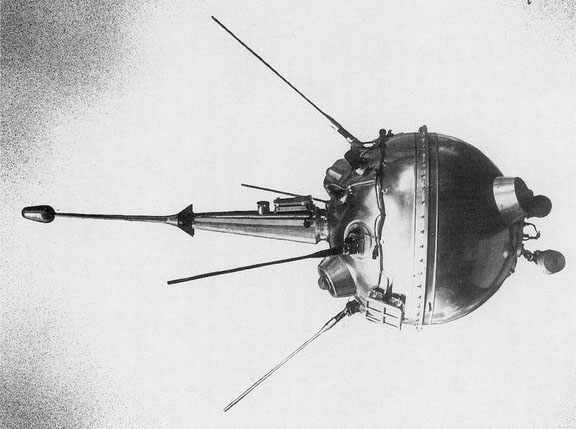
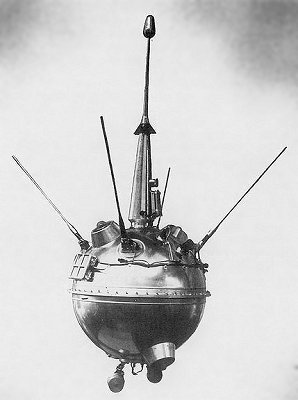
The official documents say Luna 2 carried instruments. A Geiger counter to measure radiation. A magnetometer to study magnetic fields. Micrometeoroid detectors. All very scientific. All very… boring. The perfect cover story. But the real payload, the one that sent the true message, was hidden inside the core of the probe.

The Pennants of Conquest
Tucked inside the spacecraft were two spherical objects covered in metallic pentagonal tiles. Each tile was a pennant, engraved with the Soviet coat of arms and the date of the launch. One sphere was designed to be detonated just before impact, scattering these metallic emblems across the lunar surface like shrapnel. A cosmic shotgun blast of ownership.
This wasn’t a gesture of peace. This was a flag planting, but a thousand times more permanent. A territorial claim. The Soviets weren’t just visiting the Moon; they were branding it. They were sending a message not just to Washington, but to the cosmos itself: “This belongs to us now.”
Online forums have buzzed for years with a chilling thought. What if those pennants were made of something more than just stainless steel and titanium? In an age of espionage and hidden messages, could they have contained something else? Microdots with secret data? A long-lasting radioactive isotope to “mark” the area for future detection? The theories are wild, but in the context of the Cold War, are they really that crazy?
The Sodium Cloud: A Signal in the Void
Here’s where it gets even stranger. On its final approach, Luna 2 performed a secondary experiment. It released a massive cloud of bright orange sodium gas into the blackness of space. The official explanation? The cloud, illuminated by the sun, would be visible through telescopes on Earth, allowing scientists to track the probe’s trajectory and study the behavior of gas in a vacuum.
A plausible explanation. But what if it was something else entirely?
What if it wasn’t a scientific marker, but a signal flare? A way for the Soviets to say, “Look, we are here. We can touch the sky.” A brilliant, blazing middle finger to the West, visible to any astronomer who knew where to look. Some modern theories suggest it was even more sinister. Was it a test for a chemical or biological agent dispersal system? Could you seed another planet’s atmosphere from a distance? The sodium gas was harmless, but the *technique* was the real experiment. An experiment with terrifying implications.
A Launch Pad Drama and a Silent Scream
The mission almost never happened. The original launch, scheduled for September 9th, was a failure. The booster rocket failed to ignite properly on the pad. In the super-secretive world of the Soviet program, this was a disaster. The entire rocket had to be de-fueled, removed, and a new one painstakingly erected. For three days, the fate of the mission hung in the balance. Was it simple mechanical failure? Or was it sabotage? American spies were everywhere, and the stakes couldn’t have been higher.
Finally, on September 12, Luna 2 clawed its way into the sky. For 36 hours, it was a ghost, a silent traveler between worlds. Its radio signals were tracked by the Soviets and, secretly, by the West. The British radio telescope at Jodrell Bank was one of the few places in the free world that could follow its journey.
Then, at 21:02:24 UTC on September 13, 1959, the signals stopped.
Just… gone. An abrupt, total silence. Luna 2 had hit its target. The world held its breath as Jodrell Bank confirmed the impact. The Soviets had done it. They had struck the Moon.

The Cover-Up and the Missing Crater
This should have been the end of the story. But it was just the beginning of the mystery. After the initial celebrations, a strange question began to surface: Where was the crater?
The probe weighed over 800 pounds and was traveling at more than 7,500 miles per hour. It should have left a significant mark, a fresh scar on the face of the Moon visible to powerful telescopes. But for decades, nobody could find it. Astronomers searched. They scanned the impact zone near the craters Aristides and Archimedes. Nothing. It was as if the probe had simply vanished.
This led to a whole new wave of conspiracy theories. Had the Soviets faked the whole thing? Was the sudden radio silence just a pre-planned stunt? Did they just turn off the transmitter and let the probe fly off into deep space? For a long time, it seemed possible.
Deep Dive: The Modern “Evidence”
It wasn’t until 2010, over 50 years later, that NASA’s Lunar Reconnaissance Orbiter (LRO) supposedly found the impact site. They released images showing a tiny, insignificant crater that they claimed was from Luna 2. But internet sleuths and skeptics were not convinced. The “crater” is barely distinguishable from any of the other millions of tiny pockmarks on the Moon’s surface. The evidence is flimsy at best. Is this a genuine discovery, or is it modern space agencies trying to retroactively clean up the history books and put a neat bow on a messy story?
The debate still rages in corners of the web. Could the probe have disintegrated into dust on impact? Possible. Or did it not crash at all? What if, using some unknown technology, it performed a hard landing instead of a suicidal plunge? What if it’s sitting there right now, partially intact, a Soviet secret waiting in the dust?
The Whispers That Won’t Die
When you reject the “official story” as a simplistic fairytale, you open the door to some truly mind-bending possibilities. The questions that remain are far more interesting than the answers we’ve been given.
What if Luna 2 Wasn’t the First?
The Soviet Union’s space program was notorious for its secrecy. They only announced successes. Failures were buried, their records erased, the cosmonauts and engineers involved sworn to silence. We know of many “Luna” missions that failed and were never given official names. Is it possible that a Luna 1a or 1b secretly made it to the Moon but its radio failed, making it an unannounced, unprovable victory? What if Luna 2 was just the first one they could publicly prove?
What if the Payload Was Alien?
This is where we go deep down the rabbit hole. Some of the most fringe theories suggest that the frantic race to the moon wasn’t about beating the Americans at all. What if both superpowers had detected something on the Moon? A signal, an anomaly, something non-human. What if Luna 2’s real mission was to deliver a “message” or a probe to this anomaly? A high-impact strike designed to see what would happen. To “poke the bear,” so to speak. The sodium cloud, in this scenario, becomes a signal to whatever might be watching. A far-fetched idea? Absolutely. But in a universe of infinite possibilities, can we ever be sure?
The story of Luna 2 isn’t the story of a simple metal ball. It’s the story of a world on the brink of nuclear war, a ghost engineer, a launch shrouded in secrets, a symbolic act of cosmic conquest, a mysterious orange cloud, and a crater that went missing for 50 years.
The official narrative is the story they want you to believe. But the truth might just be lying up there, scattered in a thousand metallic pieces across the Sea of Rains, waiting for someone to finally piece it all together. The first human object to touch another world is still there. And so are its secrets.