Home Alien Life Ancient Aliens 2013 – Nazca Lines

Ancient Aliens 2013 – Nazca Lines

0
74

The Nazca Lines: An Ancient Airport for Aliens?

Out in the desolate, sun-scorched plains of southern Peru, the Earth has a secret. Scars. Etched into the dry desert floor, stretching for miles, are a series of drawings so enormous, so impossibly vast, that they are completely invisible from the ground. You could walk right across one and never even know it was there.

These are the Nazca Lines.

For centuries they lay hidden in plain sight. A silent testament to… something. But what? Who carved these massive figures—a spider, a monkey, a hummingbird, and hundreds of geometric shapes and impossibly long, straight lines—into the earth? And the bigger question, the one that keeps people up at night:

Who were they for?

To see them, you have to be in the sky. You have to fly. A simple fact that blows the whole mystery wide open. The Nazca people, who supposedly created these between 500 B.C. and 500 A.D., had no airplanes. No satellites. No hot air balloons. So why create art that only the gods could see? Or was it for something else? Something that came *from* the sky?

The Official Story: Rituals, Water, and a Lot of Walking

Mainstream archaeology has a story, of course. They always do. The accepted explanation is that the Nazca culture created these geoglyphs as part of elaborate religious ceremonies. The lines, they say, were processional walkways. Paths for shamans and pilgrims to walk along during rituals, perhaps to appease gods responsible for that most precious of desert commodities: water.

They point to the careful, yet simple, construction. The Nazca people removed the 12 to 15 inches of reddish-brown, iron-oxide-coated pebbles that cover the desert floor. This revealed the light-grayish ground underneath. Boom. Instant line. The arid, windless climate of the Nazca plateau did the rest, preserving these shallow etchings for more than 2,000 years.

Researchers have shown that small teams, with careful planning and basic survey equipment like stakes and rope, could have scaled up small drawings to create the massive figures we see today. It’s plausible. It’s scientific. It’s… boring.

The Lady of the Lines

No discussion of the mainstream view is complete without mentioning Maria Reiche. A German mathematician and archaeologist, Reiche dedicated her life to the lines. For decades, she lived out in the desert, single-handedly mapping, cleaning, and protecting them. She was often seen with a broom, sweeping the lines clear of debris. She was convinced they were a giant astronomical calendar, with the lines pointing to the rising and setting of significant stars and constellations. Her work was foundational, and she almost single-handedly saved the lines from being destroyed by traffic and time.

But even with her brilliant work, nagging questions remain. Why make a calendar so big you can’t read it from the ground? Why draw a 150-foot-long spider? What does that have to do with the winter solstice?

The official story feels thin. Like a blanket with too many holes. And through those holes, a much wilder, more mind-bending theory has emerged.

Ancient Airport? Von Däniken Ignites a Firestorm

In 1968, a Swiss author named Erich von Däniken dropped a bomb on the world of archaeology. His book, *Chariots of the Gods?*, proposed a radical idea: what if, in our ancient past, we were visited by intelligent beings from other worlds? And what if they left their mark?

Nazca was Exhibit A.

Von Däniken looked at the vast, flat trapezoids and the miles-long straight lines and didn’t see ritual pathways. He saw an airport. He saw runways. Landing strips for extraterrestrial spacecraft.

Think about it. The scale. The precision. The location on a high, dry plateau. It’s a perfect spot for a spaceport. He wasn’t necessarily saying aliens *drew* the lines. His theory was even more explosive.

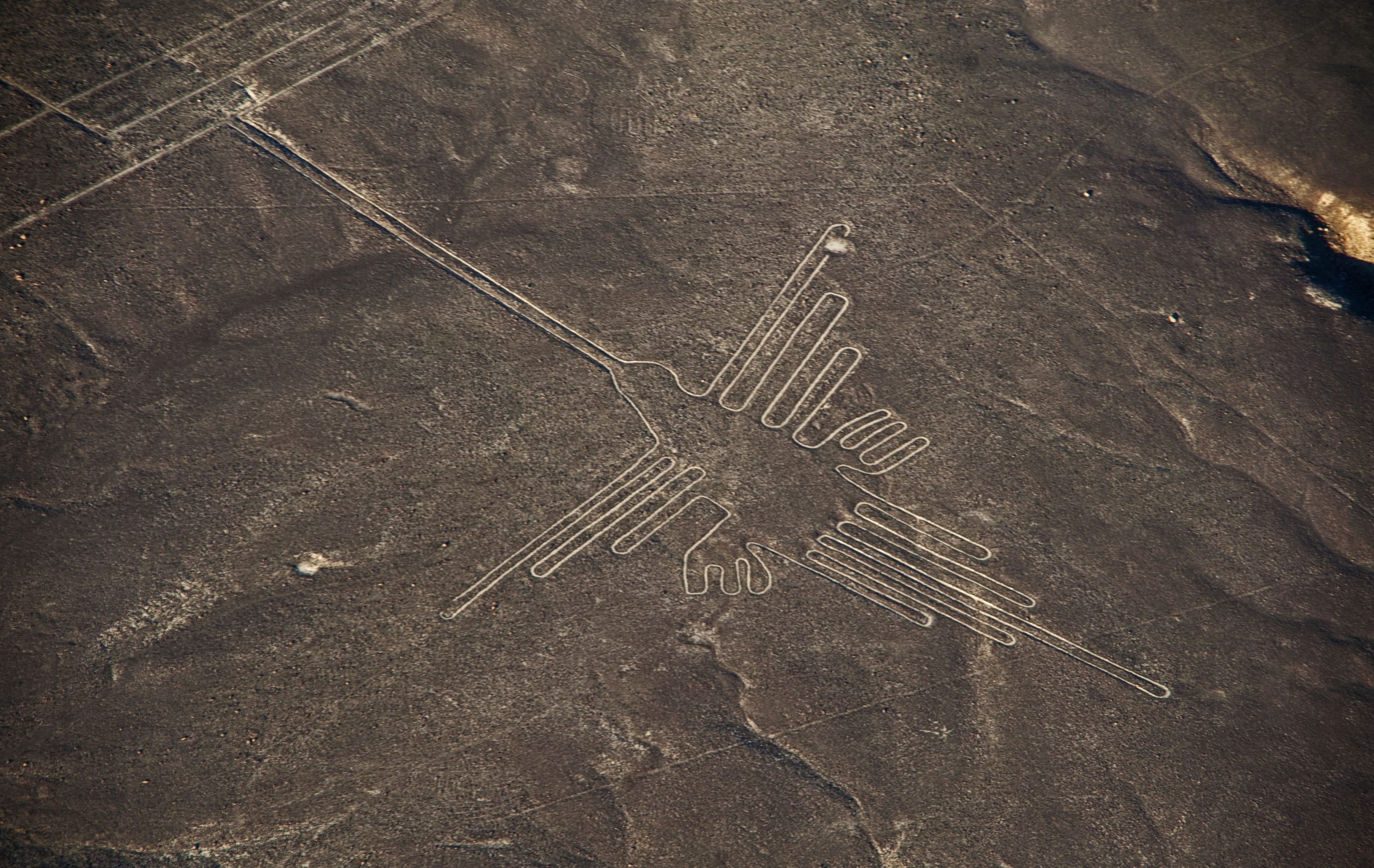
the-hummingbird

Chariots of the Gods? Or Scorch Marks on the Sand?

Von Däniken’s idea was that the first lines weren’t drawings at all. They were an accident. The byproduct of advanced technology. Imagine a powerful spacecraft descending from the heavens. As its propulsion system neared the ground, the intense energy and thrust would have blown away the dark surface pebbles, scorching the earth and revealing the lighter soil beneath. A landing strip, created not by shovels, but by rocket fire.

The local tribes watched this. Their “gods” came from the sky in fiery, loud machines. They landed on these newly cleared strips. Then, one day, they left.

And they didn’t come back.

What followed, according to von Däniken, was a classic “cargo cult.” The confused and abandoned people tried to call their gods back. They saw the giant marks their ships had left, and they tried to replicate them. They cleared more long lines, more trapezoids, hoping to signal the sky visitors, “Hey! Land here again!” When that didn’t work, they started creating giant effigies of things important to them—animals with spiritual significance—as giant offerings. A cosmic welcome mat for beings they couldn’t possibly understand.

This theory suddenly makes sense of the strangest parts of Nazca. The impossible scale? It was meant to be seen from orbit. The strange animal figures? They were desperate prayers written on the face of the Earth. The long, straight lines? They were copies of the original landing zones.

DEEP DIVE: The Figures That Defy Explanation

When you zoom in on the specific figures, the ancient astronaut theory gets even more compelling. The details are where the official story completely falls apart for many investigators.

20130822-011654.webp

The Spider Nobody Should Have Known About

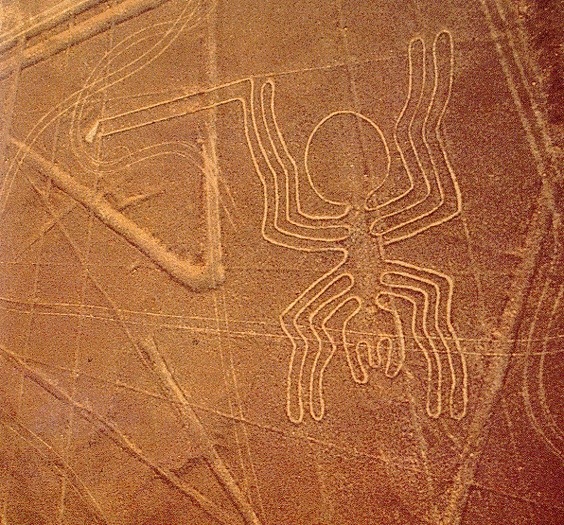
One of the most famous figures is a 150-foot-long spider. It’s clearly a spider. But not just any spider. Researchers identified it as a member of the genus *Ricinulei*, an extremely rare species just a few millimeters in size. Here’s the crazy part: *Ricinulei* spiders are not native to the Nazca desert. They live deep in the most inaccessible parts of the Amazon rainforest, hundreds of miles away.

How did a pre-literate culture, without modern transportation, even know this specific, tiny spider existed?

But it gets weirder. The drawing is a perfect biological diagram. One of the spider’s legs is extended, and at the very tip is a small, specialized organ. That organ is the spider’s reproductive apparatus. It is completely invisible to the naked eye. You would need a microscope to see it clearly.

Let that sink in. The ancient Nazca people, who supposedly had no written language or advanced tools, drew a perfect, giant replica of a tiny, obscure jungle spider, including a microscopic detail that modern science only confirmed centuries later. How? Did they have microscopes? Or did someone—or something—show them a picture?

The Hillside Astronaut: A Message to the Stars?

Carved into the side of a hill at the edge of the plateau is a different kind of figure. It’s not an animal. It’s humanoid. With a large, round head and big, circular eyes, locals call it “El Astronauta.” The Astronaut. It looks for all the world like a figure in a helmet, waving. Waving at what?

Is it a depiction of a shaman in a ritual mask, as academics suggest? Maybe. Or is it a literal drawing of what the Nazca people saw? A visitor in a space suit? The being that came down from the fiery chariots? The figure’s hand is raised, not in greeting, but as a signal. A signpost for those in the heavens, a permanent marker of a monumental event.

The Unwavering Lines of an Unknown Technology

The animal figures get all the attention, but the truly baffling parts of Nazca are the straight lines. Hundreds of them. Some are over 12 miles long. They go on and on, perfectly straight, running over hills, through valleys, and across uneven terrain without the slightest deviation.

Ask any modern surveyor, and they’ll tell you that creating a perfectly straight line over 12 miles of rugged landscape is an immense challenge even with lasers and GPS. How did the Nazca do it with sticks and rope? The lines seem to be created with a kind of indifference to the topography of the land, as if they were drawn from a single point high above, casting a perfect projection onto the ground below.

What purpose could these impossibly straight, geographically-defiant lines serve? They don’t seem to point to anything of note. They don’t lead to water sources. They just… are. Unless their purpose wasn’t to lead somewhere on the ground, but to guide something from the sky.

21st Century Theories: Are We Thinking Too Small?

Von Däniken’s theory opened the floodgates, and today’s online investigators have taken the mystery to even stranger places. What if it wasn’t just an airport?

Some researchers now connect the Nazca Lines to a global grid of “ley lines”—supposed lines of energy that crisscross the planet, connecting ancient sacred sites like Stonehenge, the Pyramids of Giza, and Easter Island. Was Nazca a massive power plant, with the lines acting as circuits or conduits for some kind of planetary energy we no longer understand? Was the entire Earth once wired with a forgotten technology?

Another theory pushes into the world of sound. What if the lines weren’t carved by hand at all? There are fringe theories about “acoustic levitation” and the power of harmonics. Could the ancient peoples have possessed a technology that used specific sound frequencies to vibrate the pebbles and move them aside, creating the lines with an impossible ease and precision?

And then there’s the ultimate modern twist: the simulation theory. If we are living in a computer simulation, what are the Nazca Lines? Are they a glitch in the code? A graphical error? Or perhaps markers left by the programmers, like coordinates on a digital map? It’s a wild idea, but in a world of quantum physics and AI, maybe it’s not so crazy after all.

The Final Question That Changes Everything

So where does that leave us? Standing on the ground, seeing nothing but dirt and rock. The academics offer a safe, comfortable story of religious art. A story that fits neatly inside the box of what we think ancient people were capable of.

But the lines themselves scream a different story. The impossible scale. The microscopic accuracy. The laser-like precision. They dare us to think bigger. To question the box itself.

What if, thousands of years ago, on a remote plateau in South America, humanity had a visitor? What if our ancestors saw things we can only dream of? And what if they left us a message? Not in a book, not in a stone tablet, but written across the very face of our planet. A message so big, so bold, we had to invent flight just to be able to read it.

The lines are silent. They offer no easy answers. They just wait, perfectly preserved in the desert air, for the day we are finally ready to understand.

Originally posted 2013-08-21 23:18:54. Republished by Blog Post Promoter