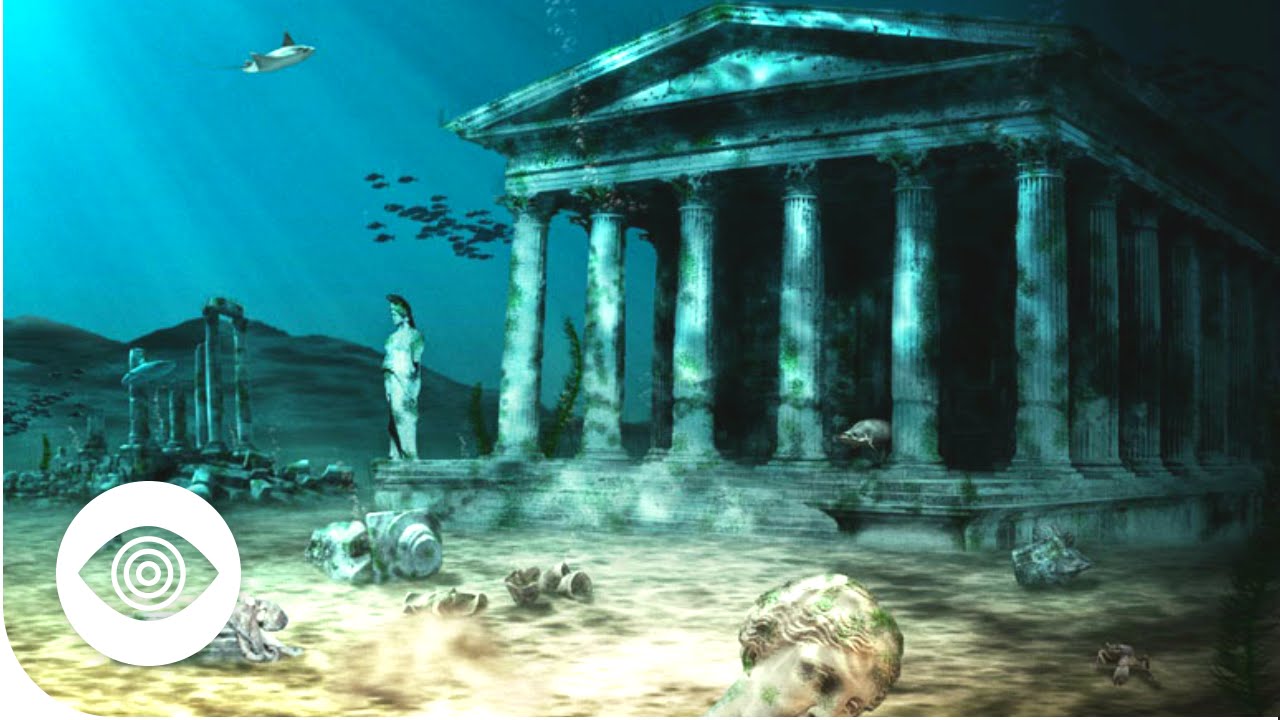
The Mother of All Mysteries
It’s the ultimate cold case. The grandfather of every conspiracy theory you have ever heard. For thousands of years, the western world has been obsessed—completely obsessed—with a legend that refuses to die. We are talking about Atlantis.
It tantalizes us. It mocks us. Stories whisper of a civilization so rich, so advanced, and so glorious that it makes modern empires look like dirt piles. And then? Gone. Swallowed by the ocean in a single day and night of misfortune. Some people think it’s just a fairy tale. A bedtime story. But others? They know better. They hope the ruins are still down there, sitting in the dark, waiting for a submarine light to hit them and change history forever.
Why do we care so much? Because if Atlantis was real, everything we think we know about human history is wrong. Everything.
The Source Code: What Plato Actually Said
Forget the cartoons. Forget the sci-fi movies for a second. Let’s look at the evidence. Almost every single detail we have about this lost super-civilization comes from one man. The heavyweight champion of ancient philosophy. Plato.
He didn’t write this on a napkin. He wrote about it in his dialogues, Timaeus and Critias. And here is the kicker: Plato didn’t present it as fiction. He presented it as history.
According to the text, the story wasn’t even Greek originally. It came from Egypt. Plato describes an Athenian lawmaker named Solon who traveled to Sais, Egypt. There, the old priests looked at him and basically said, “You Greeks are like children. You have no memory.” They told Solon about a mighty power that existed 9,000 years before their time. That puts the date roughly around 9,600 B.C.E.
Keep that date in your head. 9,600 B.C.E. It’s going to matter later.
A Paradise Built for War
Plato didn’t just say “there was an island.” He gave us blueprints. He described the layout with a level of detail that is frankly suspicious for a made-up story.
He said Atlantis lay just beyond the “Pillars of Hercules.” Today, we call that the Straits of Gibraltar. If you sailed out of the Mediterranean and turned left, you’d hit it. It wasn’t a rock. It was a continent-sized massive island. A “great and wonderful empire.”
The capital city was an engineering marvel. Imagine this:
- Concentric Rings: The city was built in alternating rings of water and land. Three rings of water, two of land.
- The Canal: A massive canal connected the outer ocean all the way to the central island.
- Exotic Stone: They quarried stone from the island itself—white, black, and red. When you look at geological formations in the Azores or Canaries today, guess what you see? White, black, and red volcanic rock.
- Orichalcum: This is the fun part. Plato claimed the walls were flashed with brass, tin, and a mysterious reddish metal called “orichalcum.” It shined like fire.
It was a paradise. The people were brave. They were virtuous. They walked with the gods. But you know how this story goes. Humans get bored with peace. They get greedy.
The Fall: When Gods Get Angry
Paradise has a shelf life. Over generations, the divine spark in the Atlanteans began to fade. They stopped acting like gods and started acting like humans. Messy. Greedy. Power-hungry.
They didn’t just stay on their island. They launched a massive war machine. They swept across the Mediterranean, conquering parts of North Africa and Europe. They were unstoppable. Until they ran into the Athenians of that time (a prehistoric Athens that history books tell us didn’t exist yet).
But the war didn’t kill Atlantis. The planet did.
Plato writes that “violent earthquakes and floods” struck. It wasn’t a slow decline. It was an apocalypse. In a single terrible day and night, the entire island sank beneath the waves. The mud rendered the ocean impassable. The empire vanished.
The Skeptics vs. The Believers
So, where is the proof? That is the million-dollar question.
Mainstream archaeology is pretty firm on this: No proof. Zero. They say Plato was inventing a “Noble Lie.” He made up a perfect enemy (Atlantis) to show how great his perfect state (Athens) could be. It was a political allegory. A warning against imperialism.
But that explanation feels… boring. And too neat. Why include such specific measurements? Why link it to specific Egyptian priests? Why give a date that perfectly coincides with the end of the last Ice Age?
This has led to a wild treasure hunt that has spanned centuries. People have looked everywhere. We have theories placing Atlantis in the Americas. In the Canary Islands. In the Caribbean (thanks to the “Bimini Road” underwater stones). Some people even think it’s hidden under the ice of Antarctica, based on the bizarre Piri Reis map that shows the Antarctic coast without ice.
But there is one theory that holds more water than the rest. It brings us back to the Mediterranean.
The Thera Theory: Did Plato Get the Date Wrong?
If you want to see a real-life Atlantis, you buy a plane ticket to Greece. Specifically, the island of Santorini. Ancient name: Thera.
In the late 1960s, a Greek archaeologist named Professor Spyridon Marinatos started digging at a site called Akrotiri on the southern tip of the island. He didn’t just find pottery. He found a ghost town.
Marinatos unearthed a sophisticated Bronze Age city frozen in time. Multi-story buildings. intricate plumbing systems (flushing toilets thousands of years ago!). Beautiful, vibrant frescoes showing monkeys, blue monkeys, and ships. It was a wealthy society, closely tied to the Minoan civilization of nearby Crete.
Then, the sky fell.
The Volcano That Screamed
Around 1600-1500 B.C.E., the volcano at the center of the island didn’t just erupt. It exploded. This wasn’t a normal eruption. It was a VEI-7 event. One of the biggest volcanic explosions in human history.
Imagine the force of hundreds of atomic bombs. The center of the island collapsed into the ocean, creating a massive caldera (which you can sail into today). It triggered tsunamis that were likely hundreds of feet high. These waves smashed into Crete, decimating the Minoan fleet and crippling their civilization.
Akrotiri was buried under 15 to 20 feet of volcanic ash. It was preserved perfectly, just like Pompeii, but thousands of years older.
Could this be it? Was Thera the land of paradise? It fits so many details:
- The Destruction: Sunk by “earthquakes and floods” (tsunamis).
- The Civilization: Advanced, wealthy, seafaring.
- The Shape: Before the explosion, the island was round (Stronghyle).
The “Extra Zero” Problem
There is just one snag. The timeline.
Plato said Atlantis sank 9,000 years before Solon. The Thera eruption happened only about 900 years before Solon. That is a massive difference.
However, proponents of the Thera theory have a clever answer. They call it the “Translation Error.” The idea is simple: When Solon was reading the Egyptian hieroglyphs (or listening to the priests), there was a confusion between the symbol for “100” and “1,000.”
If you take Plato’s numbers and divide them by ten, everything snaps into focus. 900 years ago fits the Thera eruption perfectly. The dimensions of the city, if scaled down by ten, fit the island of Thera perfectly. It’s a compelling argument. Maybe Plato wasn’t making it up. Maybe he just had bad math.
The Modern Twist: The Richat Structure
We have to talk about the internet’s favorite current theory. If you go on YouTube today, you won’t hear much about Thera. You will hear about the Eye of the Sahara.
Deep in Mauritania, West Africa, there is a geological formation called the Richat Structure. From the ground, it looks like nothing. Just rocks. But from space? It looks like a bullseye.
It is a series of concentric circles. It is huge—about 25 miles across. And guess what? The measurements match Plato’s description almost exactly.
- The Rings: Concentric circles of land and water (now dry).
- The Mountains: Plato said the city was sheltered by mountains to the north. The Richat has mountains to the north.
- The Ocean Access: Plato said it opened to the sea to the south. The Richat opens to the south (though the ocean is far away now).
The theory here is that North Africa was much wetter 12,000 years ago. If water levels were different, could this structure have been an island in a massive estuary? Skeptics say it’s a natural geological dome. But the visual similarity? It is spooky.
The Meltwater Pulse: 9,600 B.C.E. Revisited
Remember that date I told you to hold onto? 9,600 B.C.E.
For a long time, historians laughed at that date. They said, “Civilization didn’t exist back then. We were hunter-gatherers poking rocks with sticks.”
But geology has thrown us a curveball. We now know that around 9,600 B.C.E., the Earth went through a violent climate shift. It’s called Meltwater Pulse 1B. The end of the Younger Dryas period. Global sea levels shot up dramatically—some say by meters in a very short time—as the ice caps melted instantly.
So, Plato picks a date for the “destruction of the world by water.” And 2,500 years later, modern science confirms that exact specific date was when the world was actually destroyed by water.
Is that a lucky guess? That is one heck of a lucky guess.
Atlantis Tours Unlimited
Whether it was a spaceship, a super-civilization, or just a misinterpreted island of goat herders, the legend works. It pulls us in.
It is easy to understand the desire to find archaeological proof of paradise. Who wouldn’t want to be able to visit the remains of paradise on Earth? To touch the stones? To know that we aren’t the first advanced people to walk this planet?
Today, the Atlantis legend is the engine that drives tourism to Thera (Santorini). They come by the boatload. Cruise ships dock and unload thousands of people who want to catch a glimpse of the mystery. Visitors enjoy black sand beaches that are black because of the explosion that might have killed the legend.
They walk through the archaeological sites of Akrotiri, looking at the pots and the walls, wondering if they are looking at the lost empire.
And the weary? They can rest their feet at the Hotel Atlantis. It’s good marketing. But as you look out over the caldera, sipping your wine as the sun sets over the Aegean, you can’t help but wonder.

What if? What if it’s really down there?
The ocean is deep. And we have barely scratched the surface.
Originally posted 2014-06-08 16:30:01. Republished by Blog Post Promoter