Is Someone Else Parking at Our Star?
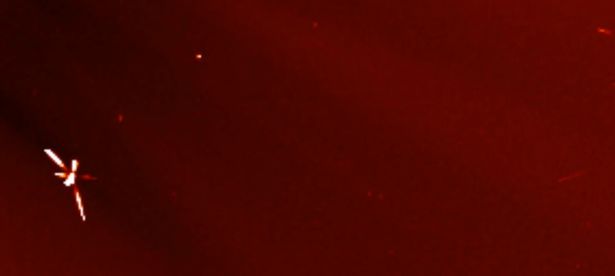
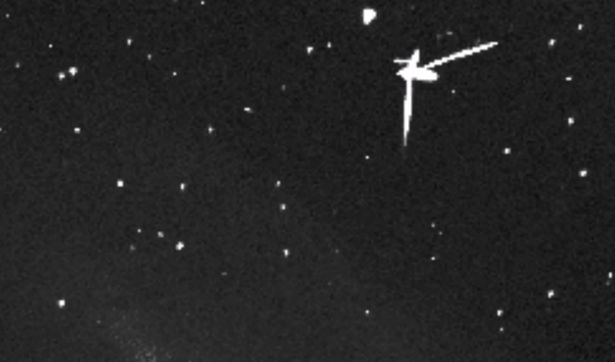
Look at the image above. Really look at it.
For decades, we’ve been told that space is empty. A cold, dead vacuum. We are told the Sun is just a massive ball of burning gas, violent and uninhabitable, a nuclear furnace that destroys anything that gets too close. But what if that isn’t the whole story? What if the Sun isn’t just a star?
What if it’s a gas station?
Recent images beamed back from the Solar and Heliospheric Observatory (SOHO) have set the internet on fire. They don’t show solar flares. They don’t show sunspots. They show something that defies physics, logic, and the official narrative provided by space agencies. Captured in the blinding glare of our local star is a shape. A structure.
A gigantic, winged object. Hanging there. Waiting.
The aerospace giants want you to move along. “Nothing to see here,” they say. But the evidence is mounting, and it is getting harder to ignore. Is it a glitch? A camera artifact? Or have we finally caught a Type II civilization refueling in our own backyard?
The SOHO Anomaly: A Glitch in the Matrix?
Let’s back up a second. To understand why this image is so disturbing, you have to understand the camera that took it.
The SOHO satellite is a joint project between NASA and the European Space Agency (ESA). It’s not some backyard telescope. This is a billion-dollar piece of hardware parked at the Lagrange Point 1 (L1), a spot in space where the gravity of the Earth and the Sun balance out perfectly. It hovers there, staring unblinkingly at the Sun, 24 hours a day, 7 days a week.
Its job is to predict space weather. It warns us about Coronal Mass Ejections (CMEs) that could fry our power grids. It is our early warning system.
But sometimes, it sees things it isn’t supposed to see.
The image in question shows a distinct, solid object. It isn’t a blurry smudge. It has geometry. It has symmetry. Nature is messy. Rocks are jagged. Gas clouds are blobs. But this? This has four distinct “arms” or “wings” radiating from a central fuselage. It looks manufactured.
The “Space Junk” Excuse
Whenever these anomalies pop up, the official response is like a broken record.
“It’s a cosmic ray hit on the sensor.”
“It’s space debris.”
“It’s a pixel processing error.”
Let’s break that down. Space debris? At that distance from the camera, for an object to show up that large, it would have to be miles wide. If it’s close to the Sun (which the lighting suggests), it would be larger than the planet Jupiter. That is not a piece of a defunct Russian satellite drifting by.
And cosmic rays? Sure. High-energy particles hit the sensor all the time. They usually look like white streaks or snow. They rarely organize themselves into a perfect, symmetrical shape that looks suspiciously like a Klingon Bird of Prey or a theoretical interstellar ramjet.
The combined aerospace organization refuses to comment on the specific geometry of this image. Their silence is loud. Very loud. By dismissing it as an “irregularity,” they hope we stop asking questions. But the anomaly hunters aren’t stopping.
The Scale of the Impossible
Wrap your mind around the size of this thing.

If this object is actually near the Sun, we are talking about a vessel of incomprehensible scale. The Earth, compared to the Sun, is a grain of sand next to a basketball. If this object is visible in the SOHO frame, it is easily bigger than Earth.
Maybe bigger than Saturn.
This brings us to the “Mothership” theory. Internet sleuths and UFOlogists have been tracking these “Sun Cruisers” for years. This isn’t the first time. It happens again and again. Massive, structured objects appear near the solar corona, hang out for a few hours, and then vanish.
Why are they so big? Because they have to be.
If you are traveling between stars, you aren’t doing it in a two-seater fighter jet. You are moving a civilization. You are moving a world. A ship this size would be a self-contained biosphere. It wouldn’t need to land on planets. It is the planet.
Harvesting the Star
Why go to the Sun? It’s hot. It’s radioactive. It’s dangerous.
But it is also the biggest battery in the solar system. In fact, it’s the only thing that matters if you are an advanced species.
There is a concept in theoretical physics called the Kardashev Scale. It measures how advanced a civilization is based on energy consumption.
- Type I: Uses all the energy on their planet (We aren’t even here yet).
- Type II: Uses all the energy of their star.
- Type III: Uses all the energy of their galaxy.
A Type II civilization wouldn’t burn coal or oil. That’s caveman stuff. They would go directly to the source. They would siphon plasma straight off the surface of a star. This is called “Star Lifting.”
The object in the SOHO image appears to have four long extensions. Solar wings? Maybe. But they could also be siphons. Magnetic intake manifolds designed to suck up superheated hydrogen plasma to fuel an antimatter reactor.
They pull up, fill the tank, and warp out. We are just the ants living on the rock next door, wondering why the lights flickered.
The Heat Problem: How Is It Not Melting?
Skeptics love to point out the temperature. “Nothing can survive that close to the Sun!”
Really? We are thinking with 21st-century human brains. We still use internal combustion engines. We still boil water to make electricity. We are primitive.
Just because our metals melt at a few thousand degrees doesn’t mean theirs do. But more importantly, you don’t need a material that withstands the heat if you can manipulate gravity and magnetism.
If this craft is capable of interstellar travel, it has shielding technology we can’t dream of. An electromagnetic force field could create a bubble around the ship, deflecting the solar radiation and heat around it like water off a duck’s back. Inside the bubble? Room temperature.
Look at the image again. The object is bright. It’s reflecting light. Or perhaps it is glowing with its own energy field. The four arms are rigid. They aren’t warping. Whoever built this knows how to beat the heat.
Alternative Theory: The Secret Space Program
There is another possibility. One that is perhaps even scarier than aliens.
What if it’s us?
Other claims have suggested it could be a secret NASA Project craft. Conspiracy circles have whispered about “Solar Warden” for years. The theory goes like this: The public space program (NASA) is a distraction. A smoke screen. While we watch them launch rockets that look like 1960s tech, the real military industrial complex has been building a secret fleet since the 1980s.
Gary McKinnon, the famous British hacker who broke into US military computers, claimed to have found excel spreadsheets listing “Non-Terrestrial Officers” and “Fleet Transfers.” He didn’t find little green men. He found a navy. A space navy.
Could this four-winged giant be a monitoring station? Is it a forward operating base for the US Navy, hidden in the glare of the Sun where no amateur telescope on Earth can spot it?
Think about it. Where is the best place to hide? In the light. If you park a ship in orbit around Earth, someone in their backyard with a Nikon P1000 is going to zoom in on it eventually. But the Sun? You can’t look at the Sun. It blinds you. It is the perfect camouflage.
The Pattern of Denial
The SOHO satellite feeds are notorious for “going down” at convenient times. Anomaly hunters will be watching the live feed, spot a cube or a saucer near the sun, and suddenly—zap. “Feed interrupted for maintenance.”
When the feed comes back hours later? The object is gone.
This image managed to slip through the cracks. Maybe a technician fell asleep. Maybe the automated censoring software missed a frame. But it is out there now. Once it’s on the internet, it’s forever.
The symmetry is the key. Chaos is random. Intelligence is ordered. Those four arms are perfectly spaced. The fuselage is centered. This isn’t a cloud of gas.
Why Are They Here?
If we accept the possibility that this is an extraterrestrial craft, the question shifts from “Is it real?” to “What are they doing?”
Scenario A: Maintenance. Maybe the Sun is unstable. Maybe they are fixing it. Some theories suggest that UFOs are often seen entering volcanoes or solar flares to stabilize planetary cores. Are they keeping our star from blowing up prematurely?
Scenario B: Refueling. As discussed, just a pit stop on the way to the Andromeda galaxy.
Scenario C: Surveillance. They are watching us. And they are parking near the Sun because it gives them a full view of the entire system. They can monitor our radio waves, our nuclear tests, and our petty wars from a position of absolute superiority.
The Verdict
We are living in an era of disclosure. The US Navy has admitted UFOs are real (they call them UAPs now). Pilots are coming forward. The stigma is breaking.
But they are only showing us the little “Tic-Tac” objects buzzing our oceans. They aren’t talking about the monsters orbiting the Sun. That is a level of reality shock the public might not be ready for.
If there are ships the size of planets harvesting our star, it means we are not the apex predators of the universe. We are arguably not even the main characters in our own solar system. We are just the wildlife living near the highway.
Keep your eyes on the SOHO charts. Watch the edges of the frames. They can claim it’s pixels. They can claim it’s dust. They can claim it’s a glitch.
But does a glitch have wings?
You decide.
Originally posted 2016-11-08 19:03:03. Republished by Blog Post Promoter