The struggle between the Israelis and the Palestinians is one of the most enduring and explosive of all the world’s conflicts.
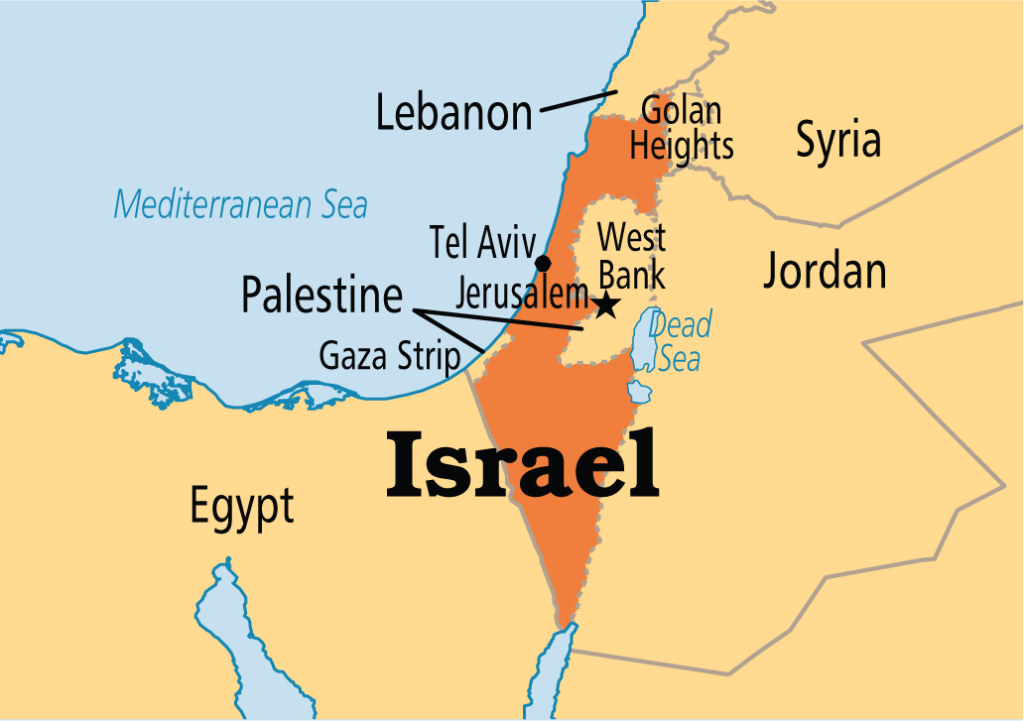
It has its roots in the historic claim to the land which lies between the eastern shores of the Mediterranean Sea and the Jordan river.
Israel has been a dry tinderbox in world affairs since 1948 when she became a nation once again. However, tensions have been steadily increasing since Palestine’s Yasser Arafat started ordering suicide and terrorist strikes against Israel from the early 1980’s. All these terror strikes, resulting in much innocent blood being spilt, has prompted various Israeli responses that have accomplished little except to stir up further hatred within the hearts of all Palestinian people.
All this terror, bloodshed, and military retaliation, has turned the entire region into a literal tinderbox, awaiting just the right spark to set the Middle East ablaze. The Muslim world intends for the Israeli-Palestinian conflict to be set ablaze as part of their overall effort to defeat both Israel and her major ally — the United States. This plan was boldly enunciated by Iranian leaders in March 2002. As Coalition Forces were fighting furiously in the southern portion of Iraq, key Arab leaders in the region announced plans to use Iraq as a “swamp” in which to tie down superior American forces and then light “many fires” in the entire Middle East region, including Israel. (Jerusalem Post).
Why is this story worthy of an Act all of its own?
It’s clear to see that no nation in the Middle East really wants a Palestinian State. Therefore, why have American Presidents from Nixon to George W. Bush spent so much time, energy, and diplomatic power behind trying to set up a state within a state that no one wants?
In forcefully heralding a Palestinian State, both Israel and the United States can tell the rest of the world that, if the Palestinians had just wanted peace, – and had stopped the terror attacks – they could have achieved it through the newly created Palestinian State. The US and Israel will be able to state that continued Palestinian terrorism just pushed Israel too far, and “they had it coming”. This will be the excuse when Israel attacks and completely destroys Palestine.
Let’s follow the play and see what happens…
March – June, 2002 — After waves of suicide attacks early in the year, Israel re-occupied almost all of the West Bank in March, and again in June. For most of 2002, Palestinian cities were regularly raided, remained cut off from each other, surrounded and under curfew for long periods of time.
April 2002 — Israeli forces entered and captured the refugee camp in northern West Bank city of Jenin. The Palestinians claimed massacre. The Israeli army, which took heavy casualties, said it met heavy organized resistance, and insisted that 52 Palestinians were killed.
May 2002 — In May, a five-week standoff at Bethlehem’s Church of the Nativity ended when 13 Palestinian militants were sent into exile. A large group of Palestinians had taken refuge in the church when Israeli troops moved into the town.
March 30, 2003 — A convoy of diplomatic vehicles arrives at Sharon’s house in Jerusalem at 3:30pm, local time to formally present him with a long-awaited internationally backed Mideast peace plan, which foresees a Palestinian state established within Israel’s borders no later than 2005, provided the Palestinians permanently cease their terror campaign. 3:30 on 03/03/2003 – are all those threes coincidental?
March 30, 2003 — As if to underscore the Palestinians’ defiance against the Peace Plan, a suicide terror attack at the Blues cafe near the US Embassy in Tel Aviv kills 3.
April 30, 2003 — US Ambassador Dan Kurtzer meets with Israeli Prime Minister Ariel Sharon to formally present him with a long-awaited internationally backed Mideast peace plan, designed to create a Palestinian state within Israel.
May 22, 2003 — President Bush literally “orders” Prime Minister Sharon to push through Cabinet acceptance of the Road Map, which envisions a side-by-side Palestinian State with Israel. Bush orders $10 billion in US loan guarantees frozen until Israel complies, and reportedly compiles a long list of punitive actions he could take against Israel if it did not back his “Peace Plan”.
May 25, 2003 — Most Israelis are aghast at the sudden turn of events: “In 63 years I have never had a sicker feeling down deep in my Jewish soul than I do this day. To think that a Prime Minister of Israel would agree to a Palestinian State against the will of the majority of the Jewish people, not only in Israel but also around the world… It is no secret that George W. Bush along with the rest of the quartet has pressured Sharon. The question in the minds of most Israelis is what is it Bush has on Sharon that could force him to turn against his own people. For there is no doubt that he will go down in Jewish and World history as the Jew who sold out his own people and gave Israel to the enemies of God.” [“It’s time to stand up for the Jewish people!”, Jerry Golden “REPORT”, 5/25/2003]
May 27, 2003 — Facing a firestorm of criticism from members of his Likud Party over his Cabinet’s approval of a U.S.-backed peace plan envisioning a Palestinian state, Prime Minister Ariel Sharon says that keeping the Palestinians under occupation harms Israel. ‘This can’t go on forever’, Sharon tells Likud lawmakers at a stormy meeting a day after the Cabinet approved the plan. ‘To keep 3.5 million Palestinians under occupation — you can dislike the word, but what is happening is occupation — is in my view bad for Israel, for the Palestinians and for Israel’s economy’, Sharon says. It was the first time that Sharon, for years a hawk and architect of the Israeli settlement drive in the West Bank and Gaza Strip, had publicly used the word ‘occupation’ to describe Israel’s military presence in those territories.”

June 4, 2003 — The Aqaba [Jordan] Peace Summit ends with profound statements from key leaders: Israeli Prime Minister Sharon, Palestinian Prime Minister Abbas and US President Bush all refer to a Palestinian State in their closing addresses – something which has been arduously avoided and fought against for many years. What’s going on? After years resisting Palestinian Independence, Israel makes a miraculous about turn and agrees to a Palestinian State.
June 6, 2003 — In sheer disgust, the Palestinian militant group, Hamas, says it is breaking off talks with Palestinian Prime Minister Abu Mazen in protest at his promise to end violence against Israelis… A spokesman for Hamas, Abdelaziz al-Rantissi, tells the BBC that the prime minister’s promise opens the door for Israel to kill Palestinians at will, and that Hamas is left with no choice but to continue fighting Israel.
June 10, 2003 — IDF helicopters fire five missiles at the car of Hamas leader, Abdel Aziz Rantisi, who survives, but three others are killed. Hamas and other Palestinian leaders vow such revenge as to cause an “earthquake”!
June 11, 2003 — A Palestinian disguised as an Orthodox Jew blows up a crowded civilian bus in Central Jerusalem, killing 17 and wounding scores. Within 20 minutes, IDF jets rocket Palestinian targets in Gaza Strip.
June 13, 2003 — Headlines throughout the region scream that both Israel and Hamas have declared all-out war on each other, during a week in which almost 50 people were killed in various terrorist attacks.
November 16, 2003 — The treasonous Geneva Accord, drafted in London, not Switzerland as is widely believed, is mailed to every Israeli household. Imagine this: a group of Americans, say presidential candidate Howard Dean, Senators Ted Kennedy, Fritz Hollings and Robert Byrd, go to the wilds of Pakistan and meet with the lieutenants of Usama bin Laden. They carry with them a “peace” proposal hammered out with various al Qaida supporters in the United States calling for the unilateral withdrawal of American forces from all Islamic countries. They present the proposal to terror agents representing bin Laden, work out the kinks and arrive at an agreement aimed at ending the conflict between al Qaida and the United States. What would the overwhelming majority of Americans say? In unison the outcry would be – Treason!
April 17, 2004 — Abdel Aziz al-Rantissi, head of the Hamas militant group in Gaza, is killed in a targeted Israeli attack. “Israel will regret this. Revenge is coming,” another Hamas leader, Ismail Haniya, told reporters. “This blood will not be wasted. It is our fate in Hamas and it is our fate as Palestinians to die as martyrs.”
December 4, 2004 — In an apparent change in long-standing policy, a top Hamas leader in the West Bank said the group would accept the establishment of a Palestinian state in the West Bank and Gaza Strip as well as a long-term truce with Israel. ‘Hamas has announced that it accepts a Palestinian independent state within the 1967 borders with a long-term truce’, Sheik Hassan Yousef told The Associated Press, referring to lands Israel captured in the 1967 Six Day war. A true turn-around of unbelievable proportions.
January 7, 2005 — Eleven months after unofficial coalition talks between Likud and Labor began, and five months after negotiations started with United Torah Judaism, the three parties signed coalition agreements at the Prime Minister’s Office in Tel Aviv. The only way in which Israel can carry out her planned unilateral withdrawal as first envisioned by the Oslo Accord is if both major parties came together to form a government which could not be shaken by the inevitable explosion of resistance from settlers and patriots who are completely, irrevocably opposed to the idea of giving up land to the Palestinian enemy.