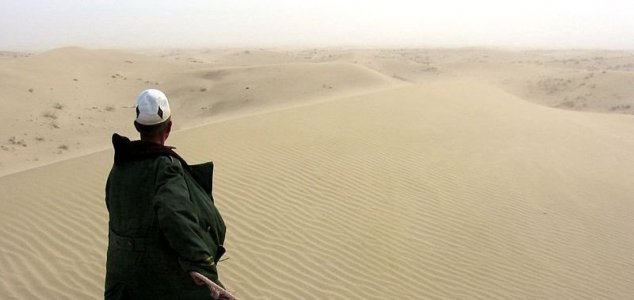
The Desert’s Darkest Secret: A Hidden Ocean Under China That Could Rewrite History
Look at a map. Find the Taklamakan Desert in the Tarim Basin, deep within China’s Xinjiang region. What do you see? Sand. Endless, searing sand. A place so hostile they call it the “Sea of Death.” A place you go in, but you don’t come out.
That’s the story we’ve always been told.
But it’s a lie.
Beneath that desolate, sun-scorched wasteland, under the very ground that has swallowed travelers and empires whole, lies a secret so immense it defies belief. A secret hidden from the world. An ocean. A colossal, subterranean sea brimming with more water than all of America’s Great Lakes combined. Ten times more.
This isn’t a theory. This isn’t a crackpot idea from some forgotten forum. This is what scientists found. And then, the story went quiet. Why? What are they hiding under the sand?
The Official Story: A “Terrifying” Discovery
Let’s rewind to 2015. A team of researchers from the Chinese Academy of Sciences was studying a very peculiar problem. The world’s carbon cycle. They were trying to figure out where all the “missing” carbon dioxide from our atmosphere was going. They suspected vast, arid regions might be acting as enormous carbon sinks, somehow absorbing CO2. But the mechanism was a mystery.
They focused on the Tarim Basin. For years, they took samples, ran tests, and analyzed data. What they found didn’t just solve their carbon puzzle. It shattered our entire understanding of what a desert is.
The ground was literally breathing in carbon dioxide. Gigantic amounts of it. The only way that could happen is if there was a massive body of water below, dissolving the gas like a planetary-scale soda water machine. It wasn’t a pond. It wasn’t an aquifer. It was an ocean.
Professor Li Yan, the lead scientist on the study, couldn’t hide his shock. His words cut through the dry, academic language of the official report. “This is a terrifying amount of water,” he said. Terrifying. Not “exciting.” Not “groundbreaking.” Terrifying.
He went on. “Never before have people dared to imagine so much water under the sand. Our definition of desert may have to change.”
Think about that. The very definition of a desert. Changed forever.
Just How Big Are We Talking?
Numbers can be boring. So let’s make this real. The Great Lakes—Superior, Michigan, Huron, Erie, and Ontario—hold about 6 quadrillion gallons of fresh water. It’s an almost unimaginable volume. Now multiply that by ten.
You’re looking at 60 quadrillion gallons. Sixty. Quadrillion.
That’s enough water to cover the entire continental United States in a glistening sheet several feet deep. It’s an amount of water that could single-handedly solve a global water crisis, turn the driest deserts into lush farmland, and support new megacities. It is, without exaggeration, one of the most significant resource discoveries in human history.
The official explanation for its origin is simple. Almost *too* simple. They say it’s meltwater. For millennia, water from the snow-capped peaks of the surrounding Tian Shan and Kunlun mountains has trickled down, seeping through the porous rock and collecting in the vast, sealed basin below. A slow, steady process over countless centuries.
It makes sense. But does it explain everything? Or is it just a convenient story to cover up something much, much stranger?
A Land Steeped in Mystery
The Tarim Basin was never just an empty patch of sand. This is a place with a history. A very, very weird history. To understand the significance of the hidden ocean, you have to understand the other secrets the desert has been keeping.
The Riddle of the Tarim Mummies
Long before the discovery of the water, the Tarim Basin was famous for something else. Mummies. But not the kind you’d expect. In the late 1980s, archaeologists began unearthing perfectly preserved bodies from the sand, some over 4,000 years old. The dry, salty soil had kept them pristine. Their clothes, their tools, even their skin and hair were intact.
Here’s the part that baffled everyone. They weren’t Asian.
They were Caucasian. Tall, with reddish-blond and brown hair, long noses, and European features. One, known as the “Beauty of Loulan,” was a woman with delicate features and long fair hair, buried with a feathered hat and a simple woolen skirt. Another, “Cherchen Man,” was over six feet tall with a reddish beard, clad in tartan leggings that looked suspiciously Scottish.
Who were these people? How did a Celtic-looking tribe end up in the heart of Western China 4,000 years ago, thousands of miles from their supposed homelands? The official story is that they were an offshoot of Indo-European migrations. But they left no written records, no explanation. Just their hauntingly preserved bodies.
Now, ask yourself this. Why would a thriving, technologically advanced culture (they had wagons and complex textiles) choose to live and die in one of the most inhospitable places on Earth? Unless… it wasn’t so inhospitable back then. Unless they knew something we didn’t. Unless they knew about the water.
Lop Nur: The Nuclear Wasteland
Travel east from the heart of the Tarim Basin and you’ll find Lop Nur, a dried-up salt lake bed that looks like a giant ear from space. This isn’t just a geological feature. From 1964 to 1996, this was China’s primary nuclear weapons testing site. Over 45 nuclear bombs were detonated here, both atmospheric and underground.
The area is a radioactive, restricted military zone. A forbidden land. Why choose this specific spot? The official reason is its isolation. But with the discovery of the vast underground ocean, a new, more sinister question emerges.
Were they just testing bombs? Or were they studying the effects of nuclear detonations on a massive, subterranean water table? Were they trying to map it? Or perhaps, trying to access it? Some online researchers have pointed out that seismic shockwaves from underground tests would be the perfect way to get a detailed picture of the geology thousands of feet down. It’s the ultimate “ping” to see what’s really there.
The Conspiracy Deepens: What They’re Not Telling Us
A discovery of this magnitude should have been front-page news for months. It should have sparked global debate, international scientific collaboration, and a rush to explore. Instead, after a brief flurry of articles in 2015, it was met with relative silence.
It just… faded away.
You have to ask why. Why would a discovery that redefines our planet’s geography and resources be so quietly shelved?
Geopolitical Dynamite
Water is life. And in the 21st century, it’s power. Nations are already on the brink of conflict over river rights and dwindling reservoirs. Now imagine one nation suddenly having a secret, untouchable reserve of water ten times the size of the Great Lakes. It’s not just a resource; it’s a weapon. It’s the ultimate strategic advantage.
With that much water, China could:
- Transform the entire Xinjiang region into a breadbasket, securing its food supply for centuries.
- Support massive industrial and technological development in its dry western territories.
- Control the destiny of its neighbors, who are increasingly desperate for water resources.
Announcing this to the world isn’t a scientific victory; it’s a political headache. It invites demands, partnerships, and oversight. Keeping it quiet allows for its study and potential exploitation without any outside interference. The silence isn’t an accident. It’s a strategy.
A Buried, Living World?
Let’s push the boundaries. This body of water has potentially been sealed off from the surface world for thousands, maybe millions of years. It’s a self-contained system. A lost world. And wherever there is water on Earth, there is life.
Are we just talking about microbes? Extremophiles thriving in the darkness and pressure? That’s the safe, scientific guess. But what if it’s more?
Ancient mythologies from all over the world, from the Far East to the Americas, speak of inner-earth civilizations, of beings who retreated underground long ago. These are stories we dismiss as fantasy. But what if they were based on a fragmented truth? What if a vast, sealed ocean, protected from the cataclysms of the surface world (ice ages, asteroid impacts, floods), was the perfect place for an ecosystem to evolve on a completely different path?
Could something be living down there? Something that knows we’re here?
The quote from Professor Li Yan comes back to haunt us. “A terrifying amount of water.” Why that word? Was it the geological implications that scared him? Or was it something else they found? Something the official report would never, ever mention?
The Future: A Ticking Time Bomb?
The story doesn’t end here. The Tarim Ocean exists. That is a fact. What happens next is where speculation and reality collide.
What happens if they try to tap it? The geological pressure of that much water is immense. Puncturing the “roof” of the basin could have catastrophic consequences. Would the water erupt in a super-geyser? Would it destabilize the entire region, triggering massive earthquakes? Could the surface of the Taklamakan Desert, the “Sea of Death,” literally collapse into the sea below?
The hunt is on for similar hidden oceans under the world’s other great deserts—the Sahara, the Gobi, the Atacama. What if our planet is not a solid rock with some water on top, but more like a water-logged sponge, with vast reservoirs hidden just out of sight? What would that mean for our understanding of everything?
The Tarim Basin is a stark reminder. We walk on the skin of our world, thinking we know it. We map the mountains and chart the seas on the surface, but we are profoundly ignorant of what lies just a few miles beneath our feet.
The greatest mysteries aren’t in outer space. They’re right here.
The desert isn’t empty. It’s full. It’s hiding an ocean. And that ocean is hiding secrets of its own. The real question isn’t how much water is down there. The real question is: what else is down there with it?