Ghosts of Fun: The Chilling Secrets of Abandoned Amusement Parks
You can almost hear it, can’t you? That phantom sound. A ghost on the wind. It’s the echo of laughter, the joyful screams of children, the tinny, looping music of a carousel that will never turn again. It’s the sound of happiness, left to rot.
Amusement parks are designed to be the loudest, brightest, most kinetic places on Earth. Every inch is engineered for pure, unadulterated joy. But what happens when the power is cut? What happens when the crowds go home for the last time and never come back?
Silence. A profound, crushing silence. Nature reclaims its territory with a vengeance, wrapping roller coaster tracks in vines and turning funhouses into dens for things that scurry in the dark. These places don’t just close. They die. And sometimes, they leave ghosts behind. Not just the spooky kind, but the ghosts of memories, of failed dreams, and of secrets buried beneath acres of rust and decay. We’re going on a tour of these fallen kingdoms, these graveyards of glee. Hold on tight. The ride is about to begin.
Lincoln Park: The Ghost on the Comet
Let’s start in a place called Dartmouth, Massachusetts. A small town. An old park. A wooden roller coaster with a dark, dark story. Lincoln Park wasn’t the biggest, or the flashiest, but for nearly a hundred years, it was *the* place. From 1894 to 1987, it was a hub of summer magic for generations of families.
Its crown jewel? The Comet.
It was a monster of wood and steel, a classic “out-and-back” coaster built in 1946. It wasn’t the tallest or fastest even then, but it was loved. It was a rite of passage. You rode the Comet. But the park, like so many small, family-owned ventures, began to struggle. Money got tight. Maintenance became… tricky. And that’s when things went wrong.
Deep Dive: The Final Ride
Tragedy struck the Comet multiple times. In 1964, a man stood up and was killed. A grim accident. In 1968, the last car derailed, dangling precariously over the edge, injuring several riders. But the final nail in the coffin came on September 29th, 1987. The braking system failed. The train overshot the unloading station and jackknifed, throwing riders from their seats. It was the end. The park closed its gates just days later, seemingly for good.
But the Comet didn’t die. It just waited.
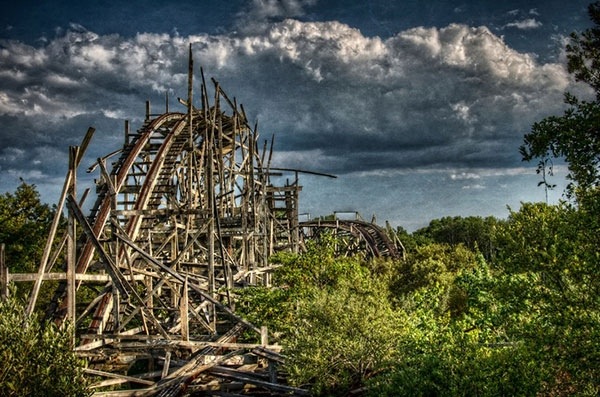
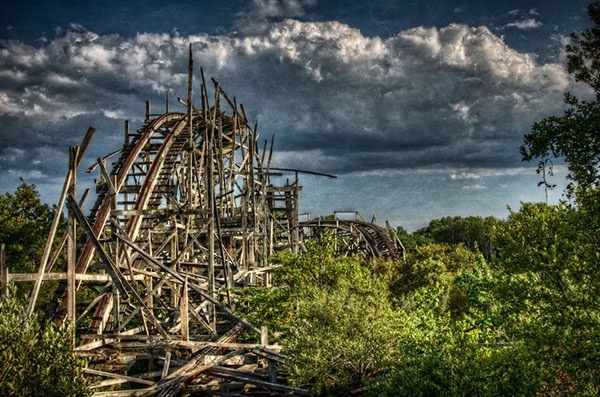
For twenty-five years, it stood there. A skeletal sentinel overlooking the highway. A local legend. Urban explorers and paranormal investigators flocked to the site, whispering stories of what they heard at night. The clack-clack-clack of the lift hill. The ghostly screams of riders. They said a spirit, maybe the man who died in the 60s, still rode the coaster, trapped in a loop of his final moments.
This picture says it all. The bones of a giant, picked clean by time. The stories became so pervasive that even the demolition crew in 2012 spoke of strange feelings, of tools going missing, of hearing noises from the decrepit structure. They tore it down, but can you ever really tear down a legend?
Nara Dreamland: The Uncanny Kingdom
Imagine this. You’re a Japanese businessman in the 1950s. You visit America and see something that changes your life: Disneyland. You are utterly captivated. You want—no, you *need*—to bring that magic back to Japan. You even meet with Walt Disney himself. But negotiations fall apart. So what do you do?
You build it anyway.
That is the incredible, bizarre origin story of Nara Dreamland. It wasn’t an homage to Disneyland. It was a counterfeit. A Xerox copy. It opened in 1961 and featured its own Main Street U.S.A., its own Sleeping Beauty-style castle, its own Matterhorn-esque mountain, its own monorail, and its own cast of pastel, vaguely familiar animal mascots. It was a knock-off on an epic, audacious scale.

For a while, the dream was real. It was a massive success. But then, the real magic arrived. First, Tokyo Disneyland opened in 1983. Then Universal Studios Japan opened nearby in Osaka in 2001. Why would anyone visit the copy when they could have the real thing? Attendance plummeted. The paint started to peel. The mascots grew faded and grimy. In 2006, the dream ended. The park closed.
And then it became a legend for a whole new generation.
The World’s Creepiest Ghost Town
Nara Dreamland wasn’t just abandoned. It was left almost perfectly intact. For ten solid years, it sat there, a fully-realized ghost of a magic kingdom, slowly being devoured by nature. It became a holy grail for urban explorers, or “haikyo” hunters in Japan. What they found inside was the stuff of nightmares and viral videos.
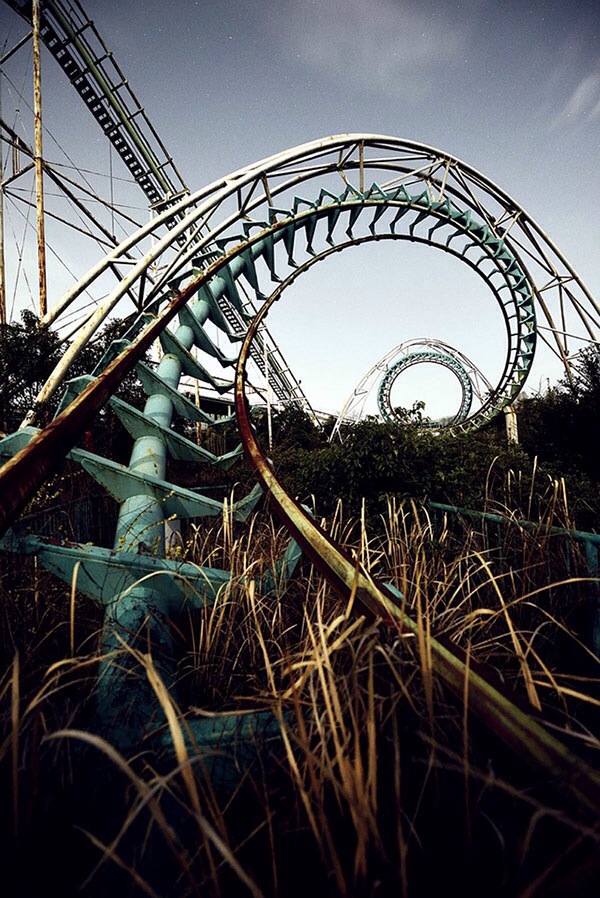
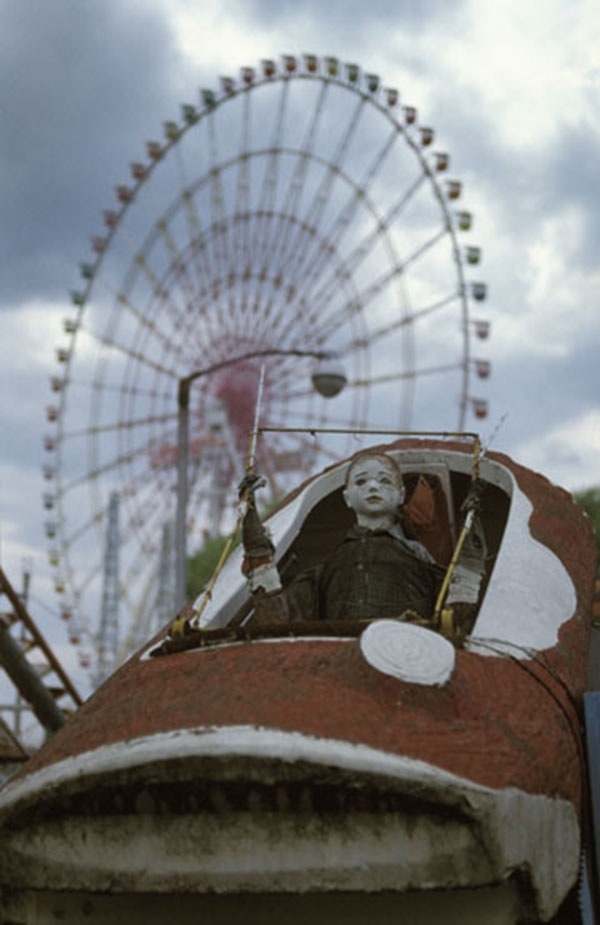
The pink castle, covered in black mold. The roller coasters, frozen mid-climb, choked with ten-foot-tall weeds. The tea cups, filled with stagnant, brown water. It was a surreal, post-apocalyptic vision of the Happiest Place on Earth.

Look at that. A silent scream of steel and rust. This wasn’t just decay; it was a perversion of joy. A funhouse mirror reflecting a distorted, dead version of our happiest childhood memories. That’s why it captured the internet’s imagination. It showed us what happens when the magic dies. The park was finally demolished in 2016, but its eerie, unforgettable images are forever burned into the web’s collective consciousness.
Spreepark: The Cocaine King’s Fallen Empire
Some stories of dead amusement parks are sad. Some are spooky. This one is just plain wild. This is a story of Cold War Germany, hubris, and an international drug smuggling plot involving a carnival ride.
You heard me right.
Spreepark, originally known as Kulturpark Plänterwald, opened in 1969. It was the one and only permanent amusement park in all of East Germany, a rare splash of capitalist-style fun in the stern world of the GDR. Its massive Ferris wheel was a landmark, a symbol of state-sanctioned joy. After the Berlin Wall fell, a showman named Norbert Witte took over.
He had big dreams. He brought in new rides, water features, and an English village theme. But Witte’s ambition was a runaway train. By 2001, the park was drowning in debt. So, what did Norbert Witte do? He packed up his family, and six of his favorite rides, and fled to Lima, Peru, under the pretense of starting a new park there.

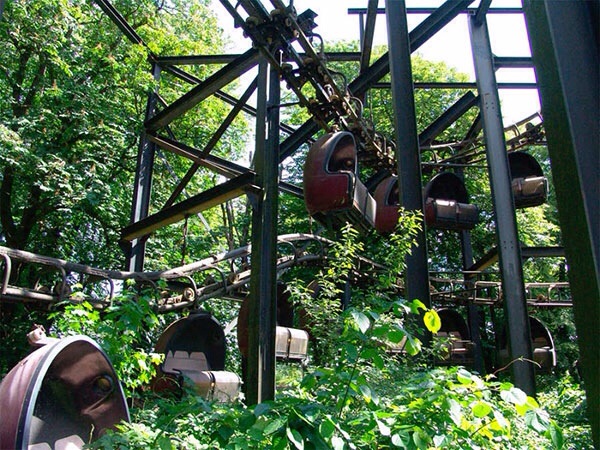
Back in Berlin, Spreepark was left to rot. Nature moved in fast. The iconic Ferris wheel creaked eerily in the wind. And a pack of giant, fiberglass dinosaurs tipped over in the fake prehistoric landscape, looking like casualties of a forgotten war. It became one of Europe’s most famous abandoned places.
Deep Dive: The Flying Carpet Plot
The story gets crazier. Witte’s Peruvian dream failed. Desperate for money, he hatched a plan. In 2003, he attempted to ship one of his rides—a “Flying Carpet” attraction—back to Germany. His plan? He’d hidden 167 kilograms of cocaine, worth millions of dollars, inside the hollow steel masts of the ride. He was caught. Witte was sentenced to seven years in prison. His son, who was also involved, got a 20-year sentence in Peru.
The park became a symbol of this insane, stranger-than-fiction story. A fallen kingdom built by a man whose greed literally brought it all crashing down. You couldn’t make this stuff up. The toppled dinosaurs, the silent Ferris wheel—they weren’t just decaying attractions; they were monuments to a bizarre criminal saga.

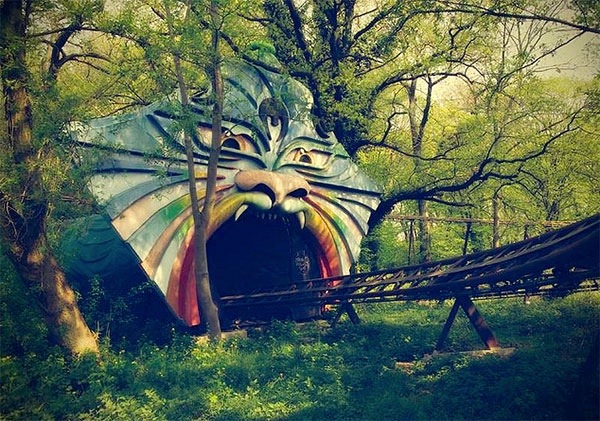
For years, you could take guided tours through the ruins, a surreal experience walking past decaying T-Rexes and silent log flumes. Today, the city of Berlin has taken control and is slowly, carefully trying to resurrect the park, not as a thrill-a-minute attraction, but as a public space for art and culture. A new life for a park with one of the wildest histories imaginable.
Takakanonuma Greenland: The Park That Was Never There
Now we venture into true conspiracy territory. A place so mysterious, so shrouded in fog and rumor, that for years people debated whether it even existed at all. This is the legend of Takakanonuma Greenland, Japan’s ghost park.
The story is a mess of contradictions and whispers. The official line is that it opened in 1973, somewhere in the mountains near Hobara. Almost immediately, things went wrong. Accidents. Deaths on the rides. The rumors grew. The park was cursed, they said. It was built near a graveyard. After only two years—or maybe just a few months, nobody is sure—it vanished from the public eye. Closed. Wiped from the map.
Then, the story goes, it quietly reopened in 1986. It limped along for another decade or so before closing for good in 1999. But there were almost no advertisements. No official records. It was as if it never wanted to be found.
Internet Sleuths vs. The Fog
For years, this park was the Sasquatch of the Urbex world. People claimed to have gone there as children, but had no photos. Locals would give vague, contradictory directions. The whole area is known for its incredibly dense fog, which only added to the mystery. Was it a real place, or some kind of shared false memory? A modern folk tale?
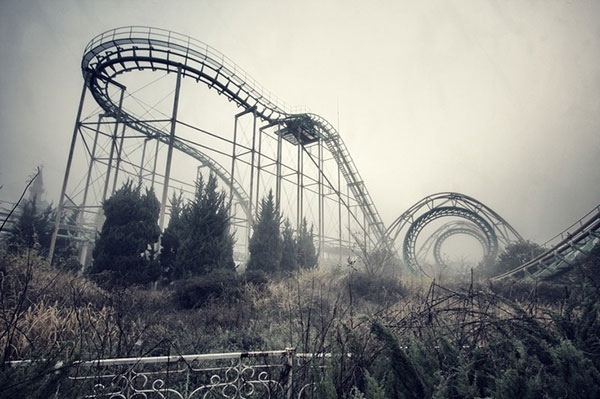
The internet took up the challenge. In the early days of online forums, explorers and sleuths pieced together the puzzle. They scanned old, low-resolution satellite photos. They dug up obscure zoning permits. And then, they found it. A ghost on the satellite map. A rusted roller coaster, a Ferris wheel, and a main gate, all being consumed by the forest, often completely hidden by a thick blanket of fog.

This image is one of the few pieces of solid evidence that circulated for years. That rusty, skeletal coaster became an icon of the truly hidden, truly forgotten places of the world. Brave explorers who finally found their way there reported a feeling of being watched, of an oppressive, heavy sadness that clung to the air. The fog wasn’t just weather; it felt like a shroud, actively trying to hide the park’s secrets. The park was fully demolished around 2007, and the site is now covered in solar panels. Erased. But the question remains: what really happened at Takakanonuma Greenland? Was it just a failed business venture in a bad location, or was there something darker at play in the fog-shrouded mountains?
What Is It About the Ruins of Joy?
Why do these places grab us? Why do we stare, mesmerized, at a picture of a rusted Ferris wheel? It’s more than just spooky curiosity. These places are a powerful reminder of a simple, brutal truth: nothing lasts forever. Especially not happiness.
They are a physical manifestation of a memory. We see the collapsed roller coaster and we can *feel* the phantom thrill in our stomachs. We see the silent carousel and we can *hear* the phantom music. It’s a collision of past and present, of joy and decay. They are monuments to impermanence, and in a strange way, that makes them beautiful. They are a warning, a story, and a mystery, all rolled into one. And they prove that sometimes, the most interesting ride begins long after the park has closed for good.