Tuesday, June 9, 2026
HomeWeird WorldStrange PlacesGhost Town - CRACO Italy: a medieval town

Ghost Town – CRACO Italy: a medieval town

The Silent Scream of Craco: What Really Killed Italy’s Most Famous Ghost Town?

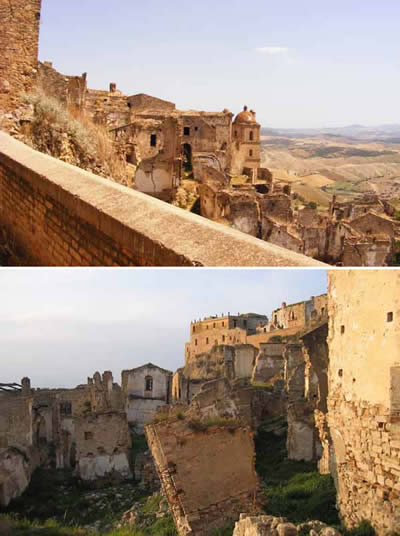
There’s a place in Southern Italy where time didn’t just stop. It shattered. It died. High on a razor-sharp peak, a town claws at the sky, a skeleton of stone against the brilliant blue of the Basilicata heavens. This is Craco. A ghost. A memory. A warning.

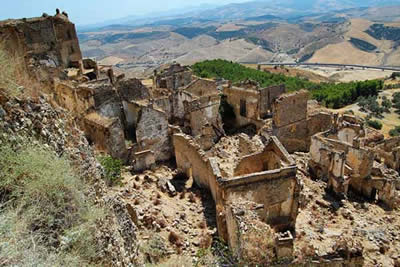
From a distance, it looks like a dream. A perfect medieval fortress, cascading down a cliffside in a symphony of weathered tile and sun-bleached walls. But get closer. The dream becomes a nightmare. Windows gape like empty eye sockets. Doorways lead to nothing but dust and sky. The only sound is the wind, a lonely mourner whistling through the corpse of a community that thrived for a thousand years.

And then vanished.

The official story is simple. Predictable. They say landslides and earthquakes, the slow, grinding revenge of Mother Nature, drove the people out. A geological inevitability. But is that all it was? When you stand at the foot of this silent giant, you can’t help but feel there’s more to it. The silence here is different. It’s heavy. It feels… deliberate. What if the ground beneath Craco wasn’t just unstable? What if it was cursed?

CRACO (Italy): a fascinating medieval town

Deep Dive: A Fortress Forged in Prayer and Fear

To understand Craco’s death, you have to understand its birth. This wasn’t just a random collection of houses. This was a statement. A defiance. Long before it was even called Craco, Greeks settled this harsh, beautiful land. But its true story begins around 1060 AD. The world was a brutal place. Norman invaders, Saracen pirates, rival city-states… danger was everywhere.

So they built upward.

The town’s location wasn’t an accident; it was a strategy. Perched atop a 400-meter-high cliff, it offered a panoramic view of the surrounding valleys. No army could approach unseen. The sheer cliffs were better than any man-made wall. It was a natural fortress, a place of safety in a world of chaos.

And at its heart was the Church. The records tell us the land was owned by Archbishop Arnaldo, the Bishop of Tricarico. This wasn’t just a line in a deed. This meant the Church was the town’s lifeblood. Its law. Its calendar. Its very soul. Life revolved around the church bells, the feast days of saints, and the watchful eyes of the priests. For centuries, this bond between the people and their faith was as solid as the rock beneath their feet. A rock they believed would never, ever fail them.

The Golden Age and the First Ominous Cracks

Craco blossomed. It grew into a complex, living organism. At its peak, just before the turn of the 20th century, over 2,000 souls called this vertical town home. It was a place of powerful families, their grand homes—the Palazzo Grossi, the Palazzo Carbone, the Palazzo Maronna, the Palazzo Simonetti—standing as proud testaments to their wealth and influence. A university was even established. Life was hard, yes, but it was stable.

Or so it seemed.

The first cracks weren’t in the earth. They were in the people’s stomachs. The land, while beautiful, was unforgiving. The undulating hills surrounding the town were difficult to farm. Yields were poor. A bad harvest didn’t just mean a tight belt; it meant starvation. Desperation began to seep into the cobblestone streets, a quiet poison that the church’s prayers couldn’t seem to stop.

A new gospel began to spread. Not of saints and salvation in the next life, but of opportunity and survival in a new world. A world called America.

The Great Exodus: When a Town Bleeds its People

Between 1892 and 1922, Craco began to hemorrhage its future. The official numbers are staggering: over 1,300 people—more than half the population—packed what little they owned and boarded ships for North America. This wasn’t just a migration. It was a flight. An escape. Entire families vanished, leaving behind empty homes that would never be filled again.

Imagine the scene. A son saying goodbye to his elderly parents, knowing he would never see them again. A young couple taking a handful of Craco’s soil with them, a tangible piece of a home they were abandoning forever. Each departure was another wound to the town’s spirit. The strong, the young, the ambitious—they were all leaving. The town grew older, emptier, and more vulnerable. It was a slow, creeping death, long before the ground itself began to move.

The Official Story: A Slow, Inevitable Collapse

And then the earth began to fight back.

The hill Craco was built on is mostly clay and sand. Unstable. Prone to erosion. For centuries, it held. But a combination of sewer and water system works, they say, may have aggravated the precarious situation. Then, the tremors began.

It started in the 1950s. Small quakes. Unsettling, but not yet catastrophic. Then came the landslides. Not one big, dramatic event, but a series of them. A relentless, creeping horror. It was a war of attrition against the town’s very foundations. Picture it. Lying in bed at night, hearing a strange groan from the walls of your ancestral home. Waking up to find a new, jagged crack running across your floor. The constant, gnawing fear that the ground beneath you was liquid. That your home was sinking, inch by terrifying inch.

Finally, in 1963, the government gave the order. Evacuate. Everyone. The remaining 1,800 residents were forced to leave their lives behind. They were moved to a new, safer settlement in the valley below, a place they called Craco Peschiera. It was practical. It was sensible. It was a complete and utter heartbreak.

They left everything. Furniture. Photographs. Children’s toys. They walked away from a thousand years of history, leaving the town to the wind and the ghosts. That’s the official story. A tidy, tragic tale of geology and public safety. But many believe the truth is far darker.

The Conspiracy Corner: What if it Wasn’t Just a Landslide?

This is where the whispers start. The stories told in low voices in the cafes of the new town. The internet theories that bubble up from the depths of forums. Was the death of Craco really so simple?

Theory 1: The Curse of San Vincenzo

The town’s protector was the martyr, San Vincenzo. His relics were housed in the church, the spiritual core of Craco. For centuries, the people honored him with festivals and processions. But what if, in the modern era, that devotion began to wane? What if a sacred promise was broken, a tradition neglected?

Local legends, hard to pin down but impossible to ignore, speak of a sacrilege. Some say a precious relic was mishandled or stolen. Others claim the town’s leaders, in their modernizing push, angered the saint’s spirit. The landslides, in this telling, weren’t a natural disaster. They were a punishment. Divine retribution. The ground didn’t just crumble; it was commanded to do so by a slighted protector who had become a destroyer. The very faith that had built the town was now being used to tear it apart.

Theory 2: The Secret of the “Bad Waters”

A more grounded, and perhaps more sinister, theory points the finger not at heaven, but at man. The clay hill Craco sits upon is known as a *frana*, a chronically unstable landslide area. But what if something made it worse? What if someone knew?

Post-war Italy was a time of rapid, often reckless, industrialization and infrastructure projects. Internet sleuths and local historians point to the possibility that government-led projects—perhaps a dam, an aqueduct, or even illegal drilling—dramatically altered the water table beneath the town. Did they divert an underground river, weakening the clay foundation until it had the consistency of wet soap? Was Craco sacrificed for “progress”?

In this version of events, the evacuation wasn’t a tragedy; it was a cover-up. It was easier to blame a “natural disaster” than to admit that a catastrophic engineering blunder, or sheer corporate greed, had destroyed a millennium-old town. The handful of geologists who warned of the problem were ignored, their reports buried in some dusty government archive.

Theory 3: Hollywood’s Prophetic Vision

This is where things get truly strange. Years before the final evacuation, Craco was already being used as a film set. But one film, a forgotten B-movie from the 1950s, supposedly featured a plot where a medieval Italian town is destroyed by an “earth-shattering force.” Coincidence? Or was Hollywood, with its deep connections to intelligence agencies and powerful figures, leaving a clue?

This theory suggests the landslides weren’t caused by water or curses, but by something else. Seismic testing. A secret underground military installation. Some researchers have pointed to strange magnetic anomalies in the region, suggesting the presence of something deep within the earth that shouldn’t be there. Perhaps the “landslides” were just a convenient explanation for the devastating side effects of a secret Cold War-era project. A project that turned Craco into collateral damage.

A Ghost on the Silver Screen

Whatever the cause, Craco’s death gave it a bizarre second life. The town’s haunting, perfectly preserved decay made it the ultimate movie set. It has become Hollywood’s favorite ghost.

It has played the role of ancient Jerusalem, most famously in Mel Gibson’s *The Passion of the Christ*, where the crumbling town provided the chilling backdrop for the hanging of Judas. It served as a dramatic setting in the James Bond film *Quantum of Solace*. It has appeared in dozens of other films and television shows, its silent streets and empty homes providing a level of authenticity that no studio backlot could ever replicate.

There is a profound irony here. A town abandoned by its people is now seen by millions. A place where real life ended has become a stage for fiction. Every time a camera crew arrives, they bring a temporary, artificial life back to the streets. But when they leave, the silence that returns is even deeper than before.

Can You Walk Among the Ghosts Today?

The question always comes up: can you go there? The answer is a cautious yes. Craco is not a tourist trap with gift shops. It is a hazardous, fenced-off ruin. You cannot simply wander in. The risk of collapsing buildings is very real.

To enter the dead city, you must join an official guided tour. You’ll be given a hard hat and led through a specific, secured path. The guides will show you the shell of the main church, point out the noble palazzi, and tell you the official story. But look closer. Look at the details they don’t mention. A single shoe in the dust. Faded paint on a bedroom wall. A cooking pot left on a hearth.

These are the things that hit you. The intimate, personal ghosts of Craco. It feels less like a ruin and more like a crime scene. A modern Pompeii, where the disaster wasn’t a volcano’s sudden fury, but a slow, creeping cancer that took decades to kill its host.

So what is the final verdict on Craco? Is it a monument to the awesome, destructive power of nature? Is it a testament to the heartbreak of migration and economic despair? Or is it a silent, stone witness to a darker secret we may never fully uncover?

Perhaps it’s all of those things. Craco is a story without a final chapter. The wind that blows through its empty arches doesn’t carry answers. It only carries more questions, whispering them across the desolate hills of a forgotten Italy. The rock failed. The faith was shaken. And the people are gone. All that remains is the silence. And the scream you can still feel, right under your feet.

Amit Ghosh
Amit Ghoshhttps://coolinterestingnews.com
Aloha, I'm Amit Ghosh, a web entrepreneur and avid blogger. Bitten by entrepreneurial bug, I got kicked out from college and ended up being millionaire and running a digital media company named Aeron7 headquartered at Lithuania.
RELATED ARTICLES
- Advertisment -

Most Popular

Recent Comments

Warren Pan Abbott on The legend of the Devil Monkey !
chris davies on The McPherson Tape Mystery
Reed Reedly on ET has Internet!
Bea Houseoffashion on Proof Of Time Travellers – Gallery
Marcus2012 on ET has Internet!
Reed Reedly on ET has Internet!
LaughsAtConspiracyNuts on The 9/11 Conspiracy – Myths and Facts
Alex Sliverman on Did the ancients fly?
Doctor Wholigan on Time Traveler in 1938 film
chris davies on The McPherson Tape Mystery
Archie1954 on 10 secret UFO hideouts
chris davies on Ghosts of flight 401
Marcus2012 on ET has Internet!
jason Macdonald on Proof of Time Travel? – China
chris davies on Long-Lost Pyramids Found?
Reed Reedly on ET has Internet!
Milkman on Connected Universe
Tenmiles on Baigong Pipes Mystery
Simon Foster on Sirius – The Documentary
From the 1st April on 2013 – Alien Contact date ?
SkyWatcher on Is ET ignoring us?
I Come From The Future on Obama to make UFO Alien disclouser soon ?
ÛñK?øWn on 2013 – Alien Contact date ?
Just another person on 2013 – Alien Contact date ?
Malcolm Windowcleaner on The strange case of Rudolph Fentz
Mason Servio on Strange Things on Mars
Marke Wisdom Seeker on What will we find as arctic melts?
Andrea A Elisabeth Levyne on Aliens Captured in Varginha, Brazil
Mitch Grouyeki on Amazing Space Shuttle pictures