The Star in a Jar: Is Limitless Fusion Energy a Suppressed Secret or Humanity’s Last Hope?
What if I told you that the secret to unlimited, clean energy for the entire planet has been known for decades? That the very same power that fuels our sun could be bottled right here on Earth, ending our addiction to fossil fuels and potentially reversing climate change overnight. It sounds like science fiction. A dream.
But it’s not.
It’s called nuclear fusion. And for over 70 years, scientists have been locked in a quiet, globe-spanning race to build a working reactor—a miniature star in a magnetic bottle. The official story is that it’s the hardest engineering problem humanity has ever faced. A challenge so immense, we are always “30 years away” from a breakthrough.
But is that the whole truth?
Hidden beneath the headlines of slow, incremental progress are moments of breathtaking achievement. Flashes of brilliance that suggest we are closer than we’re being told. One such moment happened back in 2016, a flicker of hope from a bizarre-looking machine in Germany that most of the world completely missed. It was a clue. A piece of a puzzle that, when assembled, paints a picture of a future so bright it’s almost blinding. A future that some powerful people might not want you to see.
Strap in. We’re going to explore the promise, the politics, and the potential conspiracy behind the quest for the ultimate power source.
Fusion 101: Taming the Sun’s Roaring Engine
Before we journey down the rabbit hole, let’s get the basics straight. Forget everything you think you know about nuclear power. That’s fission. Fission is the brutish, messy process of splitting heavy, unstable atoms like uranium. It works, sure. But it leaves behind a terrifying legacy of radioactive waste that lasts for thousands of years and carries the ever-present shadow of a meltdown. Chernobyl. Fukushima. Fission is like using a sledgehammer to crack a nut.
Fusion is different.
It’s elegant. It’s clean. It’s the engine of the cosmos. Instead of splitting atoms, fusion smashes them together. Specifically, it takes two light atoms—usually isotopes of hydrogen called deuterium and tritium—and under unimaginable heat and pressure, forces them to fuse into a single helium atom. The same stuff in birthday balloons.
But here’s the magic. The resulting helium atom is slightly less massive than the two original hydrogen atoms combined. That missing mass doesn’t just vanish. It explodes into a gargantuan release of pure energy, exactly as described by Einstein’s famous equation, E=mc². This is what makes stars shine.
A Fuel Source From Your Faucet
So, where do we get the fuel for this miracle process? Uranium for fission has to be mined, enriched, and carefully handled. It’s rare and dangerous. The fuel for fusion, on the other hand, is everywhere.
Deuterium can be easily extracted from water. Any water. A single gallon of seawater contains enough deuterium to produce the energy of 300 gallons of gasoline. Tritium is a bit rarer, but it can be “bred” inside the fusion reactor itself from lithium, another abundant element.
Think about that. The oceans themselves could power human civilization for millions of years. No carbon emissions. No long-lived radioactive waste. And a meltdown? Physically impossible. If the magnetic containment field fails, the super-hot gas—the plasma—simply touches the wall, cools down, and the reaction stops. Instantly. It’s a fail-safe system by its very nature.
It’s the Holy Grail. So why isn’t a fusion plant powering your city right now?
The Battle of the Machines: A Tale of Two Donuts
To build a star on Earth, you have to solve an impossible problem: how do you hold something that is 150 million degrees Celsius? That’s ten times hotter than the core of the sun. No physical material can withstand that kind of heat. Touch the walls, and your machine is vaporized. The reaction fizzles out.
The solution? Don’t use a container made of matter. Use one made of forces. A magnetic bottle.
For decades, the quest for fusion has been dominated by two competing designs, two different philosophies on how to build this magnetic cage. This is where the story gets interesting.
The Mainstream King: The Tokamak
The Tokamak is the big one. The heavyweight champion. Invented in Soviet Russia in the 1950s, its design is, in principle, straightforward. It’s a hollow, donut-shaped ring (a torus) wrapped in massive electromagnets. These magnets create a powerful, twisting magnetic field inside the donut that traps the plasma, holding it away from the walls as it’s heated to stellar temperatures.
Massive, multi-billion-dollar international projects like ITER in France are based on the Tokamak design. It’s the officially sanctioned path, the one backed by governments and massive research funding. But it has a problem. The plasma inside a Tokamak is notoriously unstable. It wants to escape. It writhes and flares like a caged serpent, requiring constant correction and an enormous input of energy just to keep it under control.
The Rebel Contender: The Stellarator
Then there’s the other guy. The weird one. The Stellarator.
If a Tokamak is a simple donut, a Stellarator is a donut that’s been twisted and warped by an angry god. Its shape is a mind-bendingly complex, asymmetrical mess of curves and coils. It looks less like a machine and more like a piece of alien sculpture. The design is so complex that for decades, it was impossible to build one with the precision required.
But there’s a genius to its madness. All those twists and turns in the machine’s shape create the perfect magnetic field *naturally*. The plasma is inherently stable. It doesn’t fight to escape. It just flows serenely along its complex path. In theory, a Stellarator could run continuously, forever, whereas a Tokamak typically has to operate in pulses. It is a more elegant, but infinitely more difficult, solution.
For years, the Stellarator was seen as a dead end, a fascinating academic curiosity but too difficult to ever work in the real world. That is, until a team in Germany decided to prove everyone wrong.
Deep Dive: The 2016 Greifswald Experiment Nobody Talks About
This brings us to that cold day in February 2016. In the small German town of Greifswald, a group of scientists, accompanied by German Chancellor Angela Merkel, gathered around the most advanced Stellarator ever built: the Wendelstein 7-X (W7-X).
After nearly two decades of construction and over a million hours of supercomputer-aided design, the moment of truth had arrived. Could this twisted beast of a machine actually work? Could it contain a plasma hot enough for fusion?

They injected a tiny puff of hydrogen gas into the vacuum chamber. Then they hit it with a blast of microwave energy, heating it in an instant.
For a brief, brilliant moment, it happened. A stable hydrogen plasma, heated to 80 million degrees, formed inside the W7-X. It only lasted for a quarter of a second. It didn’t produce any net energy. But that wasn’t the point.
The point was, it *worked*. The magnetic cage held. The fiendishly complex calculations, the decades of theoretical work, were proven correct. The rebel design was viable.
“With a temperature of 80 million degrees and a lifetime of a quarter of a second, the device’s first hydrogen plasma has completely lived up to our expectations,” said scientist Hans-Stephan Bosch at the time. A typically dry, scientific statement for what was a monumental achievement. A small milestone? Perhaps. But it was a milestone that cracked open the door to an entirely different path toward fusion energy—a path many in the mainstream had dismissed for years.
The news made a few headlines and then vanished. But for those watching closely, a question began to form. Why was this revolutionary alternative getting so little attention compared to the Tokamak projects? Why does the world continue to pour tens of billions into the “brute force” approach when this more elegant solution was just proven to work?
The Conspiracy Board: Who Is Stalling the Fusion Future?
This is where the official story frays at the edges. If fusion is so great, and we’ve been making steady progress for decades, why are we still burning coal and gas? The answer might be more complicated than just “it’s hard.”
Prime Suspect #1: Big Oil and the Energy Cartel
Let’s start with the obvious. The global energy market is worth trillions upon trillions of dollars. It’s an empire built on a finite resource that you have to dig up, ship around the world, and burn. This empire is controlled by a handful of corporations and nations whose entire wealth and geopolitical power depend on that system continuing.
Now imagine a technology that makes their entire business model obsolete. A technology that runs on seawater. A technology where the power plants can be built anywhere, freeing nations from energy dependence. What do you think the reaction of the existing energy cartel would be? Would they embrace it? Or would they do everything in their power to slow it down, to discredit it, to ensure it remains “30 years away” forever?
It’s not about men in black hats meeting in secret. It’s about lobbying, funding cuts for “unpromising” research, and subtly shaping public perception to believe that the dream is just a fantasy.
Prime Suspect #2: It’s Just THAT Hard
Of course, there’s the counterargument. Maybe there is no conspiracy. Maybe, just maybe, containing a 150-million-degree star-in-a-jar is genuinely the single most difficult scientific and engineering feat in the history of our species. The challenges are staggering. Developing materials that can withstand the intense neutron bombardment from the reaction. Figuring out how to extract the heat efficiently. And wrestling with the bizarre, almost alive behavior of plasma, the fourth state of matter.
Perhaps the slow pace isn’t a sign of suppression, but a testament to the sheer, mind-breaking difficulty of the task. Every small step, like the W7-X experiment, is a hard-won victory against the laws of physics itself.
Wildcard Theory: The Secret Military Applications
Here’s a darker thought. What if the research isn’t being stalled, but steered? A compact, working fusion reactor would be the ultimate power source. Not just for cities, but for naval vessels. Submarines that could run for 50 years. Spacecraft capable of rapid interstellar travel. Directed energy weapons. The military applications are as world-changing as the civilian ones.
Is it possible that a breakthrough has already been made in a classified project? Or that the public research is being deliberately guided away from designs that could be easily militarized? When a technology promises this much power, it’s naive to think that every government and military on Earth isn’t watching with intense interest.
The Race is On: The World After 2016
While the 2016 W7-X experiment may have been a quiet affair, the fusion world has not been sleeping. In fact, the race has become more frantic than ever.
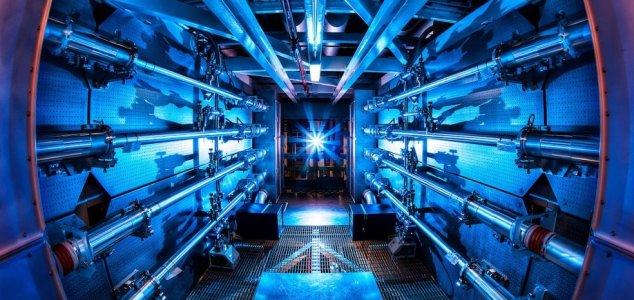
In the United States, the National Ignition Facility (NIF) took a completely different approach. Instead of magnetic bottles, they use 192 of the world’s most powerful lasers, all focused on a pepper-corn-sized pellet of hydrogen fuel, crushing it to create a momentary star. In December 2022, they announced a historic breakthrough: for the first time ever, they got more energy out of a fusion reaction than they put in to start it. Ignition. It was a massive proof of concept.
Meanwhile, the private sector has exploded onto the scene. A new generation of audacious startups, backed by tech billionaires, believe they can move faster and smarter than the slow-moving government behemoths. Companies like Commonwealth Fusion Systems (an MIT spinoff) and Helion are building smaller, more powerful reactors based on new magnet technology, promising fusion power on the grid in a decade, not half a century.
And what about the Wendelstein 7-X, our rebel hero? Since 2016, it has been steadily smashing records for plasma performance in a Stellarator, proving the design is not just viable, but potentially superior for long-duration, stable power generation.
The race is no longer between two designs. It’s a mad dash between nations, between public and private enterprise, between magnets and lasers. The secret is out, and the competition is heating up.
The Final Question: A New Dawn or a Broken Promise?
We stand at a crossroads in history. In one direction lies our current path: a world chained to dwindling resources, beholden to energy markets, and facing a looming climate catastrophe.
In the other, a different future beckons. A future powered by the same clean, limitless fire that warms our planet. A world where energy is too cheap to meter. A world of unimaginable abundance and technological progress. This isn’t a utopian fantasy; it’s a future made possible by the physics of nuclear fusion.
The breakthroughs are happening faster than ever. The science is solid. The only question left is one of will. Are we on the cusp of the greatest leap forward in human history? Or will this revolutionary power source remain just out of reach, a tantalizing promise sabotaged by greed, fear, or its own incredible complexity?
Look up at the sun. The solution has been staring us in the face for all of human history. The only question now is: are we finally ready to reach out and grab it?