Saturday, April 18, 2026
HomeFilms & DocumentariesOnly known wild jaguar in US caught on film

Only known wild jaguar in US caught on film

The Ghost Cat of the Chiricahuas: Is America’s Only Wild Jaguar Still Out There?

Something is moving in the mountains of Arizona. A ghost. A phantom that stalks the rocky canyons and sun-scorched scrubland just north of the Mexican border. It’s a creature that, according to the history books, simply shouldn’t be here. It’s too big, too powerful, too ancient. A living myth.

They call him El Jefe.

The Boss.

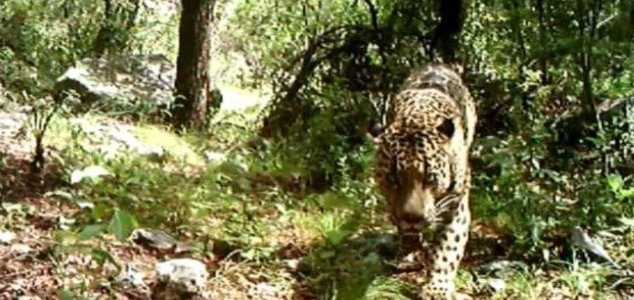
For years, his existence was just a rumor. A whisper among ranchers and a hopeful prayer for conservationists. But then, the cameras caught him. Not once, but multiple times. A ripple of liquid muscle and a coat like a star chart, he materialized from the shadows, the first wild jaguar confirmed to be living and hunting on U.S. soil in years. He was a king who had returned to a long-lost kingdom.

But his appearance raises far more questions than it answers. Is he truly alone? How did he get here? And more importantly, in the years since he was last seen, where did he go?

 jaguar

The Moment a Legend Was Caught on Film

Imagine you’re a biologist. You spend your days hiking through the rugged, unforgiving terrain of the Santa Rita Mountains. It’s a place of secrets. Your goal is simple: to see what’s out there. You set up a series of motion-activated trail cameras, hoping to catch a glimpse of a mountain lion or maybe a reclusive black bear.

You collect your memory cards, head back to the lab, and start clicking through the images. Deer. Javelina. A curious coyote sniffing the lens. More deer. Then you stop. Your heart hammers against your ribs. You lean closer to the screen, unable to process what you’re seeing.

It’s not a bobcat. It’s way too big. It’s not a mountain lion; the coat is all wrong. This animal is covered in a breathtaking pattern of black rosettes. It’s a jaguar. A living, breathing jaguar, walking with a confident, rolling gait right past your camera. In the United States.

This was the reality for researchers who first captured definitive proof of El Jefe. The footage was electric. It showed a massive, healthy male jaguar navigating his mountain territory. He wasn’t just passing through. He was home. The solitary feline, who has been living in these mountains north of the Mexican border for what experts believe was at least three years, was officially documented. He was, for a time, the only known wild jaguar in the entire United States.

The jaguar (Panthera onca) is a titan, a true big cat in the Panthera genus, and it stands alone as the only one of its kind native to the Americas. Think about that. No lions, no tigers. This is our continental apex predator. The jaguar is the third-largest feline on the planet, trailing only the tiger and the lion, and is unquestionably the largest and most powerful in the Western Hemisphere. Its very name is a weapon, derived from the indigenous word ‘yaguar’, meaning “he who kills with one leap.”

Deep Dive: The Lost History of the American Jaguar

To understand why a single jaguar in Arizona is a world-shaking event, you have to understand the secret history we’ve tried to erase. The jaguar’s present range is a shadow of its former glory, stretching from the Southwestern United States and Mexico, down through Central America to Paraguay and northern Argentina. But it wasn’t always so limited.

Forget what you think you know. This wasn’t just a “borderlands” animal.

Archaeological evidence and fossil records paint an astonishing picture. Jaguars, or their direct ancestors, roamed across the continent. Their bones have been found as far north as Washington state and as far east as Pennsylvania and Florida. They hunted in the swamps of Louisiana and the forests of the Ohio River Valley. For thousands of years, North America was a jaguar continent.

They were deeply woven into the cosmology of native cultures. The Olmecs, the Maya, the Aztecs—they didn’t just respect the jaguar; they revered it as a divine being. A creature that could walk between worlds, a master of both the day and the night. Its image is carved into ancient temples, a symbol of royalty, power, and shamanistic strength. Even for the local tribes of the Southwest, like the Hohokam, the jaguar was a figure of immense spiritual importance.

The Great Extermination

So where did they all go? The answer is simple and brutal. We killed them.

As European settlers pushed west, they brought with them a worldview that had no room for giant predators. The wilderness was not something to coexist with; it was something to be conquered, tamed, and monetized. Jaguars, with their taste for livestock, became public enemy number one. They were a direct threat to the burgeoning cattle industry.

And so, a war was declared. It was a systematic, government-sanctioned campaign of extermination. Federal agencies and private ranchers used traps, poisons, and high-powered rifles to wipe the jaguar from the American map. Bounties were placed on their heads. For every hide brought in, a hunter would be paid a handsome sum.

The slaughter was brutally effective. By the early 20th century, the jaguar had been almost completely expunged. The last verified female jaguar in the United States was shot by a hunter in Arizona’s White Mountains in 1963. With her death, the hope of a breeding population north of the border died too. Or so everyone thought.

The Phantom’s Return and the Macho B Conspiracy

El Jefe wasn’t the first ghost to cross back into the old kingdom. For decades after the last female was killed, rumors persisted. Unconfirmed sightings, strange tracks, livestock kills that didn’t look like a mountain lion’s work. Then, in 1996, it happened. A rancher photographed a jaguar in the Pelloncillo Mountains. The ghost was real.

The most famous, and most tragic, of these returning phantoms was a male known as Macho B. He was first photographed in 1996 and was studied by researchers for over a decade. He was a survivor, a testament to the animal’s resilience. But his story ends in darkness.

In 2009, Macho B was captured by the Arizona Game and Fish Department in what they claimed was a routine snaring operation to monitor a black bear. They fitted him with a radio collar. A good idea, right? But things went wrong. Terribly wrong. The aging jaguar, estimated to be around 15 years old, quickly fell ill. He was recaptured and, due to what was described as severe kidney failure, he was euthanized. The last confirmed American jaguar of his era was gone.

But the story gets murkier. A whistleblower came forward. Evidence suggested Macho B had been illegally baited and intentionally captured. The story unraveled into a federal investigation, guilty pleas, and a cloud of suspicion that hangs over the event to this day. Was it a tragic mistake, or was America’s most famous jaguar deliberately targeted? Many in the alternative research community believe his capture was no accident.

The El Jefe Enigma: Is He Really Alone?

Which brings us back to El Jefe. His presence in the Santa Ritas proved that Macho B was not a fluke. The pull of this ancestral territory is strong. These jaguars, almost always males, are likely coming from a breeding population in Sonora, Mexico. They are pioneers, scouting new territory. They follow ancient pathways, genetic highways etched into the landscape that connect the Sierra Madre Occidental with the “sky islands” of Arizona and New Mexico.

But here’s the question that keeps cryptozoologists and fringe researchers up at night. What if the official story is wrong? What if El Jefe isn’t just a lone male wanderer?

Jaguars are masters of stealth. They are arguably the most elusive big cat on Earth. In the dense jungles of the Amazon, people can live their entire lives surrounded by jaguars and never see one. The sky islands of Arizona are vast, rugged, and sparsely populated. They are a maze of canyons, caves, and thick forests. Could a small, breeding population—a handful of females and a dominant male—survive there completely undetected?

Go to the remote corners of the internet, the hiking forums, the hunting blogs. You’ll find the stories. A backpacker who found a deer carcass dragged high into a tree, a classic jaguar behavior rarely seen in mountain lions. A trail runner who swears they heard the distinctive, saw-like “grunt” of a jaguar at dusk. A rancher who found tracks that were too big, too round for a puma.

Are these all just mistakes? Misidentifications? Or are they fleeting glimpses into a secret that the mountains are not yet ready to give up?

A Concrete Dagger: The Border Wall Connection

This dream of a jaguar renaissance, however, is facing a modern-day monster: the border wall. The very corridors these animals use to travel north from their breeding grounds in Mexico are being severed by miles of impermeable steel and concrete. To a jaguar, a 30-foot steel bollard wall is as final as a hunter’s bullet. It cuts the genetic lifeline. It isolates any jaguars in the US, turning them into a doomed population on a genetic island.

Conservation groups call it a death sentence. The wall is a concrete dagger pointed at the heart of North America’s wildlife arteries. It doesn’t just stop jaguars. It blocks the movement of ocelots, black bears, Sonoran pronghorn—countless species that depend on cross-border migration for their survival.

What Happened to El Jefe?

The mystery of El Jefe only deepens after his brief moment in the spotlight. The stunning video and photographs released to the world were captured between 2013 and 2015. But since late 2015… nothing. He vanished. As mysteriously as he appeared, The Boss was gone.

Where did he go? There are a few possibilities.

  • He Went Home: The most likely and hopeful scenario is that, after failing to find a female in his new territory, he made the long journey back south to the breeding populations in Mexico.
  • He Met a Darker Fate: The Southwest is still a dangerous place for a jaguar. He could have been illegally shot by a poacher, struck by a vehicle, or died in a territorial dispute with a mountain lion or a bear.
  • He’s Still Out There: The most tantalizing possibility is that he’s simply evaded our cameras. He found a more remote, more inaccessible part of the mountains and continues to haunt the American wilderness, a true ghost once more.

But the story doesn’t end with El Jefe’s disappearance. He was a pioneer who reopened a door. In the years since he vanished, at least two other male jaguars have been photographed in Arizona: one named Sombra, and another named Yo’oko. They, too, are phantoms on the landscape, proof that the call of the north is still strong.

El Jefe proved that the kingdom was not entirely lost. He proved that the American wild is still wild enough to host its ancient king. He haunts the borderlands, a legend and a symbol. A symbol of a wildness we tried to destroy, but which refuses to die. The question now is, will we let it return? Or will we slam the door shut for good?

Look to the mountains. Listen in the quiet of the desert dusk. The ghosts are walking. And you have to wonder… who will be the next to step out of the shadows?

Arindam Mukherjee
Arindam Mukherjee
Arindam loves aliens, mysteries and pursing his interest in the area of hacking as a technical writer at 'Planet wank'. You can catch him at his social profiles anytime.
RELATED ARTICLES
- Advertisment -

Most Popular

Recent Comments

Warren Pan Abbott on The legend of the Devil Monkey !
chris davies on The McPherson Tape Mystery
Reed Reedly on ET has Internet!
Bea Houseoffashion on Proof Of Time Travellers – Gallery
Marcus2012 on ET has Internet!
Reed Reedly on ET has Internet!
LaughsAtConspiracyNuts on The 9/11 Conspiracy – Myths and Facts
Alex Sliverman on Did the ancients fly?
Doctor Wholigan on Time Traveler in 1938 film
chris davies on The McPherson Tape Mystery
Archie1954 on 10 secret UFO hideouts
chris davies on Ghosts of flight 401
Marcus2012 on ET has Internet!
jason Macdonald on Proof of Time Travel? – China
chris davies on Long-Lost Pyramids Found?
Reed Reedly on ET has Internet!
Milkman on Connected Universe
Tenmiles on Baigong Pipes Mystery
Simon Foster on Sirius – The Documentary
From the 1st April on 2013 – Alien Contact date ?
SkyWatcher on Is ET ignoring us?
I Come From The Future on Obama to make UFO Alien disclouser soon ?
Just another person on 2013 – Alien Contact date ?
Malcolm Windowcleaner on The strange case of Rudolph Fentz
Mason Servio on Strange Things on Mars
Marke Wisdom Seeker on What will we find as arctic melts?
Andrea A Elisabeth Levyne on Aliens Captured in Varginha, Brazil
Mitch Grouyeki on Amazing Space Shuttle pictures