The Secret Blueprint for Humanity’s Next Chapter: Are Underwater Cities and Flying Homes Already on the Drawing Board?
Forget what you think you know about the future. Throw out the sterile, white-washed images from old sci-fi flicks. The reality of the next century is going to be stranger, deeper, and more explosive than you can possibly imagine. We’re talking about a complete tear-down of everything we consider normal. Your home. Your city. Even your food. It’s all on the table.
Dr. Maggie Aderin-Pocock, a top British space scientist, dropped a bombshell when she said, “Over the next century we will witness further seismic shifts in the way we live and interact with our surroundings.” Seismic shifts? That’s putting it mildly. What she and a team of futurists, architects, and urbanists laid out in the SmartThings Future Living Report isn’t just a prediction. It feels like a warning. Or maybe… a preview of a plan that’s already in motion.
They’re talking about a world where humanity goes in two directions at once: down into the crushing dark of the ocean, and up into the clouds. A world where the very idea of a permanent address is history. This isn’t just a fantasy. The patents are being filed. The materials are being tested. The blueprints are being drawn. The question is, are you ready for it?
Deep Dive: The Atlantis Project for the 21st Century
Let’s start with the most mind-bending idea of all: entire cities suspended beneath the waves. Not just submarines. Not just research outposts. We’re talking about sprawling, self-sustaining communities housed in giant, transparent bubbles. Think of it. Waking up to see a pod of whales drift past your bedroom window. Commuting to your job in a personal sub, the bioluminescent creatures of the abyss lighting your way.
Crazy? Maybe. But the logic is terrifyingly sound. Our coastlines are being swallowed by rising sea levels. Our megacities are choking on their own pollution and bursting at the seams with people. Where else is there to go? The ocean covers over 70% of our planet, yet we know more about the surface of Mars than we do about our own ocean floors. It is the last, true frontier on Earth.
Is the Aequora Project a Glimpse of Our Aquatic Destiny?
This isn’t just academic theory. People are already designing these places. Take Belgian architect Vincent Callebaut. He’s not just doodling on a napkin; he’s unveiled a stunningly detailed plan for a series of underwater villages called the Aequora project. His vision is for massive, spiraling “oceanscrapers” made from 3D-printed recycled plastics from the Great Pacific Garbage Patch itself. Cleaning the ocean while building our new homes. Genius.
These aren’t small pods. Callebaut’s designs plunge 1,000 meters—that’s over 3,200 feet—into the deep. They’re designed to house 20,000 people each, with 250 floors containing everything we need: offices, homes, hotels, farms, and sports fields. The project’s supposed completion date? 2045. That’s not some distant, far-flung future. That’s just around the corner.
But how would it even work? The pressure at that depth is immense. The challenges are staggering.
- Oxygen: How do you provide breathable air for 20,000 people? The answer likely lies in electrolysis, splitting sea water into hydrogen and oxygen, powered by the relentless energy of ocean currents.
- Food: Giant algae farms and aquaculture domes would provide a constant supply of food, creating a closed-loop ecosystem. You wouldn’t be eating beef and chicken; you’d be dining on algae steaks and hydroponic vegetables grown in the blue twilight.
- Pressure: The structures themselves would need to be built from materials we’re only just beginning to understand, like carbon composites and bio-rock, a substance that uses the ocean’s own minerals to grow and strengthen itself over time.
The psychological impact is another story. What does it do to the human mind to live without a sky? To be surrounded by the infinite, crushing blue? Would we adapt, or would it drive us mad? Some theorists believe these deep-sea havens aren’t for everyone. They speculate these could be modern-day Arks, designed as self-sufficient bunkers for the global elite to ride out climate catastrophes on the surface. While the rest of us are left to deal with the fallout, they’ll be safe in their deep-sea utopia. A chilling thought.
The Vertical Age: Super-Skyscrapers and Earth-Scrapers
While some of us are headed for the deep, others will be going in the opposite directions. Up. And down. Way down.
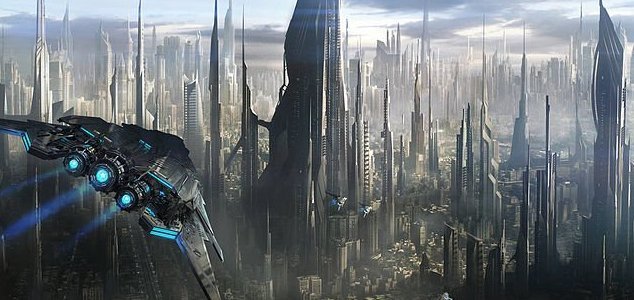
The report talks about “super skyscrapers” that will make modern buildings like The Shard in London look like a child’s toy. These aren’t just taller buildings; they are vertical cities. Complete ecosystems stacked a mile high, with their own weather systems, parks, and transportation networks. But what’s even more fascinating is the counter-proposal: the “Earth-scraper.”
Why Would We Build Down?
Why dig when you can build? The answer is simple: stability and safety. Imagine a structure that plunges 25, 30, even 50 stories straight into the bedrock. It’s almost immune to the increasingly violent weather on the surface—hurricanes, tornadoes, and superstorms would pass harmlessly overhead. It would be naturally insulated by the earth, drastically cutting energy costs for heating and cooling. And it could tap directly into geothermal energy from the planet’s core. A constant, clean, and nearly infinite power source.
You have to wonder what a society split between the sky and the earth would look like. Would the “Sun-Dwellers” of the super-skyscrapers, with their panoramic views and access to natural light, become a different class of citizen from the “Core-Dwellers” of the Earth-scrapers? It’s the stuff of dystopian fiction, but it’s a future being seriously discussed by urban planners.
Your Home is Now Your Vehicle: The End of Geography
This is where things get really weird. The report suggests that the daily commute could be replaced by personal flying drones. Not the little camera drones we have today. We’re talking about heavy-lift machines capable of moving people and cargo with ease. But they take the idea one massive leap forward.
What if your drone wasn’t just a flying car? What if it could transport your entire home?
Think about it. No more packing for a holiday. You simply program your destination, and a fleet of powerful drones gently lifts your entire modular home from its foundation and flies it to the mountains, the beach, or another country. The concept of “moving” becomes obsolete. The idea of a neighborhood becomes fluid. Your community is whoever happens to be parked next to you that week. This would be the ultimate nomadic lifestyle, a return to our hunter-gatherer roots but with Wi-Fi and air conditioning.
What kind of technology could even do that? We’re talking about a revolution in energy and propulsion. Some fringe theories suggest this is where suppressed technologies, like localized anti-gravity, could finally make their public debut. How else could you silently and safely lift a multi-ton house into a crowded sky?
Forget a vacation home in Spain. What about a vacation on another world? If we can move our homes anywhere on Earth, the next logical step is to hop off-world.
The moon becomes the ultimate holiday destination. Imagine attaching a rocket module to your home and spending the summer in the low-gravity bliss of the Sea of Tranquility. This sounds like a joke. A fantasy. But a century ago, the idea of carrying a supercomputer in your pocket that could talk to anyone on the planet was also a fantasy.
The Ultimate Ctrl+P: 3D Printing Our New Reality
So how are we going to build all of this? The underwater cities, the gigantic scrapers, the modular homes? The answer lies in a technology that’s already here, but is poised to explode: 3D printing.
We’re not just talking about little plastic toys. We’re talking about printing on a colossal scale. We already have printers that can construct a small house in 24 hours. Now, scale that up. Imagine fleets of autonomous printers using locally sourced materials—rock, sand, recycled plastic—to build these new cities layer by layer. It’s faster, cheaper, and produces almost zero waste.
From Pizza to Protein Paste
The revolution won’t stop with buildings. It’s coming for your dinner plate. The idea of 3D printing food has been around for years. Back in 2013, a device called the Foodini was introduced. It could print complex dishes, from pizza to ravioli, by extruding different ingredients in precise layers. It was a novelty then. Soon, it will be the norm.
Your future kitchen might not have a stove or an oven. Just a food printer. You’ll have cartridges of basic nutrient pastes—carbohydrates, proteins, fats, vitamins, and flavor compounds. You’ll download a recipe from your favorite chef (or a dietary plan from your doctor) and hit “print.” Out comes a perfect meal, tailored exactly to your body’s needs. No waste. No cooking. Perfect nutrition every time.
It’s the perfect solution for feeding the inhabitants of an underwater city or a Mars colony where traditional farming is impossible. But it also opens up a terrifying door. If a corporation or government controls the nutrient cartridges, they control the food supply. They could literally control what you eat on a molecular level. It’s the ultimate form of control, hidden behind the promise of convenience.
A Future by Design, Not by Chance
When you connect the dots, it’s impossible to see these as separate, quirky predictions. They are pieces of a single, integrated puzzle. A vision of a future humanity that has completely adapted to the problems we are creating right now.
Think about it. We face overpopulation and climate change. The solution? Move into the vast, untapped space of the oceans and build vertically, both up and down. We face a resource crisis. The solution? Use 3D printing to build what we need from recycled or local materials and print our food from nutrient pastes. We face a world of rigid borders and limited mobility. The solution? Make our very homes mobile, freeing us from geography itself.
It’s a breathtakingly ambitious plan. It’s a future that promises solutions to our biggest problems. But we have to ask the most important question of all. Is this a future we are choosing for ourselves? Or is it a future that is being chosen for us, designed in secret by the architects of the next world order?
The lines are being drawn. The technology is being built. The next hundred years won’t just be a change. It will be a rewiring of human existence. The only question left is: where will you choose to live?