The Unexplainable Photos: 4 Pictures That Defy Every Logical Explanation
Forget Photoshop. Forget AI image generators. We’re going back. Back to a time of film, chemicals, and darkrooms. A time when a photograph was a captured moment of reality, a physical imprint of light on a negative. So what happens when that negative shows something that wasn’t there? Something impossible?
You’re about to see four of the most chilling, controversial, and legend-making photographs in the history of the paranormal. These aren’t just blurry smudges or orbs of dust. These are images that have been scrutinized by experts, debated by skeptics for decades, and still stand as silent, terrifying monuments to the unknown. They are pictures that ask a very simple, very unsettling question: Are we really alone?
Get ready. Because some things, once seen, cannot be unseen.
The Ghost in the Squadron: A Final Farewell?
This looks like a standard-issue military portrait from a bygone era, doesn’t it? Stiff upper lips, proud faces. A memory of brave men who served together. But this photograph, taken in 1919, holds a secret that turns it from a historical document into one of the most compelling ghost photos ever taken.

The men pictured were part of Goddard’s Squadron, a Royal Air Force unit that served in World War I aboard the HMS Daedalus. The photo was meant to be a simple keepsake. But when it was developed, the men of the squadron noticed something that made their blood run cold.
Look behind the fourth airman from the left in the back row. Peeking out. A face. A ghostly, partial face that doesn’t seem to have a body. It wasn’t just any face. Several men in the squadron instantly recognized him.
It was Freddy Jackson.
Who Was Freddy Jackson?
Freddy Jackson was an air mechanic in the squadron. He was a well-liked member of the crew. But his story had come to a tragic end just two days before this photograph was taken. In a freak accident, Jackson walked into a moving airplane propeller and was killed instantly. His funeral was held on the very day the squadron gathered for this group portrait.
So how could he be in the picture?
The men who knew him swore it was him. They said he was unwilling to miss the group photo. A final, spectral appearance to stand with his friends one last time. They pointed to the uncanny resemblance, the familiar face they had just laid to rest. Could a man’s spirit be so tied to his comrades that he would defy death itself to be included?
The Skeptic’s Corner: A Simple Mistake?
Of course, there are other theories. The most common explanation is that this is an accidental double exposure. Perhaps an earlier plate with another portrait wasn’t fully cleaned, leaving a faint image that superimposed itself onto the squadron photo. It’s a plausible, scientific explanation. But it doesn’t quite fit.
Why would the “ghost” image be perfectly positioned behind another man’s head? Why would it so closely resemble a specific, recently deceased member of that exact group? The odds are astronomical. Some have suggested it’s merely a case of pareidolia—our brain’s tendency to see faces in random patterns. But for multiple men to see the *same specific face* of their dead friend? That’s a stretch.
The photo remains an official part of the RAF’s history. And to this day, the face of Freddy Jackson stares out from the past, a quiet reminder that sometimes, the simplest explanation isn’t the one that makes the most sense.
The Tulip Staircase Spectre: The Ghost That Stumped Kodak
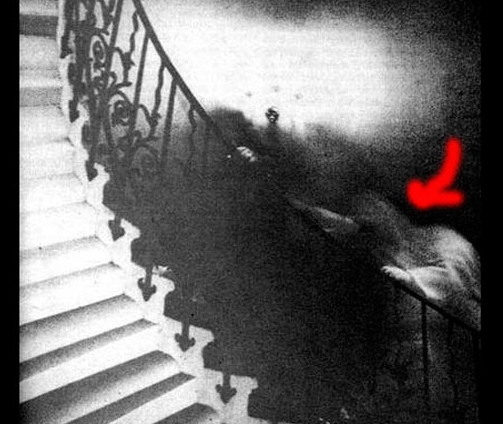
In 1966, a retired clergyman from Canada, Reverend Ralph Hardy, was on holiday in England. He decided to visit the National Maritime Museum in Greenwich, specifically the stunning Queen’s House. He was an amateur photographer, keen to capture the elegant beauty of the building. He had his camera. He saw a shot. A beautiful, spiraling staircase known as the “Tulip Staircase.” He raised his camera, aimed, and clicked the shutter. He had no idea he was about to take what many consider the most credible ghost photograph of all time.

When he returned home and developed the film, he froze. There, in his pristine photo of the empty staircase, was a figure. A shrouded, ethereal form, gripping the handrail with two distinct hands as it ascended. Or maybe descended. It’s hard to tell. What is clear is that it’s a full-bodied apparition, caught in the act of climbing.
Reverend Hardy swore up and down the staircase was empty when he took the picture. He was a man of the cloth, not a prankster. He sent the photo and the original negative back to the museum, and that’s when things got serious.
Deep Dive: The Bloody History of the Queen’s House
To understand the photo, you have to understand the place. The Queen’s House has a 400-year history soaked in whispers and strange events. Reports of ghostly activity go back centuries. Staff and visitors have reported hearing disembodied footsteps running near the staircase, seeing pale figures drift through rooms, and hearing the faint sounds of ghostly choirs.
One legend speaks of a maidservant, some say named “Maud,” who was thrown from the top balcony of the staircase, falling 50 feet to her death on the stone floor below. Was this her, forever replaying her final, terrifying moments? Or was it one of the other countless souls who passed through those royal halls?
The Un-debunkable Negative?
This wasn’t just some spooky picture passed around by friends. This was different. The photo and its original negative were handed over to a panel of experts. This wasn’t some backroom operation; we’re talking about specialists from the Kodak company. Their job was to find the trick. The double exposure. The chemical smudge. The camera flaw. Anything.
They found nothing.
After intense scrutiny, the official verdict came back: the negative had not been tampered with. It was not a double exposure. It was, as far as the world’s leading photography experts could tell, a legitimate photograph of… something… on the stairs that day.
The story exploded. It was featured in newspapers and magazines. It remains one of the few paranormal photos to have survived expert analysis with its mystery fully intact. Skeptics have tried. They suggest a slow shutter speed and someone walking up the stairs. But the figure is too defined in places, too ethereal in others. It doesn’t look like a simple motion blur. And why a shrouded figure? Who walks around a museum in a burial shroud?
Modern internet sleuths have brightened, sharpened, and analyzed the image for hours. Some claim to see the hint of a face. Others say it’s just a trick of light and shadow. But the original negative tells the tale. Something was there. Something the camera saw, even if the Reverend did not.
The Madonna of Bachelor’s Grove: A Lonely Soul in a Cursed Cemetery
Some places are just… wrong. They sit on the landscape like a scar, radiating a sense of unease. Bachelor’s Grove Cemetery, a small, abandoned graveyard on the outskirts of Chicago, is one of those places. It is widely considered one of the most haunted locations in the United States. And in 1991, it produced one of the most iconic paranormal photographs ever.
On August 10th, 1991, members of the Ghost Research Society (GRS), a respected paranormal investigation group, were exploring the notoriously active cemetery. One of their members, Mari Huff, was taking pictures throughout the deserted grounds. The place was empty, save for their small team. It was broad daylight.
But the pictures told a different story.

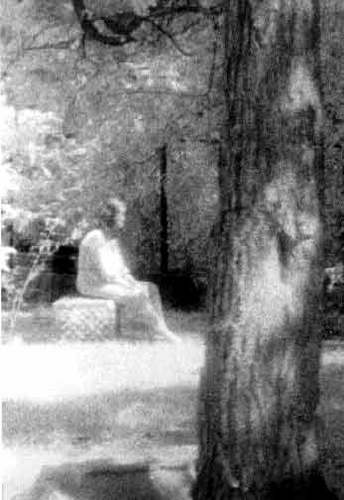
Upon developing the film, one photo stood out. It showed a lonely, translucent woman in old-fashioned clothing sitting on a tombstone. Her head is bowed. She seems lost in thought. Or perhaps in sorrow. The GRS team was adamant: no one was sitting on that tombstone when the photo was taken. They were the only people there.
A Place Steeped in Darkness
Bachelor’s Grove is not your average cemetery. Its history is a dark tapestry of chilling tales. During the Prohibition era, it was rumored to be a dumping ground for the victims of Al Capone’s mob. Stories of strange rituals, floating blue orbs of light, and even a phantom farmhouse that appears and vanishes have been told for generations. A ghostly black dog is said to guard the entrance. A “White Lady,” often seen carrying an infant, wanders the grounds on nights with a full moon.
The place is a magnet for the strange. So when the GRS investigated, they came prepared for anything. Except, perhaps, for this.
The Infrared Controversy
This wasn’t taken with a regular camera. Mari Huff was using high-speed infrared film, which is sensitive to light spectrums the human eye cannot see. Proponents of the photo argue this is key. They suggest that spirits or paranormal entities may exist on a different light frequency, a frequency that infrared film can accidentally pick up. Could this be photographic proof of another dimension layered on top of our own?
The figure itself is fascinating. She is semi-transparent; you can see the landscape and the tombstone right through her body. Yet parts of her, like her hair and the drape of her dress, have a solidity to them. It’s a paradox caught on film.
Is It Just a Woman on a Tombstone? The Great Debate
Now, let’s be honest. It looks like a woman sitting on a tombstone. Skeptics immediately cried foul. They claim it’s a staged photo, a simple double exposure, or just a living person deliberately posed for the shot. They point out that the GRS has a vested interest in producing “evidence.”
But the members of the GRS have stuck to their story for over 30 years. They are adamant the area was clear. And the nature of the image—the transparency—is difficult to fake with 1991 technology without it being obvious. If it’s a double exposure, why does the figure fit so perfectly on the tombstone? Why is the lighting consistent?
Known as the “Madonna of Bachelor’s Grove,” the lonely woman on the stone remains a fixture of paranormal lore. Is she a grieving mother? A lost soul tied to the cursed ground? Or a clever hoax that has fooled people for decades? The photo gives no answers. It just sits there, an image of profound and silent sadness.
The Phantom Monk of Newby Church: A Terrifying Intruder
Our final photograph is perhaps the most frightening of all. It’s not a subtle, ethereal shape. It’s not a translucent figure in the distance. This one is in your face. And it is terrifying.
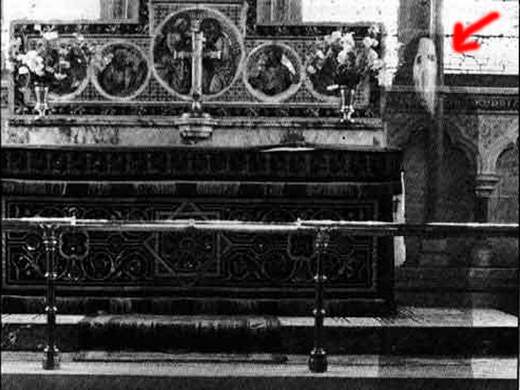
In 1963, Reverend K.F. Lord was photographing his church, the Church of Christ the Consoler, at Newby Hall in North Yorkshire, England. He was simply taking pictures of the interior, focusing on the altar. He saw nothing out of the ordinary. Just an empty church. Later, when he saw the developed print, he got the shock of his life.
Standing near the altar was a figure. A tall, menacing figure, shrouded in black, its face obscured by a white covering that looks chillingly like a mask or a skull. Its eyes are black voids. Its presence is overwhelming.
The “Specter of Newby Church,” as it came to be known, is controversial for one big reason: it seems too good to be true.
The Figure in the Frame: An In-Depth Look
The entity is estimated to be around 9 feet tall, based on its position relative to the altar. The pose is deliberate, almost confrontational, as if it is staring directly at the camera. The face… that face is pure nightmare fuel. It has a distorted, skeletal quality. The figure appears to be a 16th-century monk, though the face covering is deeply unsettling and not historically typical.
Like the Tulip Staircase photo, this image was sent to the experts. Photographic analysts examined the negative. They, too, concluded it was not the result of a double exposure. The figure is on a single plane, interacting with the light in the church in a way that suggests it was physically present when the shutter clicked.
The Case for a Hoax: Is This Just a Clever Trick?
Skeptics have had a field day with this one. They argue it’s so obviously a hoax that it’s laughable. The arguments are compelling:
- It’s a person in costume. The most common theory is that it’s simply someone dressed up. The “mask” could be just that—a Halloween mask. The shroud is just cloth. Someone was having a laugh at the Reverend’s expense.
- It’s a deliberate double exposure. Despite what the initial experts said, many modern photo analysts believe this can be achieved. By placing a costumed figure against a black backdrop in a studio, you could create a second image to superimpose onto the church photo.
- It looks fake. The biggest argument against it is its very nature. It’s too perfect. Too cinematic. Ghosts are supposed to be wispy and unclear. This thing looks solid. It looks like a monster from a movie.
But Reverend Lord always maintained his innocence. He was a man of God who claimed he had no idea how the figure got there. And there’s that pesky analysis of the negative. If it’s not a double exposure, then what is it? Did someone really dress up and stand there, nine feet tall, without the Reverend noticing?
The Newby Monk remains a true enigma. Is it one of the most incredible paranormal captures ever? Or is it one of the most audacious and successful hoaxes in photographic history? The camera caught something in that empty church. But was it a ghost from the past, or a prankster in the present?
Four photographs. Four impossible stories. They come from a time before digital manipulation was at everyone’s fingertips. They have been tested, analyzed, and debated for decades, yet they endure. They are glitches in the fabric of reality, captured on film. What truth do they hold? Perhaps they simply remind us that there are still shadows in the world that no amount of light can ever fully explain.