The Telepathic Internet: Did Zuckerberg Reveal Facebook’s Terrifying Final Goal?
You think your thoughts are private. Sacred, even. That little voice inside your head, the one that’s reading these words right now? It’s yours. It’s the last bastion of true self in a world of curated profiles and algorithmic feeds.
But what if it isn’t?
What if the endgame for social media isn’t just to know what you like, what you buy, or who you vote for? What if the goal is to get inside your head, to broadcast your every thought, your every feeling, your most buried memories, directly onto the network?
Sounds like science fiction. A crazy conspiracy theory. Right?
Then you haven’t been paying attention.
Years ago, in a seemingly innocent online Q&A session, Facebook CEO Mark Zuckerberg dropped a bombshell. A comment so audacious, so far-reaching, that most of the world just blinked and moved on. But some of us heard it. We understood. It wasn’t a prediction. It was a statement of intent.
He was talking about the future. He was talking about technology that would make everything that came before it—text, photos, even video—look like cave paintings. He was talking about the ultimate communication.
He was talking about telepathy.
The Prophecy in Plain Sight
Let’s rewind the tape. The year is 2015. Facebook has just shelled out a cool $2 billion for a virtual reality company called Oculus VR. At the time, everyone thought it was about video games. A fun, immersive toy. How naive we were.
During an online forum, someone asked Zuckerberg what he saw in the company’s future. His answer should have set off alarm bells in every capital city on Earth.
“One day, I believe we’ll be able to send full rich thoughts to each other directly using technology,” he said. “You’ll just be able to think of something and your friends will immediately be able to experience it too if you’d like. This would be the ultimate communication technology.”
Stop. Read that again.
Not just thoughts. “Full rich thoughts.” Not just an idea, but the emotion behind it. The sights. The sounds. The smells. He went on to describe a progression: from text, to photos, to video, to immersive VR… and then the final leap.
“And after that,” he continued, “we’ll have the power to share our full sensory and emotional experience with people whenever we’d like.”
This wasn’t some off-the-cuff remark. This was a roadmap. A blueprint for the colonization of human consciousness. The acquisition of Oculus wasn’t about gaming. It was about building the hardware bridge to the human brain. It was Step One.

Deep Dive: The Nightmare Tech Already Here
So, how could this even be possible? Is this just billionaire fantasy talk? Far from it. The technology, under the sterile name of Brain-Computer Interfaces (BCIs), is already here. And it’s advancing at a terrifying speed.
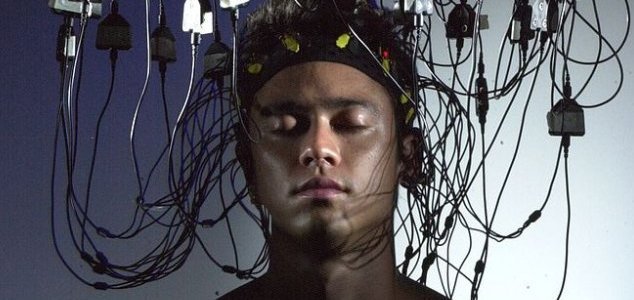
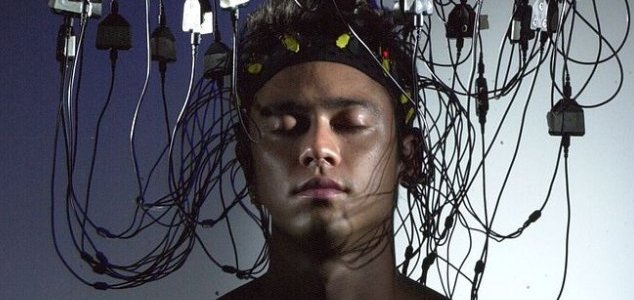
Think of a BCI as a translator. It’s a device that reads the faint electrical signals buzzing around your brain and converts them into digital commands a computer can understand. And it goes both ways.
Right now, scientists are using this for incredible things. People with paralysis can move robotic arms with their minds. They can type on screens just by thinking of the letters. It’s a medical miracle. But every miracle technology has a dark side. A military application. A corporate ambition.
There are two main flavors of BCI:
- Non-Invasive BCIs: These are the things you wear. Think of a cap covered in electrodes (an EEG) that rests on your scalp. It listens to the broad chorus of your brain activity from the outside. Meta’s own Reality Labs has been pouring hundreds of millions into wristbands that read the nerve signals traveling from your brain to your hand. They claim it’s for controlling your future AR glasses. A convenient excuse. What they’re really building is a high-fidelity mind-reader you willingly strap to your own body.
- Invasive BCIs: This is where it gets really chilling. This is the stuff of cyberpunk horror. Companies like Elon Musk’s Neuralink are developing thread-like electrodes to be surgically implanted directly into the brain tissue. They promise to cure blindness and paralysis. But the technology itself is a direct, high-bandwidth connection to your gray matter. A USB port for your soul. Musk might be the loud one, but do you honestly believe Meta, with its infinite resources, isn’t exploring the same path in some deep, dark, off-the-books laboratory?
The race is on. A new cold war, fought not for territory or nuclear arms, but for direct access to the human mind. And while Musk talks a big game about man-machine symbiosis, Zuckerberg’s vision is subtly, terrifyingly different. It’s not about enhancing a single human. It’s about networking *all* of them.
The Conspiracy: Is Social Media a Training Program for the Hive Mind?
This is where you have to zoom out and ask the big question. What if this isn’t about a future technology? What if the experiment has already begun?
Consider the modern social media feed. It’s not a neutral platform. It’s a finely tuned machine, an algorithm designed to learn you. It knows when you’re happy, when you’re angry, when you’re feeling lonely. It feeds you content to keep you in that emotional state, to keep you scrolling, to make you more predictable.
Is it such a leap to see this as a primitive BCI? A version 0.1?
The system isn’t reading your brainwaves yet, but it’s reading the next best thing: your behavior. Your clicks, your likes, your hesitations, the people you look at, the videos you re-watch. It’s building a digital model of your mind. A psychological twin. And it’s using that model to influence you, to shape your reality, to guide your thoughts.
Every time you react to a post, you’re teaching the machine. You’re training the AI that will one day form the backbone of this telepathic network. We are, all of us, willingly participating in the creation of our own prison.
And don’t forget the government angle. Organizations like DARPA, the Pentagon’s wild research wing, have been funding BCI research for decades. They call it things like the “Silent Talk” program, aimed at allowing soldiers to communicate telepathically on the battlefield. Where do you think that technology goes when the research grants run out? It trickles down to the private sector. It finds a home with corporations that have the data and the infrastructure to deploy it on a global scale.
Corporations like Meta.
Welcome to the Panopticon: A Future Without Secrets
Let’s play this out. Let’s imagine they succeed. Meta announces “TruTouch” or “ThoughtStream” or some other friendly, sanitized name. It’s a voluntary system, of course. At first.
What does that world look like? What are the consequences of broadcasting your “full sensory and emotional experience”?
Forget privacy. That concept is already on life support; this would be the final pull of the plug. Every fleeting thought, every private fantasy, every dark impulse, every embarrassing memory… it’s all just data on a server. Shareable. Hackable. Sellable.
Think about advertising. You’re already targeted based on your search history. Imagine getting an ad for a Coke injected directly into your consciousness, making you suddenly feel the thirst, the fizz, the sweet taste. You won’t see the ad; you’ll experience it as your own desire.
Think about law enforcement. Or thought police. Pre-crime divisions could monitor the network for “anti-social” or “subversive” thoughts. Before you even act, before you even speak, you could be flagged by an algorithm. Your own mind becomes a witness against you.
Hacking the Human Soul
The most horrifying possibility isn’t just reading thoughts. It’s writing them.
If you can build a two-way interface, you can send information back into the brain. You could implant a memory of a vacation you never took. You could delete the memory of a loved one. A hostile government could broadcast feelings of despair and apathy across an entire population. A corporation could make you feel an intense, artificial loyalty to a brand.
How would you know what’s real? How could you trust your own feelings if they could be manufactured and delivered to you like a push notification?
We wouldn’t be individuals anymore. We would be nodes in a network. A hive mind, directed and controlled by whoever owns the servers. Individuality, free will, the very concept of “self” would be rendered obsolete. We would be a programmable, predictable, perfectly managed herd.
This is the ultimate form of control. Not just controlling what you do or what you say, but controlling what you *are*.
But What If They’re Telling the Truth?
Every good conspiracy has a plausible cover story. The proponents of this future, the Silicon Valley utopians, will paint a very different picture. And we have to admit, it’s a seductive one.
Imagine, they’ll say, a world without misunderstanding. A world with perfect empathy. You could literally feel a starving child’s hunger or a refugee’s fear. Would wars even be possible if leaders could directly experience the suffering of soldiers on the other side?
Think about learning. Instead of spending years studying a language, you could just… download it. You could learn to fly a helicopter or perform surgery in a matter of moments, just like in *The Matrix*.
This technology could be the key to curing Alzheimer’s, depression, and PTSD. It could allow us to create art forms we can’t even conceive of today—sharing not just a song, but the raw emotion and inspiration the artist felt while creating it.
It’s a beautiful dream. A world without secrets, without lies, without loneliness. A world where we are all truly connected.
But history has shown us one thing, time and time again. Every tool of connection has been turned into a tool of control. The printing press brought propaganda. The radio brought demagogues. The internet brought mass surveillance and algorithmic manipulation.
Why would this be any different?
The Trail of Breadcrumbs Never Stopped
Since Zuckerberg’s 2015 “prophecy,” Meta’s actions have only confirmed this is their long-term trajectory. They’ve poured more money into Reality Labs than any other company on Earth has poured into… well, almost anything. Billions upon billions every single year, chasing the “metaverse.”
The metaverse, they tell us, is about virtual meeting rooms and cartoon avatars. It’s a lie. A cover story. It’s the perfect environment to develop and normalize the hardware that will eventually bridge the gap to our brains. They need to get us used to wearing their technology on our faces, on our wrists, on our bodies.
They’ve been caught funding controversial neurological research at universities. They file patents for “sensory feedback” systems and “emotion detection” in VR. Each is a small, explainable step. But when you lay them all out in a line, the destination is unmistakable.
It’s a slow, methodical march toward the future Zuckerberg laid out. A future where Facebook—or Meta, or whatever they call themselves next—isn’t just a place you visit on a screen. It’s a layer of reality you can’t escape. An operating system for your mind.
So the next time you scroll through your feed, lost in the endless stream of images and videos, take a moment. Feel the weight of the phone in your hand. And ask yourself a simple question.
Are you using it? Or is it using you?
The telepathic internet is coming. The only question left is whether we will be its masters, or its slaves.
Originally posted 2015-11-14 10:18:54. Republished by Blog Post Promoter