Home Alien Life Extraterrestrial life – the real search for aliens 2013

Extraterrestrial life – the real search for aliens 2013

0
56

Are We Alone? The Terrifying Truth Behind The Great Cosmic Silence

Look up.

Go ahead, on the next clear night, step outside and just… look. You see an ink-black canvas, splashed with a handful of glittering diamonds. But that’s a lie. A beautiful, comforting lie told by our tiny corner of the universe. What you’re really seeing is an abyss. An ocean of nothingness so vast it would shatter your sanity if you could truly comprehend it. And in that ocean, there are islands. Hundreds of billions of them. We call them galaxies.

And each galaxy holds hundreds of billions of suns. And around those suns spin worlds without number. Trillions upon trillions of planets. Some are fiery hellscapes. Others are frozen tombs. But some… some are just right.

So where is everybody?

This isn’t just a late-night thought experiment. It’s the single most profound and terrifying question humanity has ever asked. We’ve been screaming into the cosmic void for decades, listening with our giant radio ears for the faintest whisper of a reply. And the silence we’ve received in return is deafening. It’s a silence so complete, so absolute, that it suggests two possibilities, each more chilling than the last: we are completely and utterly alone, a biological fluke in an empty cosmos. Or… we’re not.

The Fermi Paradox: A Universe Teeming with Ghosts

Back in 1950, over lunch, the brilliant physicist Enrico Fermi asked that simple question: “Where is everybody?” He wasn’t talking about his lunch companions. He was talking about aliens.

His logic was brutally simple. Our sun is young compared to the universe. Our planet is just one of countless worlds. If life can happen here, it must have happened elsewhere, and likely billions of years before us. An alien civilization that got a one-million-year head start on us (a cosmic blink of an eye) should be so advanced they’d be like gods. Their technology would be indistinguishable from magic. They should have colonized the entire galaxy by now, leaving signs everywhere. Their radio signals should be filling the sky. We should be tripping over their probes, their artifacts, their cosmic graffiti.

But we see nothing. We hear nothing. This is the heart of the Fermi Paradox: the stark, screaming contradiction between the high probability of alien life and the total lack of any evidence for it.

What’s the answer? The potential solutions are the stuff of nightmares.

Deep Dive: The Great Filter Theory

Maybe the silence isn’t because life is rare. Maybe it’s because something is killing it off. This is the “Great Filter” theory. It proposes there is some kind of wall, some impossibly difficult evolutionary or technological step that almost no species can get past. The terrifying part is, we have no idea where on the timeline this filter lies.

  • Is the Filter behind us? Maybe the jump from non-life to simple life is the filter. Or the leap to complex, multi-cellular organisms. Or the development of intelligence. If so, we’re the first ones through. We won the cosmic lottery. The universe is our oyster.
  • Is the Filter ahead of us? This is the scary one. Maybe the filter is a challenge every advanced civilization faces. Nuclear self-annihilation. An out-of-control artificial intelligence. A catastrophic environmental collapse. Maybe every civilization that reaches our level of technology inevitably destroys itself. If this is true, the silence is a graveyard. And we’re next in line.

The Dark Forest and The Zoo Hypothesis

What if the problem isn’t science, but sociology? The “Dark Forest” theory, popularized by author Cixin Liu, paints a chilling picture. Imagine the universe as a dark forest full of silent hunters. Everyone is hiding. To make any noise, to reveal your location, is to invite your own destruction by a predator you can’t see and don’t understand. In this scenario, the silence is a survival strategy. The smartest civilizations are the quietest ones. And we’re the naive kid shouting “Hello?” into the woods.

Or maybe it’s the opposite. The “Zoo Hypothesis” suggests we’re being deliberately left alone. That Earth is a cosmic wildlife preserve, and advanced aliens are watching us from a distance, observing our development without interfering. We are an exhibit. An interesting, primitive species to be studied. They have a strict “look, but don’t touch” policy. Are they benevolent zookeepers? Or are they just waiting for us to do something interesting before they dissect us?

Decoding the Alien Phonebook: The Drake Equation

Okay, let’s get down to the numbers. In 1961, an astronomer named Frank Drake tried to put a formula to the great question. He wasn’t trying to get an exact answer, but to organize our ignorance. The Drake Equation is a way to estimate the number of active, detectable alien civilizations in our own Milky Way galaxy.

It looks complicated, but it’s just a string of probabilities multiplied together:

N = R* × fp × ne × fl × fi × fc × L

Let’s break that down, because this is the real recipe for finding ET.

  • R* = The average rate of star formation in our galaxy. We have a good handle on this one. It’s about one to three new stars per year. Easy enough.
  • fp = The fraction of those stars that have planets. When Drake first wrote this, it was a total guess. Now? Thanks to the Kepler Space Telescope and other planet-hunters, we know this number is high. REALLY high. It’s close to 1, meaning almost all stars have planets.
  • ne = The average number of planets that can potentially support life per star that has planets. This is the “Goldilocks Zone” – not too hot, not too cold, where liquid water could exist. Our own solar system has at least one (Earth), and maybe more (Mars in the past, maybe the moons of Jupiter and Saturn now). Estimates are all over the place, but it’s not zero.
  • fl = The fraction of those habitable planets that actually go on to develop life. This is a huge unknown. Does life pop up easily wherever the conditions are right? Or is Earth a one-in-a-trillion miracle? We have a sample size of one.
  • fi = The fraction of life-bearing planets that develop intelligent life. Another massive question mark. Life existed on Earth for billions of years before humans showed up. Is intelligence a common evolutionary outcome, or just a fluke?
  • fc = The fraction of intelligent civilizations that develop technology that releases detectable signs of their existence into space (like radio signals). Would all aliens build radio telescopes? Maybe they communicate with something we can’t even imagine.
  • L = The length of time for which such civilizations release detectable signals. This might be the most important and most depressing variable. How long does a technological society last? A few thousand years? A million? We’ve only been broadcasting for about 100 years. If the average civilization only lasts for a few centuries before blowing itself up, the chances of our listening window overlapping with their broadcasting window are astronomically small.

When you plug in optimistic numbers, the galaxy could be teeming with thousands, even millions, of civilizations. When you plug in pessimistic numbers, the answer is one. Us.

The equation doesn’t give us the answer. It shows us just how much we don’t know.

Hunting Grounds: Where Are We Looking?

So if they exist, where might they be? The search is happening on two fronts: in our own solar system, and in the deep, dark spaces between the stars.

Our Cosmic Backyard

We might not have to look far. Life, at least simple microbial life, could be hiding right under our noses.

  • Mars: The red planet was once a blue planet, with rivers, lakes, and maybe even an ocean. The Perseverance rover is currently drilling into an ancient river delta, looking for the chemical fossils of long-dead Martian bugs. We keep detecting mysterious plumes of methane gas in its atmosphere—a gas that, on Earth, is overwhelmingly produced by living things. Is something still alive, buried deep beneath the Martian sand?
  • Europa: This moon of Jupiter is a world of ice. But beneath that frozen crust, tidal forces from Jupiter’s immense gravity likely keep a vast, globe-spanning ocean of liquid saltwater warm. Here on Earth, life thrives in the deepest, darkest parts of our oceans around hydrothermal vents, completely cut off from sunlight. Could Europa’s hidden ocean be home to a whole ecosystem?
  • Enceladus: Saturn’s little moon Enceladus is even more tantalizing. Giant geysers erupt from its south pole, spewing water, ice, and organic molecules from a subsurface ocean out into space. The Cassini probe flew right through these plumes and tasted them. It’s like the moon is handing us a free sample of what’s inside.

Beyond the Sun

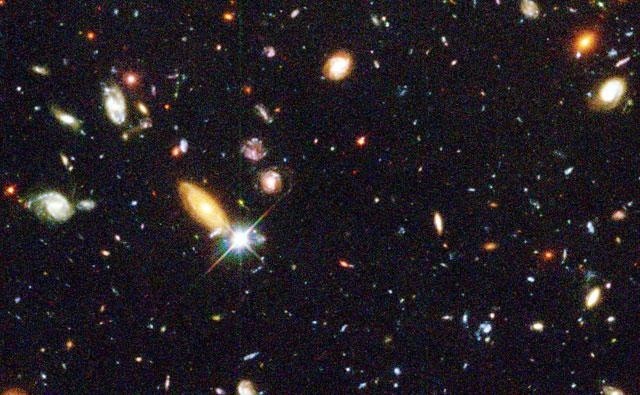
The real action is out there, in the countless planetary systems orbiting other stars. For centuries, these “exoplanets” were pure speculation. Now, we’ve confirmed the existence of more than 5,000 of them. And we’ve only just started looking.

20130613-221123.webp

The image above from the Hubble Space Telescope isn’t just a bunch of stars. Almost every single speck of light in that picture is an entire galaxy, each with billions of its own stars and planets. Could an advanced civilization exist in one of them? The odds seem to demand it.

The James Webb Space Telescope is a game-changer. It’s powerful enough to sniff the atmospheres of planets light-years away. We’re not looking for alien cities. We’re looking for “biosignatures.” Think of it as cosmic pollution. An atmosphere rich in oxygen and methane, for instance, would be a screaming sign of life, as those two gases shouldn’t exist together without some biological process constantly replenishing them. Finding that combination on a rocky, Earth-like world would be the biggest discovery in human history.

The Eavesdroppers: Listening for a Message

For over 60 years, a small group of dedicated scientists has been engaged in the Search for Extraterrestrial Intelligence, or SETI. They use massive radio telescopes to methodically scan the skies, listening for a signal that stands out from the cosmic background noise. A pattern. A beacon. Anything that says, “We are here.”

So far, mostly silence. But there was one time…

The “Wow!” Signal: The Phone Rang and Nobody Answered

On August 15, 1977, at the Big Ear radio telescope in Ohio, a signal came in. It was powerful. It was at a frequency that is largely forbidden for Earthly transmissions. It came from a blank patch of sky in the constellation Sagittarius. It lasted for 72 seconds, and then it was gone. It was so perfectly alien-like, so unlike any natural phenomenon, that when astronomer Jerry Ehman saw it on the computer printout, he circled it and wrote “Wow!” in the margin.

We’ve been pointing our telescopes back at that same patch of sky ever since. We’ve never heard it again. It remains the single most compelling, and most frustrating, potential alien signal ever detected. What was it? A secret military satellite? A bizarre, unknown natural event? Or did we, for one brief, shining moment, overhear a message not meant for us?

The Government Knows: UAPs and the Great Cover-Up

Let’s shift gears. What if the aliens aren’t light-years away? What if they’re already here?

For decades, this was the domain of tinfoil hats and late-night radio shows. Not anymore. In recent years, the United States government, the Pentagon itself, has officially acknowledged the existence of “Unidentified Aerial Phenomena,” or UAPs. They’ve released stunning cockpit videos from Navy fighter pilots showing objects that perform maneuvers that defy our known laws of physics. Objects that accelerate instantaneously, stop on a dime, and move without any visible means of propulsion.

A 2021 report from the Director of National Intelligence admitted that of 144 incidents studied, they could only explain one. The other 143 remain a complete mystery. The report didn’t say “it’s aliens,” but it also didn’t say it’s *not* aliens. The door, once firmly bolted shut, has been cracked open.

This raises some serious questions. How long have they known? Is this a new phenomenon, or have they been covering it up since Roswell in 1947? A famous (and controversial) government-commissioned study from 1960 called the Brookings Report actually warned that discovering proof of intelligent alien life could cause a global societal collapse. It could shatter religions, upend our sense of place in the universe, and cause panic.

Is that why there’s been decades of official denial and ridicule? Are they trying to protect us from a truth we can’t handle? Or are they hiding something else entirely? The official narrative is changing, and we need to ask why. And why now?

The Final Question: Are We the Children of the Stars?

Maybe the connection to alien life is even deeper. Maybe it’s in our own DNA.

The theory of “panspermia” suggests that life itself didn’t start on Earth, but was seeded here from space. That the basic building blocks, or even hardy microbes, hitched a ride on a comet or asteroid that crashed into the young Earth, planting the seed for everything that came after. In this sense, we would all be the descendants of aliens.

Some researchers at the National Institutes of Health have even extrapolated the genetic complexity of life on Earth backward in time, suggesting life in the universe may have begun a staggering 9.7 billion years ago—billions of years before our own planet even formed.

The universe is old enough for this to be possible. It’s old enough for civilizations to rise, conquer the stars, and fall to dust, all before the first cell divided on our world.

So we look up at the night sky, and we are left with the silence. A silence that could be an empty room. A silence that could be a warning. Or a silence that could be the patient, quiet observation of the zookeeper, waiting for the strange new primate to finally look up and see the bars of its cage.

The search continues. The question remains. And the silence is waiting for an answer.

Originally posted 2013-06-13 20:15:08. Republished by Blog Post Promoter