Home Unexplained Mysteries Modern Mysteries The strange legend of the Ninki-Nanka

The strange legend of the Ninki-Nanka

0
50

The Dragon of the Gambia: More Than Just a Myth?

Deep in the sweltering, bug-infested swamps of West Africa, there are stories. Whispers. Warnings passed down from one generation to the next, spoken with a mixture of reverence and raw terror. They speak of a creature that haunts the muddy banks of the Gambia River. A beast so ancient, so powerful, that its very name is a bad omen.

They call it the Ninki-Nanka.

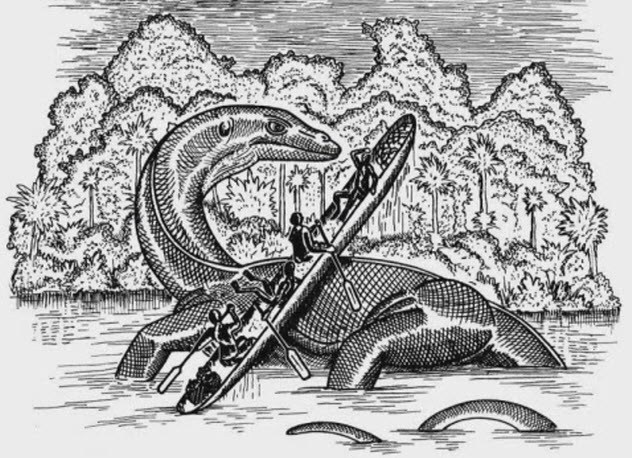
Forget your storybook dragons. This is something else entirely. Something primal. Something real, if you believe the accounts. For centuries, local villagers have described a colossal reptile, a monster that defies all known categories of zoology. The descriptions, pieced together from terrified eyewitnesses, paint a chilling picture. A creature with the body of a gigantic crocodile, but with a neck long and slender, almost like a giraffe’s. Its head? Strangely equine, like a horse. And its scales… they don’t just protect it. They shimmer. They shine with an otherworldly, metallic luster, sometimes described as being like mirrors or polished silver.

Some tales, the ones told late at night when the fire burns low, add even more terrifying details. Wings. A crest of sharp ridges running down its spine. And the most fearsome claim of all? That it can breathe fire, turning the dense jungle foliage to ash with a single, horrifying exhalation.

Is this just folklore? A boogeyman created to keep children away from the dangerous river? Or is something truly monstrous lurking beneath the murky surface of the water, a living relic from a forgotten age?

A Death Sentence in a Single Glance: The Ninki-Nanka Curse

Here’s where the story takes a turn from strange to genuinely terrifying. The Ninki-Nanka isn’t just a monster you see. It’s a monster you *survive*. Barely.

The core of the legend, the part that makes seasoned hunters tremble, is the curse. The locals are adamant: to look upon the Ninki-Nanka is to sign your own death warrant. There is almost no solid documentation, no photographs, no biological samples of the creature for one simple, bone-chilling reason. Those who see it are said to fall mysteriously ill and die soon after. Weeks. Sometimes days.

Is it a supernatural hex? A poison it emits into the air? Or is there a more rational, yet equally frightening, explanation? Perhaps the deep, isolated swamps where the creature is said to live are simply breeding grounds for deadly tropical diseases. A person who ventures deep enough to spot a Ninki-Nanka might also be exposing themselves to pathogens unknown to modern medicine. The monster becomes the face of the fever that claims them. The cause and effect become hopelessly, terrifyingly blurred.

This curse is the ultimate shield, protecting the creature from prying eyes and cameras. It creates a powerful social taboo against even searching for it. Why would you hunt for something that guarantees your own demise? It’s a perfect formula for a mystery that can never be solved. A monster that erases its own witnesses.

Boots on the Ground: The 2006 Expedition That Chased a Monster

Most Western scientists would dismiss these tales with a wave of the hand. Folklore. Myth. But not all of them.

Enter Richard Freeman. A former zookeeper and a leading cryptozoologist with the Centre for Fortean Zoology, Freeman is not the kind of man to be scared off by curses. He’s a monster hunter in the truest sense, a man who believes that behind many of our planet’s legends lies a core of biological truth. He famously suggested the Loch Ness Monster might be a species of giant, sterile eel, known to reach enormous sizes. He is a pragmatist chasing dragons.

In 2006, Freeman led an expedition into the heart of Gambia, determined to separate fact from fiction. His team wasn’t looking for a magical beast; they were searching for an unidentified animal. A species new to science. They plunged into the oppressive humidity, navigating the labyrinthine waterways, and did what so many before were too afraid to do: they started asking questions.

And people started talking.

The 165-Foot Nightmare

The team’s most stunning interview came from a man who claimed to have had a prolonged encounter with the beast. He wasn’t just a fleeting glimpse. He wasn’t a “friend of a friend” story. He looked Freeman’s team in the eyes and told them his truth.

He claimed the creature he saw was 45 meters long. Let that sink in. That’s 165 feet. Longer than a blue whale. Longer than three school buses parked end-to-end. A true behemoth. He said he hid, paralyzed by fear, and watched the creature for nearly an hour as it moved through the water. He described its immense bulk, the strange horse-like head, and the way the sun glinted off its scales.

But the encounter came with the legendary price. Soon after, he fell violently ill. A wasting sickness took hold, and he was certain he was going to die. It was only, he claimed, a powerful potion given to him by an Islamic holy man that broke the “curse” and saved his life. Was it a miracle cure? Or a traditional remedy for a known tropical illness? To the witness, there was no question: he had looked upon the Ninki-Nanka and had narrowly escaped death.

Rampage at the Pumping Station

Another account was even more bizarre, sounding like a scene ripped from a monster movie. A group of workers at a remote pumping station had their own run-in with the impossible. They told Freeman’s team that a Ninki-Nanka had emerged from the swamps and gone on a rampage, stampeding through their equipment and causing massive destruction.

In a moment of either genius or sheer desperation, the workers discovered an unlikely weapon. They grabbed a large mirror. As they presented it to the raging beast, it suddenly stopped. It saw its own reflection and, apparently horrified by its own monstrous appearance, it fled back into the jungle.

The story, however, has a dark footnote. One man involved in the incident saw the creature again a short time later. Two weeks after that second sighting, he was dead. The curse, it seemed, had come to collect.

Proof in Hand? The Crushing Reality of the ‘Dragon Scales’

For any cryptozoologist, stories are just the beginning. You need proof. Hard, physical evidence. A bone. A tooth. A photograph. Or, in this case, a scale.

During their investigation, Freeman and his team were presented with what they had only dreamed of. A local showed them what he claimed were actual scales from the Ninki-Nanka. The moment must have been electric. Was this it? The piece of evidence that would blow the world of zoology wide open? The proof that a monster of myth was a creature of flesh and blood?

niki-naga

They took the sample, handling it with extreme care. The anticipation was unbearable. But under closer inspection, the dream crumbled into dust. The “scales” were not biological at all. They were nothing more than rotted, flaking pieces of old celluloid film. The kind of material that, after decaying in a swamp for years, could easily be mistaken for something organic and strange. It was a crushing disappointment. The expedition ended without definitive proof, leaving the Ninki-Nanka shrouded in mystery once more.

Unmasking the Monster: What Is Hiding in the Swamps?

So, if it’s not a mythical dragon, what are people seeing? A man like Richard Freeman doesn’t believe that every witness is lying. He believes they are seeing *something*. The question is, what?

Theory #1: The Monitor Lizard on Steroids

This is Freeman’s own pet theory. He suspects the Ninki-Nanka might be a species of undocumented monitor lizard, or a known one that has grown to a truly terrifying size. Think about it. The largest lizard on Earth, the Komodo dragon, can reach 10 feet long. Is it so crazy to think that in the vast, unexplored swamps of West Africa, a related species could grow even larger?

Island gigantism is a known phenomenon where creatures in isolated environments grow to enormous sizes. Could “swamp gigantism” be a thing? A 20, 30, or even 40-foot monitor lizard would be a horrifying sight. It would be powerful, reptilian, and utterly unknown to science. It fits the general description of a large, crocodile-like body and could explain the sightings of a creature that is clearly not a crocodile.

Theory #2: A Prehistoric Ghost?

This is the theory that gets everyone excited. Could the Ninki-Nanka be a living dinosaur? The idea isn’t as wild as it sounds when you consider other African cryptids. The famous Mokele-mbembe of the Congo is often described as a sauropod-like creature. The description of the Ninki-Nanka, with its massive body and long, slender neck, certainly matches the profile of a small sauropod dinosaur.

Could a population of these animals have survived the mass extinction event in the deep, isolated jungles of Africa? It’s a continent that still holds vast, unexplored regions. It’s a long shot. A very long shot. But the possibility, however remote, is just too tantalizing to ignore.

Theory #3: A Case of Mistaken Identity

The swamps of Africa are home to some very large and very real animals. The African rock python can grow to lengths of over 20 feet. Could a truly massive specimen, seen swimming with only parts of its body visible, be mistaken for something more? The “shining scales” could simply be wet skin glistening in the sun. A python’s head, seen from a distance, could appear strange and unfamiliar.

What about a very large crocodile? While locals would surely recognize a normal crocodile, a specimen with a mutation or injury, or one that has grown to a record-breaking size, might be perceived as something else entirely. Fear has a way of twisting perception, turning a familiar animal into an unfamiliar monster.

The Whispers Continue: Is the Ninki-Nanka Still Out There?

The 2006 expedition may have ended without a body, but it didn’t end the story. If anything, it reignited global interest in this terrifying legend. In the age of the internet, the search has gone digital.

Obscure forums and cryptozoology websites are filled with threads dissecting the legend. People pour over satellite images of the Gambia River, looking for strange shapes in the water. In 2018, a grainy video briefly made the rounds, allegedly showing a long neck breaking the surface of a remote tributary. It was quickly—and probably correctly—debunked as a floating log, but for a moment, believers held their breath.

The stories haven’t stopped. Local fishermen still speak of strange disturbances in the water, of something massive moving just below the surface. The warnings to children are still spoken with the same gravity. The legend is alive, breathing, and waiting.

Perhaps the Ninki-Nanka is just a story. A potent combination of folklore, misidentification, and the very real dangers of the African wilderness. A way for the human mind to put a face to the nameless fears that lurk in the dark water.

Or maybe… just maybe… there’s a reason the curse exists. Maybe there is a creature out there so perfectly adapted to its environment that its greatest defense is the terror it inspires. Maybe something ancient and unknown is still swimming in the muddy waters of the Gambia. And maybe it’s best we never find it.

Originally posted 2016-04-09 16:15:07. Republished by Blog Post Promoter