We look up at the stars and wonder if we are alone. We spend billions sending rovers to Mars, listening for radio signals from the Andromeda galaxy, and dreaming of warp drives. But while our eyes are fixed on the void of space, we are ignoring the alien world right beneath our feet.
There is a monster sleeping in the Pacific. And in 2016, a team of scientists decided to poke it.
They weren’t looking for Godzilla. They were looking for the limits of life itself. The mission? To drill deeper, hotter, and more dangerously than almost anyone had ever dared before. The location? The Nankai Trough. A place known not just for its depth, but for being one of the most seismically unstable, earthquake-generating zones on the planet.

The Mission to the Center of the Earth (Almost)
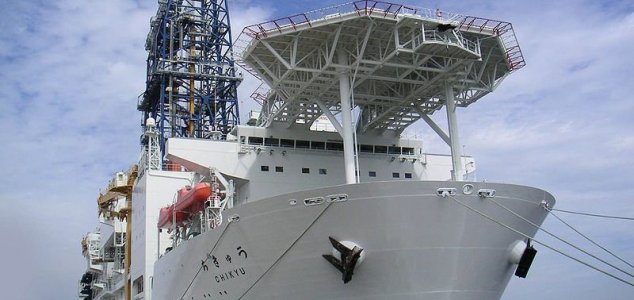
Let’s set the scene. It’s September 2016. The scientific community is buzzing. But this isn’t about a rocket launch. It is about the Chikyu. This isn’t just a boat. It is a floating fortress of science, a Japanese drilling vessel that looks more like an oil rig crossed with a spaceship than a ship. It was built for one thing: to rip through the Earth’s crust.
The target was a specific patch of the ocean floor, roughly 60 miles off the coast of Japan. The water there is deep. About 2.9 miles (4.7 kilometers) deep. That’s crushing pressure. Enough to flatten a car into a pancake. But that was just the starting line.
The goal wasn’t just to touch the bottom. It was to punch a hole 0.75 miles (1.2 kilometers) into the seabed. Through the mud, the rock, and the sediment, driving down toward the mantle.
Why? To find the “biotic fringe.” The edge of death.
The T-Limit: Where Life Burns Up
Scientists call it the “Temperature Limit” or T-Limit. We know life is stubborn. We find bacteria in nuclear waste. We find strange worms in hydrothermal vents. But there has to be a point where it simply gets too hot for biology to hold together. Where proteins cook and DNA snaps.
The Chikyu team wanted to find that line. They were hunting for the absolute bottom limit of the deep sub-seafloor biosphere. The theory was that as they drilled deeper, the temperature would spike. At some point, around 120 to 130 degrees Celsius (roughly 248-266 degrees Fahrenheit), life should stop. It should be a sterile zone. Dead rock.
But what if it wasn’t?
“We may discover some unknown life forms that can survive or adapt to the extremely challenging deep and hot sedimentary environment,” said Fumio Inagaki, the expedition’s co-chief scientist at the time. Read that again. Unknown life forms.
The Hollow Earth vs. The Deep Biosphere
This is where things get wild. For centuries, conspiracy theorists and alternative history buffs have talked about the “Hollow Earth.” The idea that a civilization, or at least a complex ecosystem, exists inside our planet.
Science laughs at the idea of a literal hollow ball with a sun in the middle. But here is the crazy part: Science has proven that the Earth is technically alive on the inside.
It’s not dinosaurs and Nazis riding T-Rexes. It’s biomass. A staggering amount of it. Recent studies suggest that the “Deep Biosphere”—the microbes and zombies bacteria living deep inside the Earth’s crust—might outweigh all the life in the oceans combined. Think about that. There might be more living matter inside the rock than there is walking on the surface.
“The nature and extent of the deep sub-seafloor biosphere is still largely unknown,” Inagaki admitted. We are sitting on top of a biological dark matter mystery.
The Zombie Bacteria
What the Chikyu and other drilling projects have found over the years is terrifying in a beautiful way. They have found microbes that operate on time scales we can’t comprehend. On the surface, bacteria replicate in minutes. Down there? They might divide once every thousand years. They are barely alive. They are in a state of suspended animation, sipping on chemical energy from rocks, surviving pressures that should turn them to paste.
If the Chikyu drilled deep enough, would they find the ancestors of all life? Many researchers believe life didn’t start in a warm pond on the surface. They think it started inside the crust, protected from the asteroid bombardments of the early Earth. We might be the aliens who crawled out of the underground.
The Technology: A Moonshot at Sea
It is easy to underestimate how hard this is. You cannot just drop a long straw into the water and start sucking up dirt.
Kai-Uwe Hinrichs, the researcher who authored the proposal for this massive undertaking, didn’t mince words. He compared it to leaving the planet.
“This expedition is as complex as a mission to outer space might be,” Hinrichs said.
Consider the logistics. You are floating on a moving ocean. You have to lower a drill bit through 4 kilometers of water. That string of pipe is heavy. It sways with the currents. Then, you have to hit a specific spot on the bottom with pinpoint accuracy. It’s like trying to lower a thread into the eye of a needle from the top of a skyscraper—while a hurricane is blowing.
Once you hit the bottom, the real work starts. You drill through ancient sediments. You have to bring those samples back up without contaminating them. If a single bacteria from the ship’s deck gets onto the sample, the whole science experiment is ruined. They needed pristine, untouched cores from the deep past.
Hinrichs explained the nightmare logistics: “It requires the technology to ‘land’ the coring bit on the right spot in over 4-kilometer-deep water, drill through ancient ocean sediments to collect samples far below the ocean floor, bring them back onboard intact, then transport them by helicopter to the super-clean geomicrobiology laboratory.”
Helicopters. Super-clean labs. Floating cities. This wasn’t cheap.
Poking the Dragon: The Danger of the Nankai Trough
Here is the angle the mainstream news often glosses over. The location. Why drill in the Nankai Trough?
The Nankai Trough is a subduction zone. It is where the Philippine Sea Plate is shoving itself under the Eurasian Plate. It is a geological violent crime scene. This area is responsible for massive megathrust earthquakes and tsunamis that have devastated Japan throughout history.
Some conspiracy theorists roared when this mission launched. “They are drilling into a fault line! Are they trying to trigger a quake?”
While geologists insist that a drill bit is too small to trigger a tectonic shift (like a mosquito biting an elephant), the fear is understandable. We are monkeying around with the stress points of the planet. The Chikyu was also there to install sensors. Monitoring devices. Listening ears. They want to predict the “Big One.”
But there is a darker “What If” here. What if the deep biosphere plays a role in earthquakes? Some fringe theories suggest that deep-earth gas releases or biological lubrication between plates actually influences when they slip. By drilling in, are we observing the process, or interfering with it?
The Shadow Biosphere
Let’s get back to the aliens. Not the ones from space. The ones from here.
There is a hypothesis known as the “Shadow Biosphere.” It suggests that life may have evolved more than once on Earth. We are Carbon-based life, using DNA and RNA. But what if there is life down there that doesn’t follow our rules? Life based on silicon? Or life that uses a completely different genetic code?
Standard tests look for DNA. If there is life down there that doesn’t use DNA, we wouldn’t even see it. We would drill right through it and call it dirt.
The Chikyu expedition was hunting for the limit of carbon-based life. But when Inagaki spoke of “unknown life forms,” the imagination runs wild. If life can survive at 120 degrees Celsius, under 1,000 atmospheres of pressure, living off of sulfur and methane… what else can it do?
Recent Discoveries and the Modern Context
Since this 2016 expedition, the mystery has only deepened. In 2020 and beyond, scientists analyzing samples from similar deep-sea drills found microbes that were essentially “waking up” after 100 million years. They fed them, and they started growing. 100 million years!
That means the creatures found by the Chikyu might have been alive when the T-Rex was walking around. They have been down there, waiting, while continents shifted and civilizations rose and fell above their heads.
High Risks, High Rewards
“This expedition is fraught with complexity, danger and vast opportunity for discovery,” Hinrichs noted. He wasn’t exaggerating.
The danger isn’t just mechanical failure. It’s the pressure. It’s the hydrogen sulfide gas pockets that can explode up the drill pipe. It is the unforgiving ocean.
But the opportunity? It is the chance to rewrite the biology textbooks. If we find life deeper than we thought possible, it changes the odds for finding life on Mars, or on Jupiter’s moon Europa. If life can thrive in the hellish oven of the Nankai Trough, it can thrive in the subsurface oceans of an ice moon.
What Are They Hiding?
We have to ask the question. Governments and massive organizations don’t spend hundreds of millions of dollars just out of curiosity. There is always a practical angle.
Resources. Methane hydrates. The “fire ice” trapped in the sea floor. Japan is resource-poor. The Nankai Trough is loaded with methane hydrates. Is the search for “life” a cover for a massive survey of future fuel sources? If they can figure out how to mine the trough without triggering a tsunami, Japan solves its energy crisis for a century.
Or perhaps it is something more obscure. Pharmaceutical companies are desperate for new antibiotics. The surface of the earth has been picked clean. But the deep biosphere? It is a war zone of chemical warfare between ancient bacteria. The next cure for cancer or the super-bug antibiotic might be hiding in the sludge brought up by Chikyu.
The Bottom Line
The Chikyu expedition of 2016 was a pivotal moment in our understanding of the planet. It was a journey into the dark. A dive into the pressure cooker.
They drilled 0.75 miles into the floor, below 2.9 miles of water. They pushed the limits of engineering and biology. And while they may not have found a hidden civilization of lizard people, they found something arguably more profound: proof that life is relentless.
We live on a thin crust of cold rock floating on a sea of magma, and in between, there is a layer of life that refuses to die. It waits in the dark. It survives the heat. And it outlasts us all.
So the next time you look at the ocean, don’t just think about the waves. Think about what is happening three miles down, inside the rock. The Earth is deep. And we have barely scratched the surface.
Originally posted 2016-09-16 17:11:03. Republished by Blog Post Promoter