Saturday, April 11, 2026
HomeWeird WorldSpaceEuropean Space Agency's Goce satellite falls to Earth

European Space Agency’s Goce satellite falls to Earth

The Ferrari From The Stars: What Really Crashed Into The Ocean Near The Falklands?

It began as a whisper, then a roar. A one-tonne, billion-dollar masterpiece of engineering, hurtling out of the black. It had no pilot. No brakes. And it was heading straight for us.

The official story is neat. Tidy. Sanitized for public consumption. They tell you the European Space Agency’s GOCE satellite simply ran out of fuel and met its fiery end, a planned and predicted demise. A spectacular but harmless light show over a remote patch of ocean.

But that’s not the whole story. Not even close.

When you start pulling at the threads of the official narrative, the whole thing unravels. The location. The timing. The strange silence after the crash. It all points to something else. Something they didn’t want us to see. Something they buried at the bottom of the South Atlantic.

They called it the “Ferrari of space.” And like any good mystery involving a high-performance machine, this one starts with a crash. But the real question is… was it an accident? Or was it a burial?

20131112-190357.webp

The Official Story: A Groundbreaking Gravity Mapper

Before we journey down the rabbit hole, we have to understand what GOCE was supposed to be. On the surface, its mission was pure science, a quest for knowledge that sounds almost poetic. GOCE, which stands for Gravity Field and Steady-State Ocean Circulation Explorer, was launched in 2009 with a singular, ambitious purpose: to map Earth’s gravity like never before.

You probably think of gravity as a constant force. A simple number. But it’s not. Our planet isn’t a perfect, uniform sphere. It’s a lumpy, messy ball of rock and water, with mountains, deep ocean trenches, and shifting densities in its molten core. All of these things create tiny, almost imperceptible variations in the pull of gravity across the globe.

Earth’s Lumpy Secret

GOCE’s job was to measure these minute differences. To create what scientists call a “geoid”—a model of the global mean sea level, the true shape of our world if it were covered only by water, influenced by gravity alone. Think of it as Earth’s lumpy potato shape. Knowing this shape is fundamental to understanding our world. It affects ocean currents, which drive climate. It gives us clues about the movement of magma deep underground, potentially helping to predict volcanic eruptions and earthquakes. It’s the baseline for everything.

To do this, GOCE had to fly low. Dangerously low.

Most satellites cruise hundreds, even thousands of kilometers up. GOCE orbited at a breathtakingly low 224 kilometers (about 139 miles). At that altitude, it was constantly being dragged down by the wisps of Earth’s upper atmosphere. It was essentially flying through a never-ending headwind.

Deep Dive: Why Was GOCE So Special?

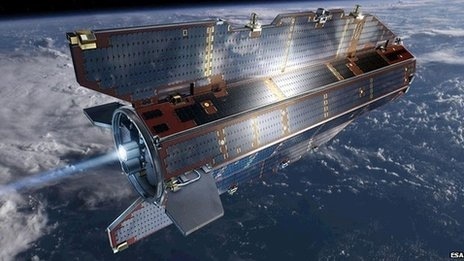
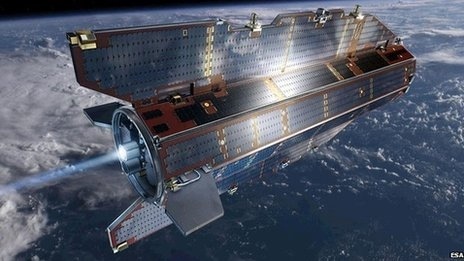
This is where the “Ferrari” nickname comes in. GOCE wasn’t a clunky box with solar panels slapped on the side. It was a masterpiece of aerospace design. Five meters long and arrow-shaped, it was built to slice through the atmosphere with minimal drag. It had fins for stability, giving it the appearance of a futuristic missile.

But its real party trick was the engine.

The Xenon Ghost Engine

To fight the constant atmospheric drag, GOCE couldn’t use traditional rocket thrusters; they were too powerful and would burn out in days. Instead, it used a revolutionary ion engine. This engine worked by using electricity to accelerate charged particles—ions—of xenon gas, creating a tiny but continuous whisper of thrust. It was a ghost engine, pushing with the force of a single snowflake landing in your hand. But over time, that gentle, constant push was exactly what was needed to keep the satellite from falling out of the sky.

For over four years, this worked perfectly. GOCE orbited the Earth, its state-of-the-art gradiometer measuring gravity with a precision that was 100 times better than any previous mission. It gave us the most detailed gravity map in human history. A stunning achievement.

And then, in October 2013, the xenon ran out. The ghost engine fell silent. The Ferrari was out of gas. And the long fall home began.

The Final Plunge: A Perfectly Tracked “Accident”

The European Space Agency knew this was coming. The mission was always meant to end this way. As GOCE began its descent, they spun up a massive public relations campaign. This wasn’t a disaster, they assured us. It was a unique scientific opportunity.

The Inter-Agency Space Debris Coordination Committee—a global forum on the ever-growing problem of “space junk”—selected GOCE as its special study project for 2013. This is a key point. It means that every major space-faring nation turned its tracking facilities towards this one falling object. A constellation of ground-based radar, telescopes, and surveillance systems followed GOCE’s every move.

Operation Global Watch

They watched it drop from 224km. They watched it hit 180km. They tracked it as the drag intensified, pulling it down faster and faster. They knew its speed, its trajectory, its spin. They knew *everything*.

The last signal was received at 10:42 PM GMT on a Sunday night, as the satellite passed just 121km over the icy expanse of Antarctica. Then, silence.

A little over an hour later, data from the United States Strategic Command (USSTRATCOM) confirmed the end. At 12:16 AM GMT on Monday, November 11th, at an altitude of about 80km, GOCE began to break apart. The official report states that the surviving debris—and they fully expected debris to survive—crashed into the South Atlantic Ocean.

The specific location? Just east of Tierra Del Fuego, south of the Falkland Islands.

And that’s where the story should end. A successful mission, a predictable re-entry, and a harmless splashdown in one of the most remote places on Earth. Case closed.

But that’s where the real questions begin.

Where The Official Story Crumbles: The Vanishing Debris

Think about it. You have a billion-dollar satellite. It’s filled with cutting-edge technology, including a gradiometer made of advanced carbon-carbon composite materials specifically designed to be incredibly tough and heat-resistant. Pre-re-entry models predicted that as much as a quarter of the satellite’s one-tonne mass—that’s 250 kilograms, or 550 pounds—would survive the fiery fall.

That’s not a pebble. That’s the weight of a motorcycle falling from the sky. Multiple pieces of highly advanced, identifiable hardware.

You have a global network of the world’s most sophisticated tracking systems pinpointing its descent with incredible accuracy. They told the public, with confidence, exactly where it was going to land.

So where is it?

The Unseen Splashdown

No recovery effort was ever announced. No photographs of floating wreckage ever surfaced. No fisherman reported finding a strange, futuristic-looking piece of metal in their nets. Nothing.

The 550 pounds of advanced space hardware simply vanished. Swallowed by the sea.

The official explanation is that the area is remote and the ocean is deep. It’s not worth the effort to go looking. But does that make any sense? This was a prime opportunity to study the effects of atmospheric re-entry on modern spacecraft materials. To compare the real-world debris with their computer models. The scientific value of recovering even a single piece would have been immense.

Unless… unless they didn’t want anyone to find it. Unless the goal wasn’t to study the debris, but to make sure it was never, ever seen by human eyes again.

The Falklands Connection: A Coincidence Too Convenient?

Let’s talk about the location. The South Atlantic, just south of the Falkland Islands. Of all the places on a planet that is 70% water, it ended up there.

This is not a random patch of blue. It is one of the most politically and militarily sensitive regions in the world. The 1982 Falklands War between the United Kingdom and Argentina is still a fresh wound. The area is a strategic chokepoint, a gateway to Antarctica, and it is heavily monitored by naval and air forces from several nations.

Dropping a piece of high-tech space hardware into this hornet’s nest seems, at best, careless. At worst, it seems deliberate.

What if GOCE’s mission wasn’t just about mapping the geoid for climate scientists? Gravity mapping also has powerful military applications. It’s used for cruise missile guidance. It’s used for submarine navigation, allowing them to move silently without surfacing for a GPS fix. It can even be used to detect underground structures, like hidden bunkers or secret submarine pens.

Did GOCE map something it shouldn’t have in this volatile region? Did it stumble upon a secret that one of the world’s powers wanted to remain hidden? Guiding its wreckage into the deep ocean nearby would be the perfect way to erase the evidence, all under the plausible cover of a predictable, end-of-life de-orbit.

Whispers From The Ice: The Antarctic Enigma

And then there’s the final data transmission. The last time GOCE phoned home, it was over Antarctica. Again, not just any random place.

For decades, researchers and conspiracy analysts have been fascinated by a massive gravity anomaly in Antarctica. The Wilkes Land anomaly, a gigantic mass concentration hidden beneath miles of ice, detected by—you guessed it—gravity-measuring satellites. The feature is huge, over 150 miles across, and sits inside an even larger impact crater.

Theories about what it is range from a massive, unusually dense meteorite fragment to something far more exotic. Whispers on internet forums and in alternative history circles speak of a buried city, a crashed UFO, a hollow-earth entrance. Mainstream science, of course, dismisses these ideas.

But GOCE was the most sensitive gravity-mapper ever built. It flew lower and saw with greater clarity than any satellite before it. As it passed over Antarctica on its final, dying orbits, what did it see? Did it get a high-resolution peek at the Wilkes Land anomaly that revealed something paradigm-shattering? Something that could not be allowed to get out?

The timeline is almost too perfect. The satellite makes its final pass over the biggest gravity mystery on the planet, and then, mere hours later, it is permanently silenced and its remains are dumped into an oceanic abyss. It feels less like a coincidence and more like a carefully executed cleanup operation.

What They Don’t Want You To Know

When you step back, the official story of a routine satellite re-entry looks like the thinnest of covers for something much deeper. Let’s consider the possibilities the mainstream media and space agencies will never discuss.

  • A Guided Execution: Was the re-entry truly “uncontrolled”? With its aerodynamic fins and the last dregs of its fuel, could GOCE have been subtly guided to a specific, pre-determined crash site? A controlled demolition disguised as a random accident.
  • A Secret Recovery: What if the debris *was* recovered? A naval vessel, perhaps a submarine, waiting in the cold waters of the South Atlantic. It wouldn’t be on any public shipping manifests. It would arrive, retrieve the critical components from the deep, and disappear, all while the world was being told it was lost forever.
  • A Message in the Fall: Perhaps the crash itself was a message. A demonstration of technological capability. “We can drop anything, anywhere on the planet, with pinpoint precision.”

The story of GOCE is a stark reminder that what we are told is often just a simplified, palatable version of the truth. We are told about a “Ferrari of space” that ran its course and died a noble death. But the evidence points to a different story. A story of secrets hidden in gravity, of geopolitical intrigue in the iciest parts of the world, and of a deliberate burial at sea.

The truth about what GOCE found, and why it was so hastily scuttled, is likely lying right where they left it. Two miles down. In the cold, dark, crushing pressure of the South Atlantic. The perfect place to hide a secret. Forever.

Amit Ghosh
Amit Ghoshhttps://coolinterestingnews.com
Aloha, I'm Amit Ghosh, a web entrepreneur and avid blogger. Bitten by entrepreneurial bug, I got kicked out from college and ended up being millionaire and running a digital media company named Aeron7 headquartered at Lithuania.
RELATED ARTICLES
- Advertisment -

Most Popular

Recent Comments

Warren Pan Abbott on The legend of the Devil Monkey !
chris davies on The McPherson Tape Mystery
Reed Reedly on ET has Internet!
Bea Houseoffashion on Proof Of Time Travellers – Gallery
Marcus2012 on ET has Internet!
Reed Reedly on ET has Internet!
LaughsAtConspiracyNuts on The 9/11 Conspiracy – Myths and Facts
Alex Sliverman on Did the ancients fly?
Doctor Wholigan on Time Traveler in 1938 film
chris davies on The McPherson Tape Mystery
Archie1954 on 10 secret UFO hideouts
chris davies on Ghosts of flight 401
Marcus2012 on ET has Internet!
jason Macdonald on Proof of Time Travel? – China
chris davies on Long-Lost Pyramids Found?
Reed Reedly on ET has Internet!
Milkman on Connected Universe
Tenmiles on Baigong Pipes Mystery
Simon Foster on Sirius – The Documentary
From the 1st April on 2013 – Alien Contact date ?
SkyWatcher on Is ET ignoring us?
I Come From The Future on Obama to make UFO Alien disclouser soon ?
ÛñK?øWn on 2013 – Alien Contact date ?
Just another person on 2013 – Alien Contact date ?
Malcolm Windowcleaner on The strange case of Rudolph Fentz
Mason Servio on Strange Things on Mars
Marke Wisdom Seeker on What will we find as arctic melts?
Andrea A Elisabeth Levyne on Aliens Captured in Varginha, Brazil
Mitch Grouyeki on Amazing Space Shuttle pictures