Saturday, June 6, 2026
HomeWeird WorldSpaceEuropa Moon, Are we alone in the universe?

Europa Moon, Are we alone in the universe?

The Ice Moon Bleeds: Has Jupiter’s Moon Europa Just Revealed Its Ultimate Secret?

There are places in our solar system that whisper of secrets. Mars, with its dusty, ancient riverbeds. Titan, shrouded in a thick, organic haze. But none of them scream with the chilling, tantalizing promise of Europa.

It’s a tiny, brilliant white moon orbiting the gas giant Jupiter. A cue ball in the cosmos. Frozen. Silent. Dead.

Or is it?

For decades, a wild idea has gripped the imagination of scientists and dreamers alike. The idea that beneath that impossibly thick shell of ice lies a secret. A vast, global ocean of liquid saltwater. An ocean with more water than all of Earth’s oceans combined. An ocean that has been locked away in absolute darkness for billions of years.

It was always just a theory. A ghost story told with magnetic field data and gravitational models.

Until now.

Because something just happened. Something that changes the game entirely. The Hubble Space Telescope, our tireless eye in the void, stared at Europa. And it saw the moon bleed.

A Ghost in the Machine: The Day the Geysers Appeared

Imagine the scene. A team of scientists, led by Lorenz Roth of the Southwest Research Institute, huddled over faint spectrographic data from Hubble. They weren’t looking for a smoking gun. They were looking for a faint hint, a chemical whisper in the faint ultraviolet light reflecting off Europa’s atmosphere.

And then they saw it.

A ghost. A phantom plume of water vapor, erupting from the moon’s south polar region. It wasn’t a trickle. It was a colossal geyser, blasting into space at incredible speeds, reaching an altitude of over 125 miles. That’s more than 20 times the height of Mount Everest. A pillar of water, born in a hidden sea, touching the vacuum of space.

This wasn’t just evidence. This was a cosmic invitation. A signpost flashing in the dark, saying, “The water is here. Come and get it.”

John Grunsfeld, NASA’s top science official at the time and a former astronaut who had personally serviced the very instrument on Hubble that made the discovery, understood the implications instantly. “If there’s a geyser 200 kilometers tall, and you could fly a spacecraft through it and sample the water coming out from Europa, that would be phenomenal,” he said, the excitement palpable. “What if there are organics in it? That’s getting to the question of ‘Are we alone in the universe?’”

He’s right. The question hangs in the air, heavier than Jupiter’s atmosphere. This discovery doesn’t just suggest an ocean; it provides a potential express elevator to its contents. But to understand why this is such a monumental shift, you have to understand the strange and violent world that is Europa.

Deep Dive: What IS Europa?

Galileo’s New Worlds

Our story begins over 400 years ago. In 1610, an Italian astronomer named Galileo Galilei pointed his newfangled “spyglass” at Jupiter. He didn’t just see a planet. He saw four tiny “stars” dancing around it. Night after night, he tracked them, realizing they weren’t stars at all. They were moons. Io, Ganymede, Callisto, and the smoothest of them all, Europa.

This was world-shattering. It proved that everything in the universe did not orbit the Earth. It was a crack in the foundation of human understanding. Little did Galileo know that one of those tiny dots of light would one day represent the biggest crack in our concept of loneliness in the cosmos.

The Voyager Revelation

For centuries, Europa remained just a point of light. Then came the 1970s. Humanity flung its first robotic messengers into the outer solar system: the Voyager probes. As Voyager 2 swept past Jupiter, it sent back the first-ever close-up images of Europa. And they were bizarre.

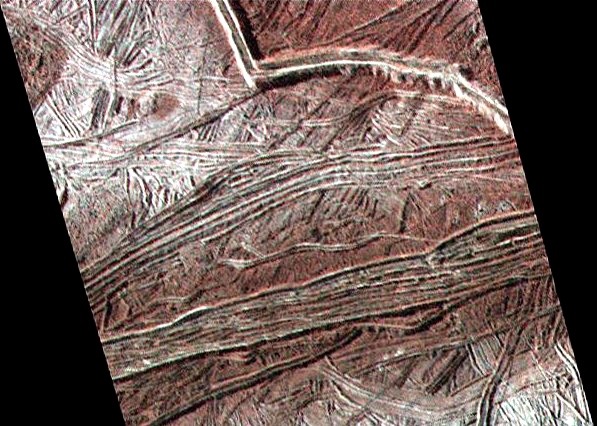
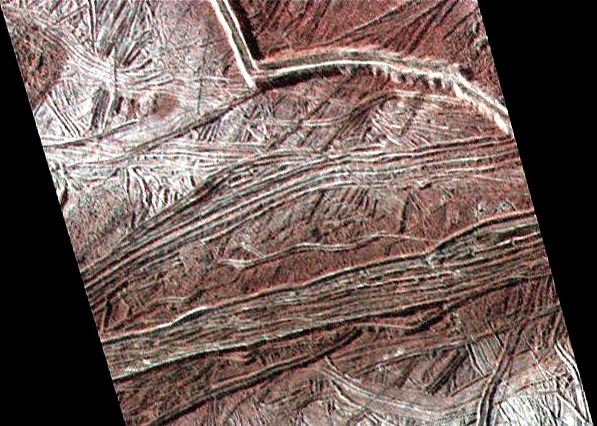
Unlike the crater-pocked surfaces of our Moon or Mercury, Europa was shockingly smooth. It was covered in a network of massive, crisscrossing cracks and reddish-brown streaks, like a cracked eggshell or a celestial roadway system. It had almost no craters. This meant the surface was young. Incredibly young. Something was constantly paving over the old surface, erasing the scars of cosmic impacts. What could do that? Only one thing: a dynamic, shifting surface floating on something liquid below.

The wild idea of a subsurface ocean was born.

Jupiter’s Gravitational Squeeze

But how? Europa is far from the sun. Its surface temperature is a mind-numbing -260 degrees Fahrenheit. Any water should be frozen solid, down to the core. How could an ocean stay liquid?

The answer is violence. Cosmic, gravitational violence.

Europa is caught in a gravitational tug-of-war. On one side is the colossal pull of Jupiter, the largest planet in our solar system. On the other are the pulls of its neighboring moons, Io and Ganymede. This constant push and pull forces Europa into a slightly elliptical orbit. As it gets closer to Jupiter, the gravity stretches it. As it moves farther away, it relaxes.

This process is called tidal heating. Imagine bending a paperclip back and forth. It gets hot, right? Now imagine that happening to an entire moon, flexed and squeezed by the most powerful gravitational force around. The friction from this constant kneading generates enormous amounts of heat in Europa’s interior. Enough heat to melt the ice and maintain a vast, churning ocean of liquid water beneath the frozen crust.

The Evidence Locker: Beyond the Plumes

The geysers seen by Hubble are the star witness, but the case for Europa’s ocean has been building for years, piece by tantalizing piece.

The Magnetic Mystery

Years after Voyager, the Galileo probe arrived for a long-term study of the Jovian system. It couldn’t see an ocean directly, but it carried a magnetometer. And it detected something deeply weird. Europa had a weak, induced magnetic field. This field was changing and shifting as Europa moved through Jupiter’s own powerful magnetic field. The only way this could happen is if there was a layer of something highly electrically conductive inside the moon. And the best candidate for that conductor? A global ocean of salty water.

Chaos Terrain

Zooming in on Europa’s surface reveals landscapes called “chaos terrain.” These are regions where the icy crust looks like it has been shattered into massive, city-sized icebergs, which then floated around and re-froze in a jumbled, chaotic mess. It looks exactly like what you’d see with ice floes in Earth’s Arctic Ocean. This is powerful visual proof that the ice shell is just a crust, a lid on something much more dynamic below.

Those Ominous Red Streaks

What about those dark, reddish-brown lines crisscrossing the surface? For a long time, they were a mystery. But now, they look like a clue. The leading theory is that this material is a salty, mineral-rich brine from the ocean below. When a crack forms in the ice shell, water from the ocean is pulled up, erupts, or oozes onto the surface. The intense radiation from Jupiter then cooks this brine, changing its color to the distinctive reddish-brown. Some scientists have even speculated that the color could be caused by organic compounds—or even the frozen remains of microscopic organisms—mixed in with the salts. Are these the frozen blood of an alien ocean?

A Free Sample From an Alien Ocean

This is why the discovery of geysers is not just another piece of evidence. It is the key that could open the entire mystery.

Think about the alternative. Before this, the only way to find out what’s in Europa’s ocean was to land a probe, somehow drill through a shell of ice that could be anywhere from 2 to 20 miles thick, at hundreds of degrees below zero, and then deploy a submarine into an unknown alien sea. The engineering challenge is staggering, almost science fiction.

But the geysers? They change everything.

They are a natural pipeline, a cosmic firehose doing all the hard work for us. They are dredging material from the hidden ocean and blasting it hundreds of miles into space. A future probe wouldn’t need a drill. It would just need a net. Or, more accurately, a suite of advanced scientific instruments.

A mission could simply fly through the plume, collecting and analyzing the water vapor and ice crystals on the spot. Is there salt? What kind? Are there simple organic molecules like amino acids, the building blocks of proteins? Are there complex ones? Could it detect lipids or carbohydrates?

Every single water molecule collected would be a message in a bottle, a report from an ecosystem we have only dreamed of.

The Plot Thickens: Modern Missions and Internet Whispers

The original Hubble discovery in 2013 lit a fire under the scientific community. Since then, the story has only gotten deeper and more complex. Follow-up observations have been both tantalizing and frustrating. Some have found more evidence of plumes; others have found nothing, suggesting the geysers might be intermittent, like Earth’s Old Faithful, only turning on once in a while.

But the idea was too compelling to ignore. The “much-discussed but still unapproved” mission mentioned in that old news report is now a reality. It’s called Europa Clipper. This NASA probe is scheduled to launch and will perform dozens of close flybys of Europa, equipped with ice-penetrating radar, high-resolution cameras, and of course, instruments designed to sniff out and analyze any plumes it might encounter.

Meanwhile, the internet has become obsessed. Online forums and conspiracy threads buzz with possibilities. Are the reddish streaks evidence of a kind of radiation-resistant red algae, staining the ice where it seeps through? Could the deep, dark ocean, warmed by hydrothermal vents on the seafloor, be home to bioluminescent creatures, creating their own light in the eternal night? This is exactly how life exists in Earth’s deepest trenches, clustered around volcanic vents, living off chemical energy instead of sunlight. Why not on Europa?

The Final Question

We stand on the edge of a discovery that could redefine what it means to be alive and what it means to be alone. Europa offers the three ingredients thought to be essential for life as we know it: water, chemistry, and energy.

The water is almost certainly there, a vast, dark ocean. The chemistry is there, in the minerals leached from the rocky seafloor and potentially delivered by asteroids. And the energy is there, in the relentless gravitational flexing from Jupiter.

The question is no longer “Could there be life on Europa?”

The question is now, “How could there *not* be?”

That ghostly plume of water, seen for a fleeting moment by a telescope hundreds of millions of miles away, wasn’t just a geological event. It was a beckoning finger from across the void. It was the whisper of a hidden ocean, finally making itself heard. And we are on our way to hear what else it has to say.

Amit Ghosh
Amit Ghoshhttps://coolinterestingnews.com
Aloha, I'm Amit Ghosh, a web entrepreneur and avid blogger. Bitten by entrepreneurial bug, I got kicked out from college and ended up being millionaire and running a digital media company named Aeron7 headquartered at Lithuania.
RELATED ARTICLES
- Advertisment -

Most Popular

Recent Comments

Warren Pan Abbott on The legend of the Devil Monkey !
chris davies on The McPherson Tape Mystery
Reed Reedly on ET has Internet!
Bea Houseoffashion on Proof Of Time Travellers – Gallery
Marcus2012 on ET has Internet!
Reed Reedly on ET has Internet!
LaughsAtConspiracyNuts on The 9/11 Conspiracy – Myths and Facts
Alex Sliverman on Did the ancients fly?
Doctor Wholigan on Time Traveler in 1938 film
chris davies on The McPherson Tape Mystery
Archie1954 on 10 secret UFO hideouts
chris davies on Ghosts of flight 401
Marcus2012 on ET has Internet!
jason Macdonald on Proof of Time Travel? – China
chris davies on Long-Lost Pyramids Found?
Reed Reedly on ET has Internet!
Milkman on Connected Universe
Tenmiles on Baigong Pipes Mystery
Simon Foster on Sirius – The Documentary
From the 1st April on 2013 – Alien Contact date ?
SkyWatcher on Is ET ignoring us?
I Come From The Future on Obama to make UFO Alien disclouser soon ?
ÛñK?øWn on 2013 – Alien Contact date ?
Just another person on 2013 – Alien Contact date ?
Malcolm Windowcleaner on The strange case of Rudolph Fentz
Mason Servio on Strange Things on Mars
Marke Wisdom Seeker on What will we find as arctic melts?
Andrea A Elisabeth Levyne on Aliens Captured in Varginha, Brazil
Mitch Grouyeki on Amazing Space Shuttle pictures