
Are We Being Ignored? The Terrifying Silence of the Cosmos
Look at your phone. Right now. You are connected to a hive mind of billions, a sprawling digital nervous system that spans our entire planet. We are obsessed with it. We live for the ping of a notification, the dopamine hit of a like, the endless scroll of information. We think this is the pinnacle of technology. We think this is the peak.
But what if it’s not? What if our precious “World Wide Web” is nothing more than two tin cans connected by a wet piece of string compared to what’s really out there?
Everyone loves the Internet. How else would we learn about dancing mortgage offers, the latest wardrobe slips, and the deep insights provided by pictures of cats? It defines our species right now. But let’s zoom out. Way out. Past Mars. Past the Kuiper Belt. Into the black void between stars.
If intelligent life exists—and the math suggests it almost certainly does—would they still be using radio waves that fade into static? No. That’s absurd. An advanced civilization would undoubtedly cherish a connected network, just like say, aliens would. And aliens, if they are out there, likely already have one, suggests one space scientist.
This isn’t sci-fi fan fiction. This is coming from the highest levels of astrodynamics.
The Galactic Internet: It’s Already Here
Here is the reality check that hurts. We might be the galactic equivalent of a tribe in the Amazon rainforest trying to signal a passing jetliner with smoke signals. The pilot isn’t ignoring them out of malice. The pilot just doesn’t see them. The technology gap is too wide.
“A galactic Internet might be in use already, but by aliens, not by humans yet,” says Italy’s Claudio Maccone, writing in the current Acta Astronautica journal. This man isn’t a fringe blogger. Maccone is a heavyweight. He serves as a co-chairman of the Search for Extraterrestrial Intelligence (SETI) permanent committee of the International Academy of Astronautics.
When someone like Maccone speaks, you listen. And what he is saying is mind-bending.
In his wide-ranging report—which ponders everything from the last 3.5 billion years of life to the next 10 million years of humanity undertaking galactic colonization—the notion of aliens with e-mail is among the more mild of his suggestions. He is proposing something far more profound. A network. A massive, star-spanning infrastructure that makes our fiber optics look like Stone Age tools.
The Science of the Stars: Gravitational Lensing
How would they do it? How do you send a text message across a thousand light-years without it turning into garbage noise?
You don’t use big antennas. You use stars.
Maccone thinks that space physics explains why aliens, if they are out there, are likely too busy with their own galactic version of Facebook to pay much attention to all the noise coming from Earthly broadcasts of old baseball games and M.A.S.H. episodes, now making their way across space. They likely have a better way to talk to each other, thanks to an effect called gravitational lensing.
How to Hack Gravity
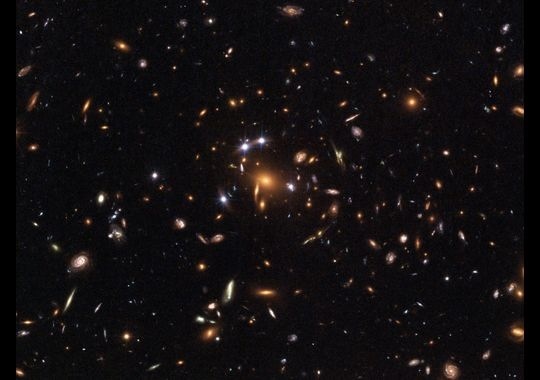
Einstein predicted this decades ago. Massive objects warp space-time. If you put a massive object—like our Sun—between you and a distant target, the gravity of the Sun bends the light coming from that target. It acts like a giant magnifying glass. A telescope the size of a star.
This is the “Secret Sauce” of the Galactic Internet.
Imagine an alien civilization. Let’s call them the Architects. They place a receiver at a specific distance from their home star (the focal point). By doing this, they can use their own sun to amplify signals from across the galaxy by a factor of millions. Not double. Not triple. Millions.
This allows for high-bandwidth data transmission over impossible distances. We are talking about streaming 8K video from the Andromeda galaxy instantly. No static. No loss.
The “Dial-Up” Civilization
This theory solves one of the biggest mysteries in human history: The Fermi Paradox. If the universe is teeming with life, where is everyone? Why is the sky so quiet?
Maybe the sky isn’t quiet. Maybe we are just deaf.
Think about it. We are scanning the skies with radio telescopes, looking for radio waves. That is 19th-century technology. We are looking for the cosmic equivalent of a telegraph beep. Meanwhile, the rest of the galaxy might be communicating via a highly directional, laser-optical network powered by gravitational lenses.
We aren’t detecting them because their signals are tight, focused beams aimed directly at each other. They aren’t broadcasting omnidirectional noise like we do. They are efficient.
It’s like walking through Times Square and wondering why no one is yelling at you. They aren’t yelling. They are texting each other. The conversation is happening all around you, invisible and silent to your senses.
The Dark Forest and The Router of the Gods
There is a darker angle to this. Recent internet theories often discuss the “Dark Forest” hypothesis—the idea that civilizations stay quiet to avoid being wiped out by predators. But Maccone’s theory suggests something different. It suggests indifference.
If you had access to a Galactic Internet, containing the knowledge of a billion worlds, the history of the universe, and the art of a thousand species, would you bother tuning into Earth? Would you care about our political squabbles? Our reality TV?
Probably not. You’d be too busy.
Are We The Glitch?
Maccone suggests that the sheer physics of space dictates this evolution. Any civilization that survives long enough must discover gravitational lensing. It is the only way to communicate effectively across the void. Therefore, the “Galactic Internet” is an inevitability.
It’s a chilling thought. A web of light crisscrossing the galaxy right above our heads. Beams of pure information shooting past our solar system. And here we are, sitting in the dark, wondering if we are alone.
The FOCAL Mission: Can We Join the Club?
So, how do we get the password to the WiFi? We have to build our own node.
This is where it gets exciting. We actually have plans for this. It is called the FOCAL mission. The idea is to send a spacecraft to the gravitational focus of the Sun. That is about 550 AU away (550 times the distance from Earth to the Sun). For context, Voyager 1, the farthest human object ever made, is only about 160 AU out after flying for 45 years.
It is a long trip. But if we get a probe there, we could turn the Sun into our own antenna. We could tap into the network. We could listen to the whispers of the gods.
Or maybe we are already seeing the glitches? Some conspiracy theorists argue that phenomena like Fast Radio Bursts (FRBs)—strange, high-energy flashes from deep space—aren’t natural events at all. Could they be data packet leakage? Are we catching brief glimpses of alien file transfers?
The 10-Million-Year Plan
Maccone looks far into the future. He isn’t just talking about next week. He sees a future where humanity expands. We spend the next 10 million years colonizing. But to do that, we need the network.
Without it, our colonies would be isolated islands. With it, we remain one species, connected by the speed of light and the gravity of stars.
The universe is not a silent, empty room. It is a crowded, noisy, vibrant party. We are just stuck outside in the parking lot because we haven’t figured out how to open the door yet. The Galactic Internet is waiting. The router is our Sun. We just need to plug in.
Until then, keep watching the cat videos. But every once in a while, look up. The real feed is out there.