Detroit. The Motor City. The Paris of the West.
Or at least, it used to be.
If you look at the skyline today, you see a battlefield. A graveyard of giants. We aren’t just talking about empty rooms and broken windows here. We are talking about colossal stone skeletons that scream of a lost timeline. A time when America built things to last for a thousand years.
So, why didn’t they?
Look closer. These aren’t just buildings. They are temples of industry left to rot. Why would a civilization at the peak of its power just walk away from millions of tons of limestone, marble, and copper? Was it just the economy? Was it just the riots? Or is there a deeper, darker frequency humming beneath the pavement of Woodward Avenue?
I’ve been digging through the archives. I’ve been looking at the blueprints. And what I found doesn’t match the official story in the history books. We are going to look at four specific monoliths today. Four survivors.
Buckle up.

The Book Tower: A Temple to forgotten Gods?
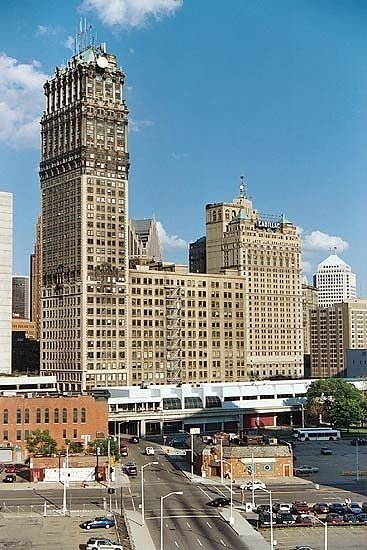
Look at that image above. Seriously, stop scrolling and look at it.
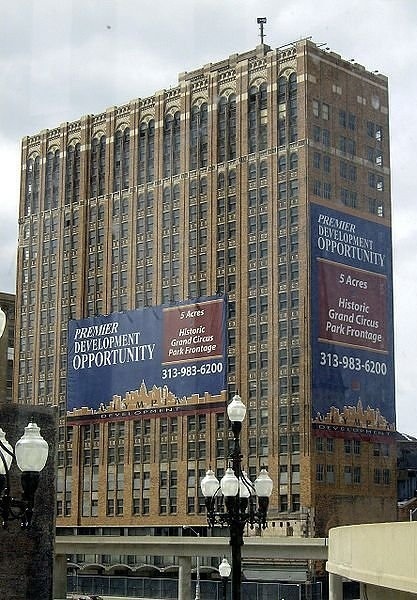
Does that look like a generic office building to you? Or does it look like something ripped out of the Old World and dropped into Michigan? This is the Book Tower.
Stats that don’t add up:
- Height: 475 feet (145 meters)
- Floors: 38 stories of pure intimidation
- Style: Italian Renaissance (supposedly)
Standing tall. Beautiful. And for a long time, completely empty.
The official narrative tells us that the Book Tower took a full decade to build. From 1916 to 1926. Think about that timeline. World War I was raging. The Spanish Flu wiped out millions. Yet, in Detroit, the Book Brothers were pouring money into this massive stone needle. It was finished just as the Art Deco craze was taking over the world, making it a weird architectural anomaly right out of the gate.
For two years, this was the tallest building in Detroit. A beacon. A lightning rod. Then the Penobscot Building stole its crown in 1928.
The “Pagan” Connection
Here is where things get weird. You can’t make this stuff up.
For decades, this building sat there. Watching. Waiting. In July 2006, the tower was sold. To whom? The Pagan Organization. I’m not saying there’s a secret society involved, but when you buy a giant Renaissance temple and your name is “Pagan,” the conspiracy forums go wild.
But the energy wasn’t right. Not yet.
A subsidiary of the Pagan Organization filed for bankruptcy less than a year later in May 2007. It’s like the building itself rejected the ownership. In January of 2009, the last soul inside—Bookies Tavern—packed up and left. The lights went out. The Book Tower went completely dark.
The Resurrection (Modern Update)
The original reports on this place were bleak. They said plans existed for renovation but “nothing has been finalized.”
Flash forward to today. The narrative has flipped. Bedrock, the real estate giant reshaping Detroit, bought it. They poured nearly $400 million into it. It reopened recently as a luxury hotel and apartment complex. The grime is gone. The caryatids (those stone statues holding up the roof) are clean.
But ask yourself this: When they scrubbed the walls, what history did they erase? Renovations are often the best way to hide the original purpose of a structure. Now, it’s shiny. It’s new. But the bones… the bones are still from 1916.
Broderick Tower: The Eye of the Whale
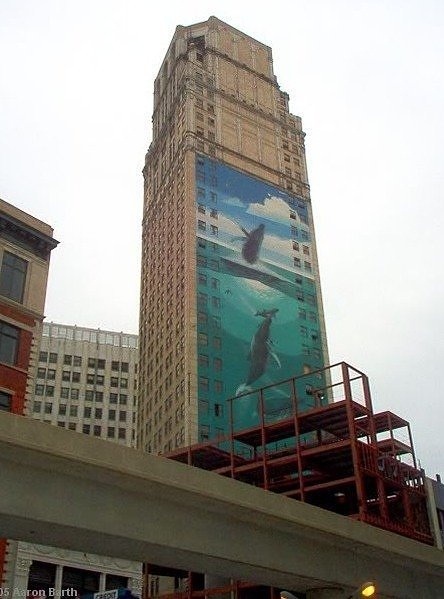
Next up, we have the Broderick Tower. This isn’t just a skyscraper; it’s a canvas.
The Specs:
- Height: 369 feet (113 meters)
- Floors: 35
- Style: Neo-Classical meets Beaux Arts
If you have ever been to downtown Detroit, you have felt eyes on you. Specifically, the eyes of a massive humpback whales. That’s the mural by the artist Wyland, painted in 1997. It covers the entire side of the building. A whale. In the middle of a concrete jungle.
Symbolism? Maybe. Water holds memory. Stone holds vibration.
The David Broderick Tower was finished in 1928. The peak of the Roaring Twenties. Champagne was flowing. Stocks were up. The crash was just a year away. It stands as a tombstone for that era of excess. It was named after David Broderick, an insurance broker who bought the place in 1945. A man selling insurance against disaster, owning a building born right before the biggest financial disaster in history. Irony?
The Long Sleep
Broderick died in 1957. After that? Chaos. The tower changed hands more times than a hot potato. By the 1980s, the doors were locked. The elevators stopped.
For thirty years, this massive structure was a vertical ghost town. Imagine the air inside. Stale. Frozen in 1980. Coffee cups left on desks. Calendars on the wall that never flipped over. Except for a few bars on the ground floor keeping the pulse alive, the heart of the building had stopped.
The Twist: Just like the Book Tower, the Broderick has come back from the dead. Redevelopment started around 2010. Now? It’s residential. People sleep there. People eat there. They live inside the ghost.
But the layout is strange. A mall on the first four floors? Offices above that? And then residential apartments shooting up to the 34th floor? It’s a city within a building. A self-contained ecosystem. Almost like a bunker in the sky.

The United Artists Theatre: The Acoustic Mystery
Look at the brickwork in the image above. They don’t lay bricks like that anymore. They slap up drywall and glass. This is the United Artists Theatre Building.
Constructed in 1928. (Notice a pattern? 1928 was a busy year for the masons). The style is Renaissance Revival. It is almost entirely brick. Dense. Heavy. Grounded.
The name gives it away: United Artists. This was Hollywood planting its flag in Detroit. It wasn’t just an office; it was a theater. A place of projection. A place of illusion.
The Sonic Signature
The offices were used until 1973. The movie theater kept projecting films until 1978. But here is the detail that keeps me up at night:
The Detroit Symphony Orchestra used this building as a recording theater for five years.
Why? Acoustics. The geometry of this place was perfect for sound. For vibration. Audiophiles know that old buildings “sing” differently. The resonance in the United Artists building was legendary. But then, silence.
It finally closed in 1984. The music stopped.
The Super Bowl Cover-Up
Since the closure, the building fell apart. Windows shattered. The wind howled through the brick corridors. Graffiti artists—the modern-day cave painters—covered the ground floor in tags. It was raw. It was real.
Then came the 2006 NFL Super Bowl.
The city couldn’t have the world see the decay. They didn’t fix the building; they just scrubbed the graffiti. It was a cosmetic fix. A mask. They wanted to hide the rot, not cure it. There has been talk of a “new lease on life” for nearly two decades. But unlike the Book or the Broderick, no concrete plans have saved this one yet.
Why is this one left behind? Is the damage too deep? Or is there something inside they don’t want to disturb?

Lee Plaza Hotel: The Titanic on Land
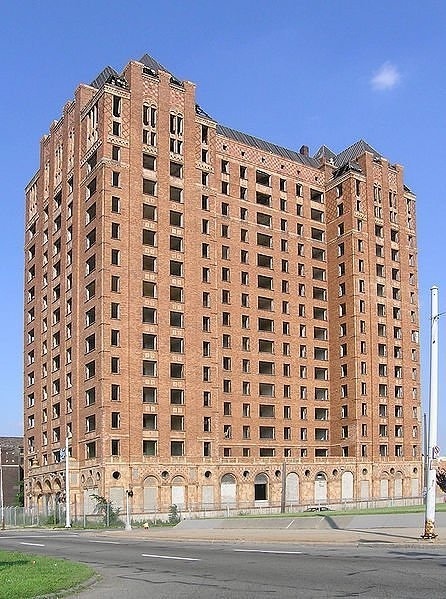
If the other buildings are tragedies, the Lee Plaza is a horror story. Just look at it. It stands alone, looming over the empty lots like a tombstone.
The Specs:
- Height: 15 floors (183 feet / 56 meters)
- Builder: Charles Noble
- Year: 1928 (Again! What happened in 1928?)
The Lee Plaza wasn’t just a hotel. It was an “apartment cum hotel.” It was designed for the ultra-wealthy who wanted the services of a hotel with the permanence of a home. It was built with such splendor that it rivaled the Book-Cadillac. We are talking frescoed ceilings, marble pillars, gold leaf. The works.
It was a palace for the American royalty of the industrial age.
From Gold to Dust
The fall of Lee Plaza is the most heartbreaking. Economic hardship hit it fast. The ownership shuffled around like a deck of cards. Eventually, in a twist of cruel irony, this palace of luxury was turned into a senior citizens’ complex.
Think about that energy shift. From roaring parties and flappers to the quiet decline of the elderly.
It closed as a residence in the early 1990s. And then the vultures descended.
The Great Scavenging
The text says “scavengers.” That’s a polite word for what happened. This building was gutted. Systematically stripped.
It wasn’t just kids breaking windows. Professional crews came in. They ripped out the copper wiring. They stole the brass fixtures. They pried the architectural terracotta lions off the roof (some of which were found later in Chicago salvage yards, selling for thousands). They stole the building’s nervous system.
Today, the Lee Plaza Hotel grins toothless—er, windowless—into the downtown Detroit landscape. It is a shell. A husk.
Why was it allowed to happen? Police stations were nearby. The city knew. Yet, for years, trucks pulled up and loaded up pieces of history, and drove away. It feels less like theft and more like an erasure.

Deep Dive: The Lost Technology of the 1920s?
Let’s zoom out. We have four buildings here. All built around the same time. All built with a level of craftsmanship we literally cannot afford to replicate today.
Modern skyscrapers are steel and glass. They are cheap. They are disposable. They are designed to last 50 years. These Detroit towers? They were built with stone, brick, granite, and copper.
There is a theory circulating online—you might have seen it—about the “Mud Flood” or the Tartarian empire. The idea is that these majestic buildings weren’t just built by guys with hammers in the 1920s, but were inherited from a previous, more advanced civilization, and we just “renovated” them.
Now, I’m not saying I buy it 100%. But look at the Lee Plaza. Look at the Book Tower. The intricate geometry. The sheer volume of material. Does it make sense that they threw these up in 12 months while horse-drawn carts were still on the streets?
Detroit is the epicenter of this mystery. It rose faster than any city in history, and it fell harder.
The Future: Ruin or Renaissance?
We are at a crossroads.
The Book Tower is back. The Broderick is back. Money is flowing into Detroit again. The lights are turning on. But the Lee Plaza still sits there, stripped and cold. The United Artists Building is still waiting for its encore.
Are we saving history? Or are we just building a new layer over the secrets of the past?
Next time you walk past an abandoned skyscraper, don’t just see a ruin. See a puzzle piece. Stop. Listen. The stones are talking. You just have to tune your frequency to hear them.
Stay curious. Stay skeptical. And keep your eyes on the skyline.