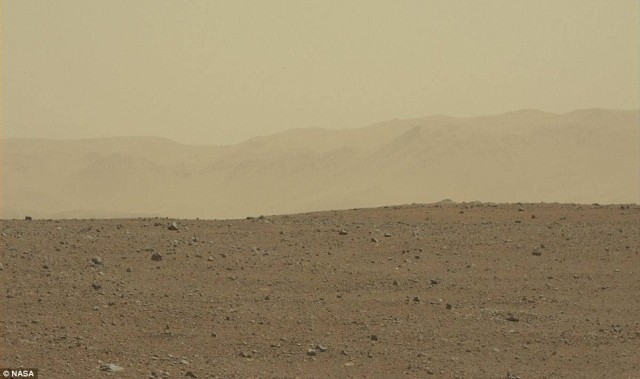
We send our robots to the cold, silent dust of Mars, expecting to find nothing but rocks and rust-colored desolation. We’re told it’s a dead world. A planetary graveyard. A place where nothing has stirred for a billion years.
But what if that’s the greatest lie ever told?
What if, just days after landing, our own multi-billion dollar rover, our pinnacle of human achievement, captured something impossible? Something that defies all explanation. Something that suggests we are not the first visitors to the Red Planet. Something… watching us.

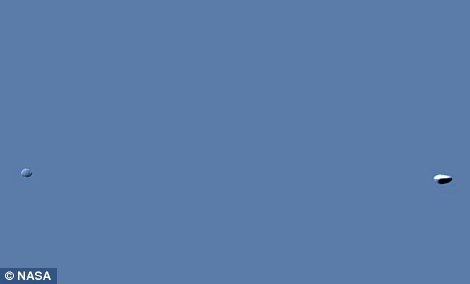
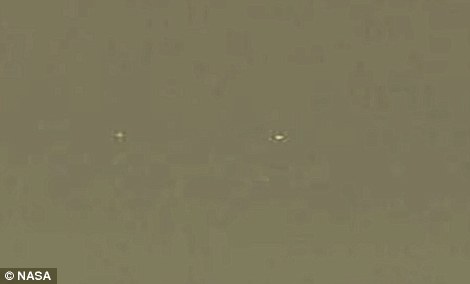
Look at that image. Stare at it. Let it sink in. That’s not a weather balloon. That’s not a flock of birds. It was captured by a NASA rover, millions of miles from home, in an atmosphere almost 100 times thinner than Earth’s. And yet, there it is. Four distinct points of light, arranged in a perfect, geometric formation, hanging in the alien sky.
They look manufactured. They look controlled. They look, for lack of a better word, like ships.
And the most chilling part? When these images were beamed back to Earth, sparking a firestorm on internet forums and among anomaly hunters, the official response from NASA was… silence. A deafening, calculated silence. No press release. No explanation. No comment.
Why? Why would they refuse to address such a monumental discovery? Are they simply stumped? Or is something else going on behind the closed doors of the Jet Propulsion Laboratory? Are they hiding the single greatest truth in human history from us?
The Official Silence: A Pattern of Deception?
This isn’t the first time the agency has gone quiet when confronted with uncomfortable evidence. It’s a pattern. A routine. For decades, researchers who pour over the raw, publicly-available NASA feeds have pointed out anomalies that simply don’t fit the sterile, lifeless narrative we’re sold. And each time, they are met with one of three responses: silence, ridicule, or a painfully flimsy “official explanation” that insults our intelligence.
Think about it. We are talking about an organization that meticulously plans every single second of these missions. They can land a car-sized robot on a dime from 140 million miles away. They analyze every grain of sand and every gust of wind. Yet when multiple, seemingly structured objects appear in their own photographs, they suddenly have nothing to say?
This isn’t just an oversight. It feels like policy. A policy of information control. The questions pile up, but the answers are nowhere to be found. Who are they protecting? What truth is so terrifying, so world-altering, that it must be kept under lock and key? Are they afraid of global panic? Or are they under orders from someone—or something—else?
A Deep Dive into the “Gale Crater Formation”
Let’s call the objects in that first photo the “Gale Crater Formation,” named for the region the Curiosity rover was exploring when it captured them. Skeptics, as they always do, scrambled for conventional explanations. They screamed “camera artifacts!” and “cosmic rays!” But those explanations fall apart under even the slightest scrutiny.
A cosmic ray hit on a camera sensor creates a single, random streak or a whiteout pixel. It doesn’t create four separate, almost identically-shaped objects flying in what appears to be a tight, intelligent formation. That’s not random noise. That’s a signal. That’s structure.
Furthermore, these objects appear to have dimension. They cast faint shadows. They reflect the dim Martian sunlight. They seem solid. Real. And they were captured in multiple frames, indicating they were physically present in the sky, not just a one-off glitch in the camera’s electronics.
A Closer Look: Debunking the Debunkers
The “Gale Crater Formation” was just the beginning. As the rover continued its mission, more strangeness followed. More objects that simply shouldn’t be there. And each one chips away at the “dead planet” story.
Let’s examine another one of the photos that NASA refuses to discuss. This one is even more provocative. More blatant.

What are we looking at here? This isn’t a collection of lights. This is a single, distinct object against the pale Martian sky. It’s shaped like a classic disc. A saucer. The very thing that has been reported in our own skies for over 70 years.
Is it just a Pixel Error? Look Again.
The go-to excuse is a “hot pixel” on the camera sensor. But look at the edges. A pixel error is sharp, digital, and square. This object is slightly blurred, exactly as a distant object moving through a thin atmosphere would be. It has a brighter top section, suggesting a reflection from the sun, and a darker, shadowed underside. It looks physical. It looks like it’s banking in a turn. It looks like it is under intelligent control.
The second image from this sequence shows the same, or a similar, object. Look at this.

Again, notice the definition. This isn’t a smudge on the lens. It isn’t a weather phenomenon in an atmosphere that barely qualifies as an atmosphere. It’s an object. A solid thing. And it’s flying.
The “Ice Crystal” Theory Doesn’t Hold Water
Another popular dismissal from the professional debunkers is that these are simply ice crystals high in the Martian atmosphere, catching the sun. It sounds plausible, right? Until you actually think about it for more than two seconds. Ice crystals are irregular. They tumble randomly in the wind. They don’t form perfect discs or fly in tight, four-ship formations. They would appear as a shimmering haze, not a distinct, solid-looking craft. This explanation is a desperate attempt to force the extraordinary into a boring, ordinary box. It doesn’t fit.
Not The First Time: A History of Strange Sights on the Red Planet
To understand why these photos are so explosive, you have to realize they don’t exist in a vacuum. They are part of a long, shocking history of NASA capturing things on Mars that look disturbingly artificial. For over 40 years, the Red Planet has been showing us signs of a lost past, and maybe, a hidden present.
The Face on Mars: Cydonia’s Ancient Secret
The mystery began in 1976. The Viking 1 orbiter was mapping the surface of Mars when it snapped a photo of a region called Cydonia. And there, staring back at the camera, was a face. A massive, mile-long stone face with eyes, a nose, and a mouth, seemingly gazing up into the cosmos. It was undeniable.
NASA quickly dismissed it as a “trick of light and shadow.” A geological formation that just happened to look like a face from that one angle. They told us not to worry about it. But people did worry. Researchers like Richard Hoagland saw it not just as a face, but as the centerpiece of a massive, ruined city complex, complete with giant pyramids and a fortress. They argued it was a message. A monument left by a dying Martian civilization.
Years later, NASA sent other probes to re-photograph the “Face.” The new images, taken from different angles and with better cameras, were much lower in quality and showed a heavily eroded, natural-looking mesa. Case closed, they said. But the conspiracy community cried foul. Were the new images intentionally degraded? Was the contrast manipulated to hide the artificial features? For many, the Cydonia mystery was the first proof that NASA wasn’t just exploring Mars, it was managing the information coming from it.
The Mars “Pyramids” and Other Artificial Structures
The weirdness didn’t stop in Cydonia. The rovers, with their ground-level views, have sent back a steady stream of baffling images. Photos of what look uncannily like pyramids—not lumpy, mountain-like pyramids, but structures with sharp, defined edges and flat faces, strikingly similar to those found in Egypt. Geologists say it’s possible for wind to carve rocks this way. Possible, yes. But the sheer perfection of the angles, the symmetry… it strains belief.
Then there are the smaller finds. The internet is filled with official NASA rover photos showing objects that look like carved statues, metallic debris, and even a “thigh bone” resting in the dust. Every time, we are told it’s just pareidolia—our brains tricking us into seeing familiar shapes in random patterns. And sure, some of them are probably just weird-looking rocks. But all of them? Every single one?
At what point does a series of coincidences become a body of evidence?
The Big Question: If It’s a Ship, Whose Is It?
This is where things get really wild. If we accept, just for a moment, that these aren’t rocks or glitches—that they are actual, physical craft flying in the Martian sky—then we have to ask the ultimate question. Who is flying them?
Theory 1: The Ancient Martians Survived
Science tells us that Mars was once a world like Earth, with a thick atmosphere, oceans, and rivers. A planetary catastrophe—perhaps a massive asteroid impact or the slow death of its magnetic field—stripped that all away, turning it into the frozen desert we see today. The popular story is that any life that might have existed died with the planet. But what if it didn’t? What if some of the ancient Martians, a highly advanced civilization, saw the end coming? What if they retreated? Not into space, but down. Into the planet’s crust.
Could Mars be home to a surviving, subterranean civilization? A people who live in vast underground cities, protected from the harsh surface radiation? Perhaps the ships our rovers are seeing are their drones. Their scout craft. Rising from hidden hangars to monitor the strange, metal creatures we’ve sent to crawl across the ruins of their world. They are watching us. Studying us. Trying to figure out what our intentions are.
Theory 2: An Extraterrestrial Outpost
Maybe the ships don’t belong to Martians at all. Maybe they belong to someone else entirely. For any spacefaring species, Mars is the perfect regional outpost. It’s close enough to Earth to observe us, but far enough away to remain hidden. It has resources (water ice, minerals) and a low-gravity environment. It’s the perfect place to set up a quiet base of operations, a cosmic gas station, or a scientific observatory to study the noisy, primitive primates on the third planet over.
In this scenario, we aren’t just stumbling upon ancient ruins. We’re stumbling into someone else’s active territory. Our rovers might be like automated cameras set up in a protected nature preserve, and the objects in the sky are the park rangers, making sure our little toys don’t wander off and discover the main lodge.
Theory 3: The Secret Space Program (It’s Us)
This is perhaps the most mind-bending theory of all. What if the technology in the Martian sky isn’t alien? What if it’s human?
There is a powerful and persistent conspiracy theory that suggests there is a “breakaway civilization.” That a secret, parallel human society with technology 50, even 100 years ahead of the public sector has been operating in space for decades. This “Secret Space Program,” funded by black budgets and hidden from all public oversight, allegedly has bases on the Moon and, yes, on Mars. They supposedly developed anti-gravity technology, mastered interstellar travel, and are already interacting with other species in the galaxy.
According to this theory, NASA is just a public-facing dog-and-pony show. A distraction to keep us all looking at slow, primitive rovers while the real action is happening far over the horizon. The ships seen by the Curiosity rover? They could be our own. Patrol craft from a human colony we were never meant to know existed.
The pieces are all on the table. The official photos are out there for anyone to see. The silence from the people who took them is undeniable. The explanations offered by skeptics feel hollow and forced, a desperate attempt to maintain a comfortable, but fragile, reality.
We are left with a simple choice. Do we accept the easy answer, the “trick of light,” the “camera glitch,” and go back to sleep? Or do we accept the chilling possibility our eyes are showing us? That Mars is not a dead world. That something is flying in its thin, orange sky.
The truth is out there. Maybe it’s been staring us in the face all along, from the dusty plains of our nearest planetary neighbor.
Originally posted 2016-03-26 00:28:25. Republished by Blog Post Promoter