Home Weird World Strange Stories Did Man Survive At Sea for 13 Months?

Did Man Survive At Sea for 13 Months?

0
66

The Ghost of the Pacific: Did a Fisherman Really Survive 438 Days Lost at Sea?

It started with a whisper. A rumor carried on the salt-laced wind across the most remote islands on Earth. A man. A wild man, bearded and feral, had stumbled out of the endless blue and onto the coral sands of Ebon Atoll.

He was a ghost. A phantom from the sea.

He spoke a language no one understood, his words tumbling out in a torrent of Spanish, his body emaciated in some places, yet strangely puffy in others. He pointed to the west, back across an impossible expanse of ocean, and claimed to have come from Mexico. The journey, he said, had taken him more than a year. He had drifted for 438 days.

It was a story that seemed torn from the pages of a forgotten adventure novel, a tale so improbable, so utterly beyond the pale of modern experience, that authorities initially refused to believe a single word of it. This is the story of José Salvador Alvarenga. And it might just be the most incredible, and disturbing, survival account of our time.

The Day the World Disappeared

Everything was normal. That’s how these stories always begin, isn’t it?

The date was November 17, 2012. Not December 21st, as he first misremembered in the fog of his trauma. The place was a fishing village in Chiapas, Mexico. A place called Costa Azul. Alvarenga was a seasoned fisherman, a pro. At 36, he was strong, stout, and knew the sea. He specialized in sharks, a tough and dangerous living. He was supposed to go out with his usual partner, but the man bailed. So, he hired a young, inexperienced local kid, 22-year-old Ezequiel Córdoba. The plan was simple: a 30-hour shift. Go out, hunt for shark and tuna, come back, get paid. Easy.

They loaded their 24-foot, open-topped fiberglass boat. A simple vessel. No canopy. No cabin. Just a large icebox for the catch. They had their gear, some water, and not much else. Why would they? They’d be back in a day.

But the ocean had other plans.

The Monster From The North

They were miles from shore when the sky turned a sick, bruised purple. A storm, a dreaded “El Norte,” slammed into them with the force of a freight train. It wasn’t just rain. It was a liquid wall. Waves, monstrous and black, crashed over the sides of their tiny boat, tossing it around like a child’s toy. For five days, the storm raged.

Five. Days.

They fought. They bailed water. They prayed. The motor, their only connection to civilization, sputtered and died. Drowned by the sea. Then, their radio went quiet. Their GPS was fried. They had lost their anchor, their supplies, everything. They were stripped bare by the fury of the storm.

When the sun finally broke through the clouds, it revealed a terrifying truth. Land was gone. The horizon was a perfect, unbroken circle of blue in every direction. They were a speck of dust in the Pacific Ocean. Adrift. Utterly and completely lost.

A Grim New Reality: The Rules of Survival

Days melted into weeks. The initial shock gave way to a horrifying, gnawing reality. There would be no rescue. No one was coming. They were on their own.

Their world shrank to the confines of that small, damaged boat. The sun was a relentless enemy, blistering their skin. The nights were a cold, star-filled terror. Survival became a primal, minute-by-minute struggle. Alvarenga, the experienced waterman, knew they had to adapt or die. And so began the most desperate routine imaginable.

The Castaway’s Menu

Food was everywhere, yet nowhere. Alvarenga, with the patience of a predator, learned to hunt with his bare hands. He would lie motionless for hours, his hands dangling in the water, waiting for a turtle to swim by. He’d grab it by a flipper, haul the struggling creature aboard, and kill it.

Birds, exhausted from long flights, would sometimes land on the boat. A fatal mistake. Alvarenga would snatch them, break their necks, and eat them. Raw. Feathers, bones, and all. Small fish began to shelter in the shade beneath their boat, creating a tiny, mobile ecosystem. He’d scoop them out of the water and swallow them whole, like a pelican.

Jellyfish. He ate jellyfish. He learned to avoid the stinging parts and consume the gelatinous bells. It wasn’t much, but it was something.

The Thirst That Kills

Worse than the hunger was the thirst. It’s the thirst that drives a person mad. Their small supply of fresh water was gone in days. Their only hope was rain. When it came, they’d capture every precious drop they could in overturned turtle shells and plastic bottles they scavenged from ocean garbage.

But what about the long, dry spells?

This is where the story turns stomachs. Alvarenga drank turtle blood. It was salty, but it was liquid. In the most desperate times, he drank his own urine. He tried to get Córdoba to do the same, but the younger man couldn’t. He would just vomit.

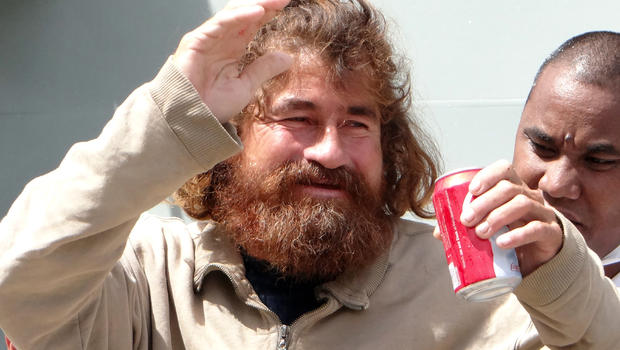
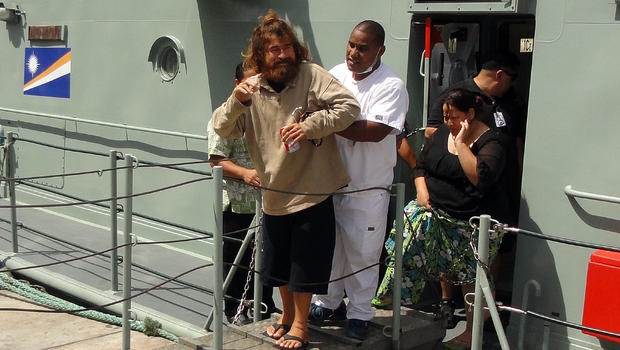
A castaway walks with the help of a nurse in Majuro after his long ordeal

The Heartbreak at Sea: The Fate of Ezequiel

This is the dark heart of the story. The part that haunts Alvarenga to this day.

While Alvarenga forced himself to eat whatever nature provided, no matter how repulsive, Córdoba could not. The younger man grew sick from eating raw bird meat and became violently ill. After that, he refused to eat. He would just lie in the bottom of the boat, his eyes wide with fear and despair, slowly starving to death.

Alvarenga pleaded with him. He tried to force-feed him. But Córdoba’s will was broken. He turned his face away and gave up.

One morning, about four months into their ordeal, Córdoba looked at Alvarenga and made a final, grim request. He made Alvarenga promise not to eat his body after he died. He made him promise to find his mother and tell her what happened. Alvarenga promised.

Then, Ezequiel Córdoba died.

For the next six days, Alvarenga kept his friend’s body in the boat. He couldn’t let him go. He would talk to the corpse, asking it questions, propping it up as if it were still alive. A desperate act against the crushing loneliness. Finally, one morning, he realized he was talking to a dead man. He was losing his mind. He slid his only companion into the Pacific and watched him sink into the abyss. Now, he was truly alone.

Alone with Ghosts: 10 Months of Madness

The solitude was an enemy worse than the sun or the sharks that circled the boat. Alvarenga’s mind began to fray. He experienced vivid hallucinations. He saw celestial visions, imagined delicious food, and often spoke to his dead companion, who he felt was still sitting across from him.

To stay sane, he created a rich fantasy life. He would imagine himself walking through his hometown, eating his favorite meal of tortillas and chicken. He would pace the tiny boat—one step forward, one step back—for hours, just to feel his legs moving. He tracked the passing of time by the phases of the moon, scratching a mark for each new cycle. He counted 14 of them. His grasp on reality was a thread, and he clung to it with everything he had.

He saw container ships. So many ships. He would wave frantically, screaming until his throat was raw. But his boat was too small, a mere fleck of white on the vast ocean. Each time a ship passed without seeing him, it was a fresh stab of despair. But he never gave up.

Landfall on a Lost World

After 438 days, he saw something that wasn’t a cloud. It was a faint, greenish smudge on the horizon. Land. At first, he thought it was another hallucination. But it grew larger. He saw trees. He started to cry.

He abandoned his battered boat and swam for shore, the last of his strength propelling him through the waves. He collapsed on the beach of Ebon Atoll, a remote ring of coral in the Marshall Islands, over 6,700 miles from where he had started. He was discovered by two locals who were shocked to find this wild, long-haired man, clad only in tattered underwear, babbling in Spanish.

They gave him water and food. They couldn’t understand his words, but they understood his desperation. He was a man reborn from the sea.

Jose Salvador Alvarenga steps off a Sea Patrol vessel in Majuro, Marshall Islands

The Doubters and the Debunkers

When his story hit the news, the world was captivated. But almost immediately, the questions began. How could anyone survive that long? Where was the proof?

“Too Healthy to Be a Castaway”

The first wave of skepticism came from officials who met him. Gee Bing, the acting secretary of foreign affairs for the Marshall Islands, went on record. “It does sound like an incredible story and I’m not sure if I believe his story,” Bing said. “When we saw him, he was not really thin compared to other survivors in the past. I may have some doubts.”

He wasn’t skeletal. He looked puffy. But doctors quickly provided an explanation. His swollen ankles and face were a classic sign of edema, a condition caused by severe protein deficiency and high salt intake—exactly what you’d expect from someone living off raw fish and turtle blood for over a year. His body was a wreck, but not in the way people expected a castaway to look.

The Internet Conspiracy Machine Fires Up

Then came the internet sleuths and armchair experts. The theories were wild. Was he a drug runner whose shipment went wrong? Was he covering up a crime? His story had small inconsistencies, a result of trauma and the long months of disorientation. The dates were off at first. The exact location of his departure was fuzzy.

But the darkest theory emerged later. In 2015, Ezequiel Córdoba’s family filed a one-million-dollar lawsuit against Alvarenga. Their shocking accusation? That he had survived by committing the ultimate taboo. They claimed he had eaten Ezequiel’s body to stay alive. There was zero evidence for this. Alvarenga vehemently denied it, pointing to the promise he made his dying friend. The lawsuit, many believe, was a cruel attempt to cash in on his book deal. But the accusation stuck, adding a sinister shadow to his incredible tale.

The Science of the Impossible Journey

Could a small boat really drift that far? Scientists say yes. Absolutely.

Oceanographers like Erik van Sebille from the University of New South Wales ran computer models. They confirmed that a boat set adrift off the coast of Chiapas, Mexico, would be caught in the powerful North Equatorial Current. This current is like a massive conveyor belt, flowing west across the Pacific. And its path goes directly through the Marshall Islands.

While the journey would typically take closer to 18 months, the 13-month timeline was deemed entirely plausible depending on winds and the exact path. The science backed him up. The currents proved his journey was not just possible, but in a way, almost inevitable.

The Aftermath: A Lingering Mystery

José Salvador Alvarenga returned home to El Salvador a hero, but also a broken man. He was diagnosed with severe PTSD. He developed a deep fear of the water and couldn’t bear to be near the ocean. The man who conquered the Pacific was now terrified of it. He slept with the lights on and needed constant companionship to fight off the ghosts of his long solitude.

His story was documented in the book *438 Days* by journalist Jonathan Franklin, who spent hundreds of hours interviewing Alvarenga and cross-referencing his account with scientific and medical experts. The consensus? His story, as unbelievable as it sounds, holds up.

So what are we left with? Is this the single greatest tale of human survival against all odds ever documented? A story of resilience, ingenuity, and the unbreakable will to live? Or is it a darker tale, a secret buried at sea between two men, one of whom never returned?

The Pacific Ocean is vast and keeps its secrets well. But one thing is certain: in January 2014, it spit a man out onto a remote shore, a man who had seen the other side of hell and somehow, impossibly, came back to tell the tale.

Originally posted 2014-02-23 17:04:21. Republished by Blog Post Promoter