The Norwegian Dawn Incident: A Close Call in the Devil’s Triangle
The ocean is vast. It is deep. And sometimes, it gets hungry.
Imagine sitting down for a luxury dinner. You are surrounded by crystal glasses, laughter, and the gentle hum of a massive engine. You are safe. You are on a floating city. Then, in a split second, the world tilts. Plates slide. The laughter dies. The massive steel beast beneath your feet shudders violently and grinds to a terrifying halt.
This isn’t a movie script. This happened.
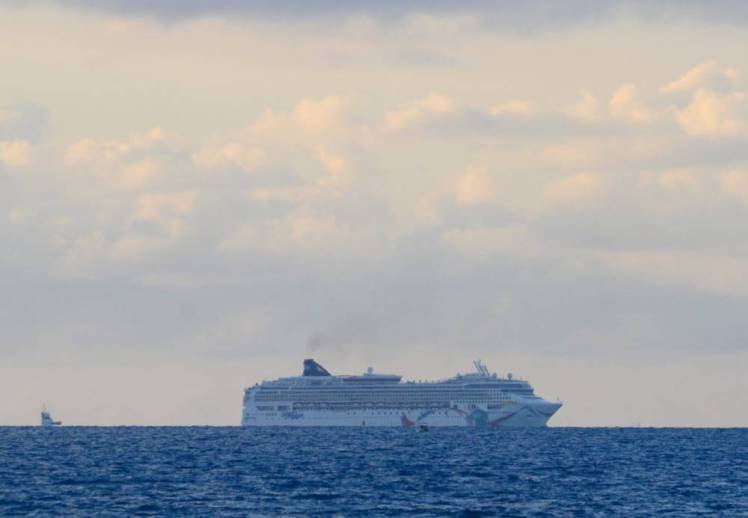
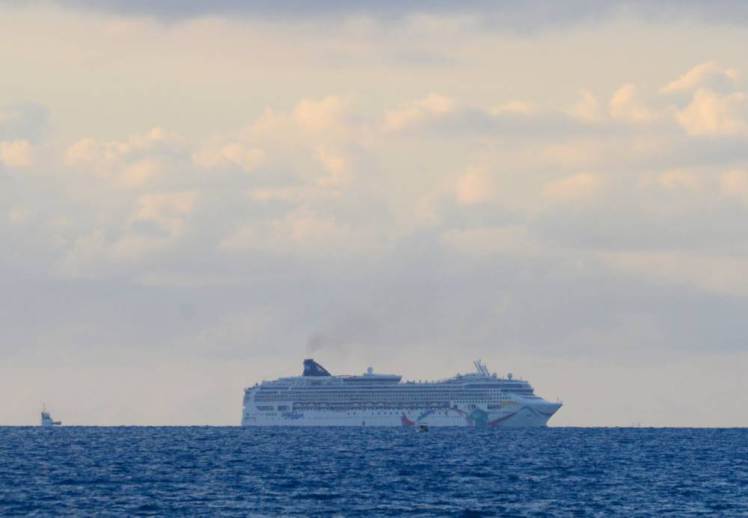
On May 19, 2015, the massive Norwegian Cruise Line ship, the Norwegian Dawn, found itself the latest victim of the world’s most infamous patch of water. It ran hard aground. Stuck. Trapped.
Where? Right at the top corner of the Bermuda Triangle.

While the media played it cool, calling it a “temporary malfunction,” those who study the dark history of this region know better. This was a brush with the unknown.
What Actually Happened on the Norwegian Dawn?
Let’s look at the facts. The ship was leaving King’s Wharf, Bermuda. It was bound for Boston. A standard trip. Thousands of people do this every year. But this time, something went wrong.
There were 2,443 passengers on board. Add in 1,059 crew members. That is over 3,500 souls.
According to the official statement from Norwegian Cruise Line, the ship suffered a “temporary malfunction” of its steering system. Just like that. The steering died. The ship drifted off course and slammed into the reef near the North Channel. Steel met coral. The ship stopped dead.
Passenger Rachel Hansen, from Londonderry, New Hampshire, described the moment of impact. It wasn’t subtle.
“We were in the middle of eating dinner,” she said. “There was a shudder for maybe 30 seconds to a minute and then there was a sudden stop.”
Think about that. A ship that weighs 92,000 tons doesn’t just “stop.” The inertia is massive. For the passengers, that minute of shuddering must have felt like an eternity. Was it just a mechanical failure? Or did the ship’s instruments get confused? Did the compass spin? Did the electronics fry?
Small boats, divers, and tug boats circled the stranded giant for hours like flies around a wounded animal. They probed the hull. They checked for leaks. The Norwegian Dawn was helpless, waiting for the moon to pull the tides high enough to lift it free.
Eventually, high tide arrived. The ship was pushed off the reef and moved to deeper water to drop anchor. Officials were quick to say, “All guests and crew are safe and there were absolutely no injuries.”
They were lucky. Incredibly lucky. Because history shows that when ships stop moving in the Bermuda Triangle, they often don’t come back.
The Devil’s Triangle: A Graveyard of Giants
You have heard the name. You know the shape. Miami. Puerto Rico. Bermuda. Connect the dots, and you get a kill zone covering roughly 500,000 square miles of open ocean. Some call it the “Hoodoo Sea.” Others call it the “Limbo of the Lost.” Most know it as the Devil’s Triangle.
The Norwegian Dawn incident didn’t happen in a vacuum. It happened in a place where the laws of physics seem to take a vacation.
This region is notorious. It is legendary. And it is dangerous.
Paranormal enthusiasts and conspiracy theorists have long claimed the area is cursed. Maybe it’s ancient technology from the lost city of Atlantis firing from the seabed. Maybe it’s a portal. Maybe it’s aliens. Skeptics laugh, but the body count is real.
Check out this breakdown of the strangeness associated with the area:
The Ghost of the USS Cyclops
The grounding of the Norwegian Dawn brings up chilling memories of a much darker event. The prompt mentioned a sinking in 1918. That was the USS Cyclops.
This wasn’t a little fishing boat. The Cyclops was a monster. A Proteus-class collier of the United States Navy. It was 540 feet long. It was built to haul coal and manganese ore. It was tough. It was war-ready.
In March 1918, it left Barbados. It was heading for Baltimore. It had 306 crew and passengers on board. The weather was fine. The ship was heavy but stable.
Then? Nothing.
No distress signal. No “Mayday.” No debris. No oil slick. No life jackets found bobbing in the waves. The ship simply vanished from the face of the earth. It remains the single largest non-combat loss of life in U.S. Naval history. 306 people. Gone.
President Woodrow Wilson was baffled. The Navy was embarrassed. How does a 540-foot steel ship disappear without a trace? If the Norwegian Dawn had hit that reef a little harder, or if the weather had turned, could we have seen a modern-day Cyclops?
The Theories: Why Does This Keep Happening?
So, why did the Norwegian Dawn lose steering? Why do planes vanish? Why do compasses spin? Let’s break down the wildest, scariest, and most compelling theories floating around the internet today.
1. Electronic Fog and Time Warps
One of the most popular theories comes from a pilot named Bruce Gernon. He claims that in 1970, he flew his plane into a “strange cloud” near Bimini. This wasn’t normal fog.
He says the cloud formed a tunnel. He flew through it. Inside, his electronic instruments went haywire. Compasses spun. Radio died. When he shot out the other side, he was over Miami Beach.
The catch? He arrived 30 minutes too early. He claims he traveled through a “time warp” or “electronic fog.”
Did the Norwegian Dawn hit a patch of this electronic fog? Is that why the steering system failed? Systems usually have backups. And backups for the backups. For the whole ship to lose control suggests a massive, systemic failure of the electronics.
2. Methane Hydrates: The Ocean Burp
This is the favorite theory of the “science” crowd, but it is just as terrifying as any ghost story. The ocean floor in this region is rich in methane hydrates. Basically, frozen gas pockets.
The theory goes like this: An underwater landslide or seismic shift cracks the sea floor. Boom. A massive bubble of methane gas is released. It rushes to the surface.
When the gas hits the surface, it makes the water frothy. It reduces the density of the water. A ship floats because it is less dense than the water. But if the water suddenly becomes a fizzy soup of bubbles? The ship loses buoyancy.
It drops like a stone. Instantly. No time for an SOS.
If a smaller methane release occurred under the Norwegian Dawn, it could have affected the water density or the propulsion intake, causing the loss of control that drove it onto the reef.
3. Rogue Waves
The Triangle is a perfect storm for weather. You have storms coming from Mexico, storms coming from the Atlantic, and the Gulf Stream rushing through like a river in the ocean. This can create “Rogue Waves.”
These are walls of water. 80 feet high. They appear out of nowhere in calm seas. They hit with the force of a nuclear bomb. A rogue wave could easily knock out a ship’s bridge or smash its steering gear.
4. The Atlantis Connection
We have to go there. We have to talk about Atlantis. Edgar Cayce, the famous “Sleeping Prophet,” predicted that the ruins of Atlantis would be found near Bimini (in the Triangle) in the late 1960s. Low and behold, divers found the “Bimini Road,” a strange underwater rock formation that looks like a paved street.
The theory is that the Atlanteans had advanced energy crystals. Huge power sources. When the city sank, these crystals were buried but not destroyed. They are still active on the ocean floor, intermittently firing beams of energy that disrupt modern navigation systems.
Was the Norwegian Dawn zapped by a dormant Atlantean power station?
Flight 19: The Legend Begins
You cannot talk about the Bermuda Triangle without mentioning Flight 19. This is the story that started the panic. The Norwegian Dawn was lucky it didn’t share their fate.
December 5, 1945. Five TBM Avenger torpedo bombers take off from Fort Lauderdale, Florida. 14 men. It was a routine training run. The weather was decent.
The flight leader, Lieutenant Charles Taylor, was an experienced pilot. But soon, strange radio transmissions were picked up.
“We don’t know where we are,” Taylor said. “Everything is wrong. Strange. We can’t be sure of any direction. Even the ocean looks different.”
Even the ocean looks different? What does that mean?
The compasses failed. The five planes flew aimlessly until they ran out of fuel. They ditched in the sea. All 14 men were lost.
But here is the kicker: A rescue plane, a PBM Mariner with a 13-man crew, took off to find them. It also vanished. In one day, 27 men and six planes evaporated.
This history is painted into the very water the Norwegian Dawn was sailing through.
Modern Dangers: Why Is The Triangle Still Active?
You might think, “Hey, we have GPS now. We have satellites. The Triangle is old news.”
Wrong.
Ships and planes still go missing. In 2015, the same year the Norwegian Dawn ran aground, the cargo ship El Faro disappeared in the Triangle during Hurricane Joaquin. It sank. All 33 crew members died. The ship was found later, sitting upright at the bottom of the ocean, 15,000 feet down.
In 2017, a private plane carrying a CEO and her children vanished. Debris was found, but the fuselage? Gone.
The area is notoriously difficult to navigate. The Gulf Stream is fast and turbulent. It can erase evidence of a crash in hours. If you go down there, the ocean cleans up the mess before the rescuers can even start their engines.
Did The Norwegian Dawn Escape a Curse?
Let’s go back to that dinner service on the Norwegian Dawn. The ship shudders. The power flickers? (Maybe). The steering locks up.
Skeptics say it was just a mechanical failure. A busted gear. A computer glitch. And they are probably right. Probably.
But consider the location. The “top corner” of the Triangle. Consider the history. The Cyclops. Flight 19. The El Faro.
Was it just a coincidence that the steering failed exactly there? Or was it a warning?
The passengers aboard that ship might not realize how close they came to becoming a statistic. If that ship had drifted into deeper water before losing power, or if the hull had been breached by the reef, we wouldn’t be reading a news story about a delay. We would be reading about a tragedy.
The Psychological Toll
Imagine being on that ship. It is night. You are stuck on a reef. You look out into the pitch-black water. You know the stories. You know where you are.
Every creak of the hull sounds like the ship is breaking apart. Every wave sounds like a monster. The psychological pressure in that situation is immense. The “shudder” that Rachel Hansen described wasn’t just metal on rock; it was the realization that human engineering is fragile.
Conclusion: The Mystery Remains
The Norwegian Dawn was freed. It sailed to Boston. The passengers got home. They have a cool story to tell at parties. “We shipwrecked in the Bermuda Triangle!”
But the ocean keeps its secrets.
For every Norwegian Dawn that escapes, there is a USS Cyclops that doesn’t. For every pilot that navigates the electronic fog, there is a Flight 19 that flies into oblivion.
The Bermuda Triangle remains one of the greatest mysteries of our world. It is a place where the map gets fuzzy. Where the compass lies. And where, sometimes, the only thing that comes back is silence.
Next time you book a cruise, check the map. Check the route. And maybe, just maybe, bring a life jacket.
Originally posted 2015-10-17 04:28:44. Republished by Blog Post Promoter