
History books tell one story. The dusty, forgotten files in the basement tell another. And sometimes, a single photograph falls out of an archive box and shatters everything we thought we knew about World War II.
We aren’t talking about secret jets or experimental German rockets. We are talking about something else entirely. Something wet, metallic, and clearly not from this planet.
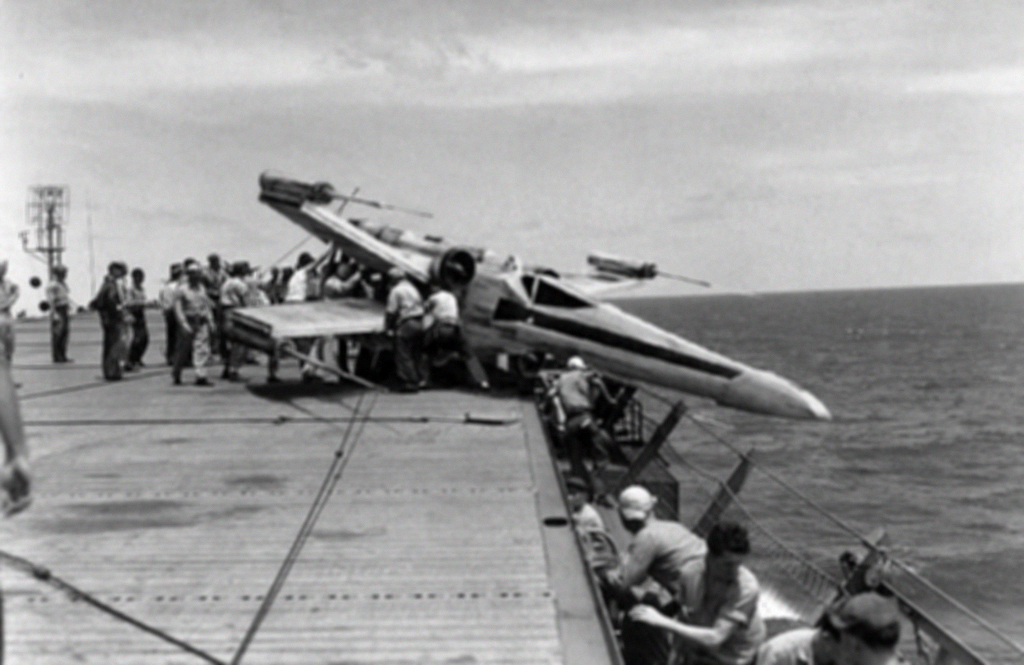
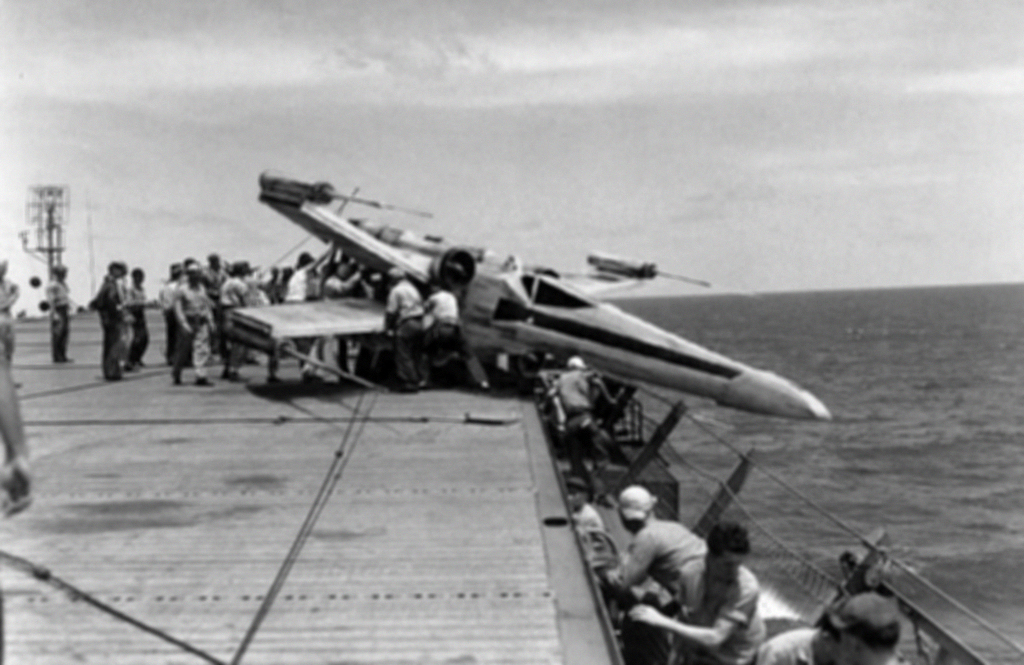
Look at that image. Really look at it. This isn’t a grainy smudge in the sky. This is up close. Personal. Tactile.
This explosive photograph, reportedly unearthed from a forgotten stack of classified records, depicts United States Marines in the Pacific theater. But they aren’t storming a beach. They aren’t fighting the Japanese Imperial Navy. They are standing waist-deep in the ocean, wrestling with a smooth, saucer-shaped object that defies every aerodynamic rule of the 1940s.
The location? Johnston Atoll.
If that name doesn’t send a shiver down your spine, it should. This isn’t just a sandy rock in the middle of nowhere. For decades, Johnston Atoll was the dark closet where the U.S. military hid its skeletons. And according to this leak, it was also the parking garage for a crashed extraterrestrial vehicle.
The Johnston Atoll Mystery: Why There?
To understand the gravity of this photo, you have to understand the place. Johnston Atoll is isolated. We are talking 750 nautical miles west of Hawaii. In the 1930s and 40s, it was the perfect place to do things you didn’t want the newspapers to write about.
Officially? It started as a wildlife refuge. A bird sanctuary. That’s the cover story the government loves to use. “Nothing to see here, folks, just some rare seabirds.”
But in 1934, the vibe changed. President Franklin D. Roosevelt placed the atoll under the control of the U.S. Navy. Why does a bird sanctuary need a naval garrison? Almost overnight, the birds took a backseat to bulldozers. The military carved out a runway, dredged a lagoon, and turned this coral speck into a fortress.
By the time World War II was in full swing, Johnston Atoll was a critical refueling stop for submarines and planes. But recent theories suggest it served a darker purpose. Was it a collection point? A secure drop-off zone for “anomalous materials” recovered from the Pacific theater?
The “Roswell Before Roswell”
Most people think the UFO cover-up started in 1947 with the Roswell crash. That is the safe, mainstream timeline. But military pilots were reporting “Foo Fighters”—glowing orbs and metallic discs—years before Roswell. They saw them over Germany. They saw them over Japan. And they definitely saw them over the vast, empty stretches of the Pacific Ocean.
If a pilot shot one down, or if one malfunctioned and crashed into the sea, where do you take it? You can’t drag a flying saucer into Pearl Harbor. Too many eyes. Too many civilians. You need a place that doesn’t exist on most maps. You take it to Johnston Atoll.
The photo above claims to show exactly that moment. The recovery. The cleanup before the cover-up.
Deconstructing the Image: What Are We Seeing?
Let’s break down the visual evidence. We see men in fatigue uniforms. Marines. They are in the water. The object is partially submerged. It has a classic discoid shape—a dome on top, a sloping rim. It looks heavy, yet buoyant enough to float.
Notice the surface. It’s smooth. In 1940s aviation, everything had rivets. Look at a B-29 bomber or a Zero fighter. They are covered in seams, bolts, and rivets. This object appears seamless. It looks like it was grown, not built.
The body language of the soldiers is telling. They don’t look like they are posing for a victory shot with a captured enemy tank. They look confused. They look like they are trying to figure out how to grip the thing. There are no obvious handles. No wings. No propellers.
How did it get there? Did it crash gently? Did it land? The structural integrity suggests a controlled descent or a material strength far beyond aluminum or steel.
The Cleanup: The 2004 Discovery
Fast forward sixty years. The world has changed. The Cold War is over. But the secrets remain.
The story goes that this picture was found during a massive clear-out of archived files at Johnston Atoll. This part of the timeline is verifiable fact. In 2003, the military finally decided to wash its hands of the atoll. They handed the site back to the Fish and Wildlife Service.
But before they left, they had to clean house.
Sometime in 2004, countless boxes of naval files, photographs, and logs were moved into an unused hangar for sorting. Imagine the scene. Decades of salt air, rotting paper, and classified stamps. It was in this chaotic shuffle that the image reportedly surfaced.
Why wasn’t it destroyed earlier? Bureaucracy. The U.S. government is a machine that generates paperwork. Sometimes, the most dangerous secrets aren’t shredded; they are just misfiled. They get shoved into a box marked “Miscellaneous” and pushed to the back of a damp warehouse. They sit there, ticking time bombs of information, waiting for someone to open the lid.
The Toxic Legacy: Hiding Evidence with Poison?
Here is where the theory gets dark. Really dark.
After World War II, Johnston Atoll didn’t go back to the birds. It became one of the most toxic places on Earth. The military used it for high-altitude nuclear tests in the 1950s and 60s. Then, they turned it into a storage site for chemical weapons. We are talking about Agent Orange. Sarin gas. The nastiest stuff humanity has ever cooked up.
Why turn a strategic base into a toxic wasteland?
Alternative history researchers have a theory: Area Denial.
If you have a secret underground facility—perhaps a bunker housing the wreckage seen in that photo—how do you keep people away forever? You can’t just put up a “Keep Out” sign. People are curious.
But if you cover the island in radioactive fallout? If you stack barrels of leaking nerve gas on the runway? Nobody goes there. Not tourists, not snooping journalists, not foreign spies. The toxicity is the ultimate security fence.
The “Starfish Prime” Connection
In 1962, the U.S. conducted the “Starfish Prime” test. They detonated a 1.4-megaton nuclear warhead 250 miles above Johnston Atoll. It was a space nuke. It created an artificial aurora borealis visible from Hawaii to New Zealand. It also fried satellites and knocked out power grids in Honolulu.
Official explanation: Cold War muscle flexing. Testing the effects of EMPs.
Conspiracy explanation: They were trying to shoot something down. Or perhaps, they were trying to destroy something on the ground (or deep underwater near the atoll) that they couldn’t risk moving.
Did the craft in the photo have friends? Was there a base nearby? When you start connecting the dots between a recovered saucer in the 40s and a nuclear detonation in space in the 60s, the picture gets terrifyingly clear.
The Technology Gap: Did We Reverse Engineer It?
Look at the technological leap the world took after WW2. In 1945, we were flying propeller planes. By 1969, we were walking on the moon. The transistor, fiber optics, lasers, stealth technology—it all exploded onto the scene in a historically short window.
Skeptics say it was just human ingenuity. But looking at the craft in this photo, you have to ask: Did we get a helping hand?
If the Marines hauled this thing ashore at Johnston Atoll, where did it go? It likely didn’t stay on the beach. It would have been crated up, put on a dark ship, and sent to Wright-Patterson Air Force Base or Groom Lake. Scientists would have spent the next thirty years trying to figure out how it worked.
Maybe the stealth bomber looks the way it does because it’s a crude human copy of the thing in the water.
The Modern Context: It keeps Happening
For years, people laughed at photos like this. “Swamp gas.” “Weather balloons.” “Optical illusions.”
But the laughter has stopped. In the last few years, the Pentagon has admitted that UAPs (Unidentified Anomalous Phenomena) are real. We have seen the “Tic Tac” video. We have heard testimony from Navy pilots like Commander David Fravor, describing objects that move in ways that defy physics.
The “Tic Tac” object described by modern pilots—smooth, white, oblong, no visible engines—sounds suspiciously like the object the Marines are recovering in this WW2 photo. The shape is slightly different, but the characteristics are the same. No rivets. No exhaust. Just silent, impossible tech.
Is the craft in the Johnston Atoll photo an early version? A scout? Or is it the same technology, visiting us for decades, while our government sits on the evidence?
What Lies Beneath the Concrete?
In 2003, the chemical weapons incineration plant on Johnston Atoll completed its mission. The bunkers were supposedly cleaned out. The site was handed back to nature. It is now part of the Pacific Remote Islands Marine National Monument.
It sounds peaceful. A victory for the environment.
But buried under that concrete, beneath the coral sand, the ghosts of the past remain. The archives were cleared out in 2004, but did they get everything? This photo slipped through the cracks. It survived the shredder. It survived the censors.
It serves as a silent witness to a moment in history that wasn’t supposed to exist.
The Final Question
We have to ask ourselves: What else was in those boxes?
This is just one photo. One snapshot of a sunny day in the Pacific where humanity came face-to-face with the unknown. If this image is real—and the grain, the shadows, the uniforms all scream authenticity—then our history books are missing the most important chapter.
The Marines in the water knew. The commanders at Johnston Atoll knew. And now, thanks to a leak in the digital age, we know too.
The truth doesn’t stay buried forever. Sometimes, it just waits for the tide to go out.









