The Devil’s Breath: Are Siberia’s Hellmouth Craters the Key to the Bermuda Triangle?
It starts with silence. A vast, unending quiet across the frozen plains of Siberia. This is the Yamal Peninsula. In the local Nenets language, it means “the end of the world.” For millennia, this land has been nothing but ice, wind, and the lonely cries of reindeer. Then, one day in 2014, the silence was broken.
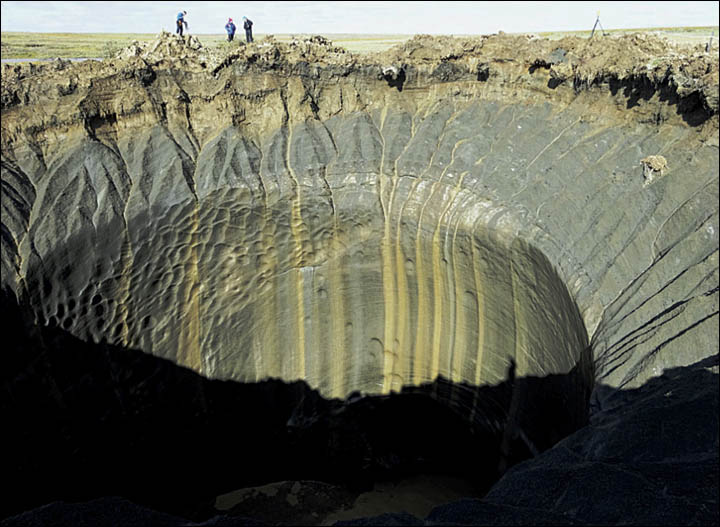
Reindeer herders stumbled upon something impossible. A hole. Not a sinkhole, not a gentle depression in the earth. This was a wound. A violent, perfectly circular gash punched through the permafrost, nearly 100 feet wide and plunging into an icy darkness. The earth around its rim was thrown outward, as if from a massive underground explosion. It looked, for all the world, like the planet had violently exhaled.
What created it? The internet, of course, exploded with theories. A meteor strike, but with no impact crater? A stray missile from a secret military test? A botched drilling operation? Or was it something else entirely? Something ancient and angry, stirring beneath the ice.
Scientists scrambled to the “end of the world” to find an answer. What they found was far more frightening than a missile. It was gas. Methane. And their investigation opened a door to one of history’s most enduring mysteries—a puzzle of vanished ships and lost planes thousands of miles away, in the warm, tropical waters of the Bermuda Triangle.
A Pattern of Rupture: The Siberian Outbreak
The Yamal crater wasn’t a freak event. It was just the first. Soon, reports of more holes trickled in. Another appeared in the Taz District. Then a third on the Taymyr Peninsula. A pattern was forming. The frozen north was… popping.
The first expedition to the Yamal crater was a nail-biting affair. Scientists rappelled into the abyss, their headlamps cutting through the gloom. The walls were sheer ice and frozen soil. The bottom was a slushy, muddy lake. The air itself was the biggest clue. It was thick with methane. Dangerously thick. Concentrations were nearly 10 percent—hundreds of times higher than normal. The slightest spark could have turned the entire chasm into an inferno.

The official theory began to solidify, and it was a chilling one. The culprit was something called a methane hydrate. Think of it as “fire ice.” It’s a substance where methane gas is trapped inside a crystal structure of frozen water, held in place by immense pressure and frigid temperatures. The Siberian permafrost is loaded with it. Trillions of cubic feet of it.
But the world is getting warmer. The permafrost, once eternally frozen, is beginning to thaw.
Imagine a bottle of champagne. The gas is dissolved, held in check by the pressure and the cork. Now, imagine shaking that bottle and warming it up for decades. The pressure builds. And builds. And builds. Until the cork can no longer contain the fury within.
That, scientists believe, is what happened in Siberia. A pocket of methane hydrate, buried deep underground, began to melt. The solid ice turned into a colossal bubble of high-pressure gas. The ground above bulged, forming a hill called a “pingo.” Finally, the pressure became too great. BOOM. The earth gave way, and a geyser of soil, ice, and methane gas erupted, leaving behind a terrifying, perfectly round scar.
A planetary burp. A geological bombshell. The mystery of the holes seemed solved. But this discovery didn’t close a book. It opened a much scarier one. Because this process, this sudden, violent release of gas from a frozen prison, doesn’t just happen on land.
It happens in the ocean, too.
From Arctic Blasts to Tropical Ghosts
Let’s leave the frozen tundra and travel halfway across the world. To a place of sunny skies, turquoise water, and a dark, persistent legend. The Bermuda Triangle. The Devil’s Triangle. An infamous stretch of the Atlantic between Florida, Bermuda, and Puerto Rico where the laws of physics seem to bend… and break.
The stories are iconic. They’re modern folklore.

Flight 19. Five US Navy Avenger torpedo bombers on a routine training mission in 1945. They flew into the Triangle… and vanished. Radio transmissions spoke of disoriented pilots, of compasses spinning wildly. “Everything is wrong… strange…” one pilot said. “We can’t be sure of any direction. Even the ocean doesn’t look as it should.” They were never seen again. A rescue plane sent to find them also vanished. Gone. Thirteen men erased from the sky.
The USS Cyclops. A massive US Navy collier ship, over 540 feet long. In 1918, it left Barbados with 306 crew and passengers. It sailed toward the Triangle and disappeared without a trace. No SOS. No wreckage. No lifeboats. It was one of the single largest losses of life in US Naval history not involving combat.
The list goes on. The Carroll A. Deering, a five-masted schooner found hard aground and completely abandoned. The Star Tiger and Star Ariel, two sister passenger planes that disappeared a year apart on the same route. The KC-135 Stratotankers that collided and exploded, yet searchers found a bizarrely small debris field, as if the ocean had swallowed the rest.
The official explanation is always the same. Storms. Human error. Rogue waves. But for so many cases, the disappearances were too sudden. Too complete. They happened in calm weather. Experienced pilots and captains suddenly went silent, leaving no wreckage, no oil slicks, nothing. As if a hole had opened in the sea and sky and swallowed them whole.
And that’s when Russian scientists, staring into a methane-filled crater in Siberia, put two and two together. What if the same “champagne cork” effect that blew holes in the tundra was also happening, silently and catastrophically, on the ocean floor?
Deep Dive: The Ocean’s Methane Bombs
The ocean floor, particularly along the edges of continental shelves, is just like the Siberian permafrost. It’s cold, and it’s under crushing pressure. The perfect environment for methane hydrates to form. And one of the largest known deposits of these “fire ice” reserves on Earth is on a place called the Blake Ridge.
Where is the Blake Ridge? Right off the southeastern coast of the United States. Just north of the Bermuda Triangle.
The theory is as simple as it is terrifying. An underwater landslide, or a slight warming of ocean currents, could destabilize a massive deposit of methane hydrate. The solid ice would sublimate, turning instantly into a gargantuan bubble of gas. This bubble, maybe hundreds of feet wide, would surge toward the surface.
Any ship unlucky enough to be sailing above this spot would face an instantaneous catastrophe.
How a Bubble Sinks a Battleship
It sounds like science fiction, but the physics are shockingly real. A ship floats because the water beneath it is dense. It displaces a weight of water equal to its own weight. This is buoyancy. Basic stuff.
But what happens when that water is suddenly filled with gas? It becomes a froth. An effervescent foam. The density plummets. Imagine trying to float in a glass of soda. You can’t. The water is no longer solid enough to support you.
A ship sailing into a patch of ocean that has just been hit by a methane eruption would lose all buoyancy. Instantly. It wouldn’t gently take on water. It would drop like a stone. The bow would plummet, the stern would lift, and the entire vessel would slide into the abyss in seconds. There would be no time for an SOS. No time to launch lifeboats. One moment you’re on a calm sea, the next you’re in a churning cauldron of gas and water, being dragged into the dark.
This explains the lack of wreckage. The ship isn’t torn apart; it sinks whole. It plummets to the deep ocean floor, where the immense pressure would crush its hull, burying it in the silt. Gone forever.
What about the planes? The theory gets even wilder. A massive cloud of methane gas wouldn’t just stop at the ocean’s surface. It would erupt into the atmosphere. Methane is lighter than air. It would rise, creating a huge plume of un-breathable, highly flammable gas. A plane flying through this plume would see its engines stall from lack of oxygen. A single spark from their electronics could ignite the entire cloud in a massive fireball. Or, the gas could simply overwhelm the pilots, causing disorientation and hypoxia before the plane falls from the sky.
Suddenly, the spinning compasses of Flight 19 and the strange atmospheric conditions reported by other victims don’t sound so paranormal. They sound like the effects of a massive, invisible gas cloud erupting from the sea.
The Skeptic’s Corner: Is This All Just Hot Air?
Now, let’s pump the brakes. Before we declare the mystery solved, we have to face the counter-arguments. Mainstream science is, to put it mildly, skeptical.
Geologists like Benjamin Phrampus at Southern Methodist University point out a major timing issue. Yes, there are huge methane hydrate deposits near the Triangle. But, they argue, the last time this area saw a massive, catastrophic gas release was at the end of the last Ice Age, some 20,000 years ago. There’s no hard evidence of a ship-sinking “ocean burp” happening in modern times.
Then there’s the very existence of the Bermuda Triangle itself. The U.S. Navy and the U.S. Board on Geographic Names don’t even recognize it as an official region. They state, unequivocally, that it does not exist.
Insurance giant Lloyd’s of London, which has to pay out when ships sink, has stated that their data shows no more losses in that area than in any other heavily-trafficked, storm-prone part of the ocean. Most of the famous “mysterious” disappearances, when investigated, turn out to be far less mysterious. They were hit by hurricanes, had known mechanical problems, or were piloted by inexperienced crew.
The “methane bubble” explanation, they say, is a solution looking for a problem that doesn’t actually exist.
A Final, Chilling Thought
But what if the skeptics are wrong? What if the timeline is off?
The same force that is melting the permafrost in Siberia—global climate change—is also warming our oceans. Ocean temperatures are rising. Currents are shifting. What if these changes are beginning to destabilize the methane hydrates on the Blake Ridge *right now*?
Perhaps we don’t need a single, massive, apocalyptic gas eruption. What if smaller, more frequent methane releases are happening? Not big enough to sink a supercarrier, but just big enough to create a patch of frothy water that could swamp a yacht. Or release a plume of gas that could cause a small plane’s engine to sputter and fail.
The Siberian craters are a warning. They are proof that our planet has a volatile, explosive mechanism built right into its crust. We can see the evidence, carved into the land at the end of the world. They show us what happens when the freezer gets too warm.
We can’t see what’s happening on the deep ocean floor. We have mapped the surface of Mars more accurately than we have mapped the bottom of our own seas. The fire ice is down there. Waiting.
Are the holes in Siberia and the legends of the Triangle just two different symptoms of the same planetary fever? Are these violent gasps from the Earth a preview of something far more devastating to come? The evidence is there. The theory fits. The craters are real. The ships are gone. Connect the dots. Or dismiss it as fantasy.
The choice is yours.