The Unthinkable Question: Did a Castaway Eat His Friend to Survive 438 Days at Sea?
What would you do to live? No, really. Strip away everything. Your home, your phone, your future. Put yourself in a tiny boat, lost on an endless ocean. The sun is your torturer. The water, your tormentor. Hunger is a monster gnawing at your insides. How far would you go? This isn’t a thought experiment. For one man, it was a horrifying reality. And for the family of the man who died beside him, it’s the source of a chilling, million-dollar question.
One man washed ashore. A ghost. A man who had been declared dead for over a year. His name was Salvador Alvarenga. He had survived 438 days adrift on the Pacific Ocean. An impossible feat. A miracle. But his story of survival, a tale of catching turtles with his bare hands and drinking his own urine, was soon shadowed by a much darker accusation. An accusation of the ultimate taboo.
Cannibalism.
A Fishing Trip to Hell
It started so simply. As these stories always do. November 17, 2012. The small fishing village of Costa Azul in Chiapas, Mexico. The air was thick with salt and the promise of a good haul. José Salvador Alvarenga, a seasoned and stocky 36-year-old fisherman, was getting his 25-foot fiberglass boat ready. It was a simple vessel. Open-topped. Powered by a single 75-horsepower engine. Its most important feature was a large, coffin-like icebox for storing the catch.
His usual fishing partner was a no-show. So, he turned to a younger, less experienced local man, 22-year-old Ezequiel Córdoba. Córdoba was hesitant, but the pay was good. They were planning a 30-hour trip, chasing shark, marlin, and sailfish. They packed light. A little water, a few supplies. They had a radio. They had an engine. What could go wrong?
Everything.
Hours into their trip, the sky turned a sick, bruised purple. A storm, a monster they call “El Norte,” fell upon them without warning. The wind shrieked. Waves, the size of small buildings, crashed over their tiny boat. The engine, their only hope, sputtered, coughed, and died. They were at the mercy of the sea. Alvarenga, the veteran, fought to get a message out on the radio. He reached his boss, screaming their coordinates, screaming that they were lost. Then, silence. The radio was dead. The storm had severed their last link to the world.
Surviving at the Edge of the World
The storm raged for five days. Five days of terror, bailing out water, clinging to the boat for dear life. When the sun finally returned, it revealed a new, horrifying reality. They were in a blue desert. Land was gone. The horizon was an unbroken, mocking circle in every direction. They were lost.
Days bled into weeks. Thirst became the immediate enemy. The small amount of fresh water they had was gone in a flash. Alvarenga, a man who knew the sea, began the grim calculus of survival. He taught Córdoba to drink turtle blood for hydration. To drink his own urine when there was no rain. He showed him how to catch fish with his bare hands, dangling them over the side to lure curious prey close enough to snatch.
It was a brutal, primal existence.
- Hydration: Rain was a blessing from heaven, collected in every possible container. When it didn’t rain, the options were grim: turtle blood and their own urine.
- Food: Anything that came close to the boat was fair game. Alvarenga would lie motionless for hours, waiting for a seabird to land, then snatch it. He caught dozens of turtles, eating their meat raw. Small fish, jellyfish, anything. Raw. Always raw.
Alvarenga adapted. He had to. His mind and body hardened to the new reality. But Córdoba was breaking.
The Slow Fade of Ezequiel Córdoba
The younger man wasn’t built for this. The psychological toll was immense. He was terrified of the raw food, often vomiting after eating. He would weep for his mother. The isolation and hopelessness were eating him alive, faster than the hunger. Alvarenga would try to rally his spirits, talking about the feasts they would have when they were rescued, describing giant meals in vivid detail to spark some will to live in his friend.
It didn’t work.
According to Alvarenga, Córdoba’s mind began to unravel. He would have hallucinations. One day, he tried to throw himself overboard, into the shark-patrolled waters, screaming that he wanted to end it. Alvarenga had to physically restrain him.
The final blow came from a bird. A hungry Córdoba snatched a seabird and, against Alvarenga’s warnings, ate it whole—including the poisonous sea snake he found in its stomach. He became violently ill. After that, he refused to eat. He gave up. Wasting away, he made Alvarenga promise him two things: that he would find his mother and tell her what happened, and that he would not eat his body. Alvarenga promised. A few days later, Ezequiel Córdoba died.
Alone with the Dead
What happened next is perhaps the strangest, most disturbing part of Alvarenga’s tale. He didn’t push the body overboard. Not right away. For six days, he kept his dead friend in the boat. He propped him up. He talked to him. He’d ask, “How was your sleep?” He’d ask, “Have you eaten?”
Was this a man consumed by grief and loneliness, clinging to the last human face he had seen? A mind shattered by trauma, creating a phantom companion to fend off the crushing insanity of solitude? Or was it something else?
On the sixth day, Alvarenga said he looked at the corpse in the morning sun and realized he was talking to a dead man. The shock of it, the reality, finally broke through his psychosis. He said goodbye to his friend and gently pushed the body of Ezequiel Córdoba into the Pacific.
Now, he was truly alone.
For more than a year, Salvador Alvarenga drifted. He drifted across 6,700 miles of ocean. He saw container ships, tantalizingly close, but they never saw him. He battled the sun, the storms, and the madness within his own mind. He counted the full moons. Fourteen of them. Then, on January 30, 2014—438 days after he left Mexico—he saw it. Green. Trees. Land.
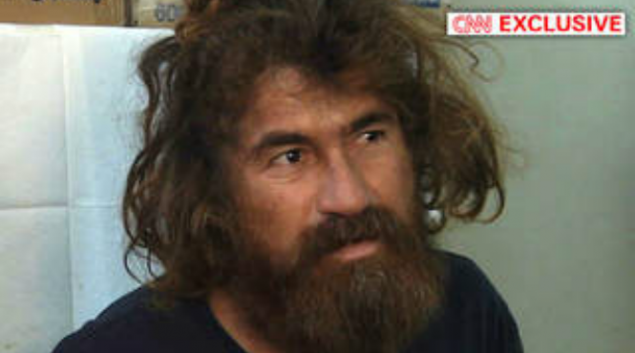
He washed ashore on the Ebon Atoll in the Marshall Islands, a wild-haired, bearded man who looked more like a creature than a human. He was found by locals, his incredible ordeal finally over. The world was stunned. He had done the impossible.
The Million-Dollar Accusation
The story was a media sensation. A testament to human endurance. Alvarenga returned home a hero, a modern-day Robinson Crusoe. He collaborated on a book, titled simply *438 Days*. But as the details of his story emerged, so did the questions. And then came the lawsuit.
The family of Ezequiel Córdoba filed a one-million-dollar lawsuit. The charge? That Salvador Alvarenga had not simply survived alongside their son. They claimed he had survived *because* of their son. They accused him of cannibalism.
Suddenly, the story twisted. The hero was now a potential monster. The details that once seemed like tragic quirks of a broken mind now looked sinister. Why keep the body for six days? Was it to “befriend” a corpse, as he claimed, or was it for a more practical, gruesome purpose? The family’s lawyer was blunt, suggesting Alvarenga survived by eating Córdoba’s flesh to stay alive.
He Said, They Said: Unpacking the Mystery
The case against Alvarenga was circumstantial, built entirely on suspicion and the perceived improbability of his survival. There was no physical evidence. Just a story that seemed too incredible to be true and a grieving family looking for answers.
The Family’s Doubts:
- The Six Days: This was the biggest red flag for them. Why would a sane person keep a decaying corpse in a small boat under the hot tropical sun for almost a week? To them, it defied logic, unless there was a sinister motive.
- The Miraculous Survival: Alvarenga was found in remarkably stable health. He was puffy and had trouble walking, but he wasn’t the emaciated skeleton many expected. Could raw birds and turtles alone sustain a man for 14 months?
- The Book Deal: The lawsuit was timed around the release of Alvarenga’s book. The family felt he was profiting from their son’s death, and they wanted a piece of the money they believed he was making—and they wanted the truth to come out.
Alvarenga’s Defense:
- Psychological Trauma: His supporters, including the book’s author, Jonathan Franklin, argued that his behavior was a classic symptom of extreme psychological distress. Keeping the body was a way to stave off total madness, a desperate act of a mind on the brink.
- The Promise: Alvarenga has always been firm that he promised his dying friend he would not eat him. He insists he honored that promise, no matter how desperate he became.
- Expert Analysis: Survival experts and doctors who examined Alvarenga found his story plausible. His physical condition (being overweight) was explained by organ and tissue damage causing him to retain massive amounts of fluid. His detailed knowledge of micro-survival techniques—like how to catch birds and turtles—was consistent with his background as a fisherman.
What If? Entering the Heart of Darkness
Let’s ask the question that the lawsuit forces us to confront. What if they’re right? What if Alvarenga, faced with certain death, made the most terrible choice a human can make?
It wouldn’t be the first time. History is littered with grim tales of survival cannibalism. The Donner Party, trapped in the Sierra Nevada mountains in 1846, resorted to eating their dead to survive the winter. The survivors of the 1972 Andes flight disaster, immortalized in the book and movie *Alive*, made a pact to use the bodies of the deceased so that some might live.
These are not stories of monsters. They are stories of ordinary people pushed far beyond the limits of human endurance. In these situations, morality becomes a luxury. The biological imperative to survive overrides everything else. If Alvarenga did what the Córdoba family accuses him of, does it make him a murderer? Or does it make him a survivor who did what was necessary when trapped between the unthinkable and the impossible?
The act is horrifying. But the judgment of it, from the comfort and safety of our own homes, is a complicated thing. We have no concept of the kind of hunger that could drive a person to that point. No idea of the madness that an empty ocean can breed.
A Mystery the Ocean Won’t Give Up
The lawsuit ultimately faded, generating headlines but little else. Alvarenga’s book did not become a bestseller. There was no windfall of cash, just a quiet, haunted life back on land. He suffers from PTSD and a deep fear of the water. The man who survived the ocean can no longer stand to be near it.
Today, the story of Salvador Alvarenga lives on, debated in internet forums and true-crime podcasts. Internet sleuths pick apart his timeline. They question the science of his survival. They debate the psychology of his six days with the dead.
But the truth? The absolute, final truth of what happened in that tiny boat between two men—one who lived and one who died—remains lost at sea. It’s a secret kept by the vast, silent Pacific.
We are left with two portraits of the same man. Is he one of the most remarkable survivalists in human history, a man whose iron will and knowledge of the sea allowed him to endure the unendurable? Or is he the keeper of a dark secret, a man who carries the weight of a terrible choice made in a moment of ultimate desperation?
The ocean gave him back his life. But it may have kept his soul.