Wednesday, August 12, 2026
HomeSpace & ScienceScienceWhat is the upper size limit of black holes?

What is the upper size limit of black holes?

The Cosmic Monsters Hiding in the Dark: Why 50 Billion Suns Might Just Be the Appetizer

Space isn’t just dark. It isn’t just cold. It is hungry.

When you look up at the night sky, you see the stars, the reassuring twinkle of distant light. But the real action? The real terror? It’s happening in the voids between the lights. There are things out there that defy physics. Monsters that chew up reality itself and spit out nothing.

For years, astronomers slept soundly believing there was a limit. A cap on the madness. They thought gravity had a ceiling.

They were wrong. Or at least, they were only looking at the things they could see. But what about the things they can’t see?

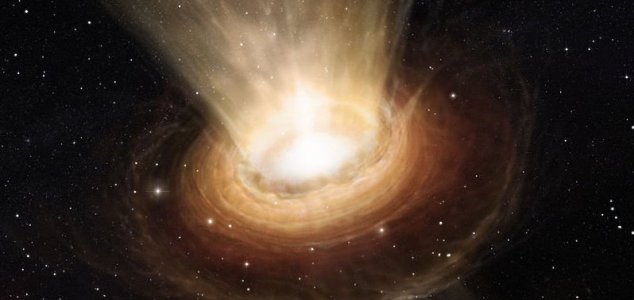
Black holes can grow to become truly monstrous.

The 50 Billion Limit: A Cosmic Speed Limit?

Let’s rewind. Back to the basics of cosmic horror.

We know about black holes. You take a star, you crush it down to a single point of infinite density, and you get a gravity well so deep that not even light can climb out of it. It’s a one-way ticket to oblivion. For a long time, we knew about “stellar mass” black holes—maybe 10 or 20 times the mass of our sun. Scary, sure. But small potatoes.

Then we found the Supermassives.

These sits at the center of galaxies like spiders in the center of a web. Sagittarius A* is right in the middle of our own Milky Way. It holds us together. It’s huge. But recently, a study led by Professor Andrew King from the University of Leicester dropped a bombshell that shook the astrophysics community to its core.

His calculations suggest there is a physical limit to how big these things can grow via traditional feeding.

50 billion solar masses.

Read that again. Fifty. Billion. Suns.

That is a number the human brain physically cannot process. If the Earth were a grain of sand, this black hole would be the size of the entire Solar System. Maybe bigger. It is a size that borders on the ludicrous. Professor King’s research looked at the accretion discs—the swirling buffet of gas and dust that orbits a black hole, waiting to be eaten.

The “Choking” Point

Here is where the physics gets weird. And fascinating.

A black hole eats by pulling gas in. As that gas spirals down the drain, it heats up. Friction. It gets hot. Incredibly hot. It glows brighter than a thousand galaxies. That’s how we see them. We don’t see the hole; we see the dinner.

Professor King found that when a black hole reaches that magic number—50 billion times the mass of our sun—the game changes. The gravity is so intense, and the disc is so massive, that the gas on the outer edges doesn’t just spiral in. It collapses under its own weight.

It turns into stars.

Instead of feeding the monster, the food turns into a solar system. It’s like trying to drink a milkshake, but the milkshake freezes into solid rock before it hits your mouth. The black hole stops growing because its food supply cuts itself off. It chokes on its own size.

“The significance of this discovery is that astronomers have found black holes of almost the maximum mass, by observing the huge amount of radiation given off by the gas disc as it falls in,” said Professor King. “The mass limit means that this procedure should not turn up any masses much bigger than those we know, because there would not be a luminous disc.”

Case closed? We are safe from anything bigger than 50 billion suns?

Absolutely not.

The Invisible Nightmares: SLABs and Dark Mergers

Science is never settled. It just finds new, terrifying questions.

Professor King’s study puts a cap on black holes that eat gas. But there is another way to grow. A darker, more violent way.

Cannibalism.

What happens when a black hole that is 50 billion solar masses meets another black hole that is 50 billion solar masses? They don’t stop. They don’t bounce off each other. They merge. They crash together in a cataclysm so powerful it ripples the fabric of spacetime itself—gravitational waves that wash over the universe like a tsunami.

And the result? A monster of 100 billion solar masses.

But here is the catch. The terrifying catch.

“But no light would be produced in this merger, and the bigger merged black hole could not have a disc of gas that would make light,” King explained.

Did you catch that? No light.

This creates a class of object that theorists are now calling SLABs—Stupendously Large Black Holes. Or “Ultramassive” Black Holes. These entities could be drifting through the cosmos right now. They could be 100 billion, 500 billion, maybe even a trillion times the mass of the sun.

And they would be completely, utterly invisible.

The Great Attractor Connection

Have you ever heard of the Great Attractor? If you want to lose sleep tonight, look it up.

Our galaxy, and thousands of other galaxies around us, are being dragged through space at tremendous speeds. We are being pulled toward… something. Something heavily obscured by the “Zone of Avoidance” (a dusty patch of sky we can’t see through). For decades, astronomers have scratched their heads.

What has enough gravity to pull galaxies across the universe like toys on a string?

Could it be one of these Dark Mergers? A Silent King sitting in the void? If a black hole grows large enough, effectively eating its own accretion disc and merging with others in the deep dark, it becomes a ghost. A ghost with the gravitational pull of a god.

We wouldn’t see it coming. We would just feel the tug. And by then, it’s too late.

Modern Findings: The Beast of TON 618

Since this original theory surfaced, the internet has gone wild over a specific coordinate in the sky: TON 618.

This isn’t science fiction. This is a real object, located about 10.4 billion light-years away. It is currently the heavyweight champion of the known universe. It is a quasar—a black hole actively feeding. And its mass?

66 billion solar masses.

Wait. Didn’t we just say the limit was 50?

This is where the mystery deepens. TON 618 pushes the absolute boundaries of King’s model. It suggests that perhaps in the early, violent universe, the rules were different. Or perhaps TON 618 is the result of a “direct collapse”—a cloud of gas so huge it bypassed the star stage and just crunched straight into a singularity.

TON 618 is so large that its event horizon—the point of no return—is 1,300 astronomical units (AU) wide. For context, Pluto is about 40 AU from the Sun. You could fit our solar system inside TON 618 side-by-side dozens of times over. A beam of light would take weeks to cross its shadow.

It defies logic. It defies sanity.

The Alternative History: Are They Portals?

We have to ask the question. We have to look at the fringe theories. Because when the mainstream science gets this bizarre, the “crazy” theories start looking reasonable.

Why do these things exist?

Einstein called them a mathematical error. He didn’t think they could physically form. But they are here. Some alternative historians and theoretical physicists suggest that supermassive black holes aren’t just trash compactors. They might be engines. Or seeds.

The Universe as a Hologram

There is a theory called the Holographic Principle. It suggests that all the information in our 3D reality is actually stored on a 2D surface at the edge of the universe. Where does this math come from? Black hole thermodynamics.

If these “Ultramassive” giants exist—the ones King says are invisible—are they the hard drives of reality? Are they deleting data? Or are they backing it up?

Some suggest that our entire universe is actually the interior of a black hole in a much larger universe. It sounds nuts, right? But mathematically, it checks out. The expansion of our universe looks suspiciously like the time-reversed collapse of a black hole.

If that’s true, then these monsters we see—TON 618, the Great Attractor, the 50-billion-sun giants—might be the birth canals of other, baby universes. We are looking at the backsides of creation.

The Fear of the Dark

Let’s bring it back to Professor King’s warning. “Bigger black hole masses are in principle possible… But no light would be produced.”

This is the ultimate cosmic horror. We rely on light. We hunt for exoplanets by watching stars dim. We hunt for black holes by watching gas glow. We are creatures of the light. We assume that if something is dangerous, we will see it coming.

But the biggest predators in the jungle don’t wear neon signs. They are camouflaged.

Imagine a black hole the mass of a galaxy. No disc. No radiation. Just a pure, silent sphere of warped space. It could pass through a star cluster and simply delete the stars one by one, without a flash, without a sound. Just… gone.

Are there wandering Ultramassive Black Holes in the voids between galaxies? Almost certainly.

Could one enter the Milky Way? Theoretical models say it’s unlikely, but “unlikely” is not “impossible.” And in a universe that is 13.8 billion years old, “unlikely” events happen every day.

The “Primordial” Theory

There is another twist. Recent internet theories have resurrected the idea of Primordial Black Holes. These didn’t form from dying stars. They formed in the first fraction of a second after the Big Bang, when the universe was hot and dense.

Some of these could be microscopic. Others could be colossal. If a Primordial Ultramassive Black Hole exists, it wouldn’t need to follow King’s rule about accretion discs. It was born big. It has been lurking in the dark since before the first star ignited.

It is older than light itself.

Summary: The Abyss Stares Back

So, what do we do with this information?

Professor King has given us a ceiling for the “normal” monsters. 50 billion suns. That is the limit for the glowing, eating, screaming black holes we can see with our telescopes. It is a comforting limit. It suggests order. Rules. Physics we can understand.

But he also opened the door to the things in the basement.

The Dark Mergers. The silent giants. The ones that have grown fat on the corpses of other singularities. They are out there, drifting in the Deep Fields, invisible to our eyes but heavy on the fabric of reality.

Space is not empty. It is full of ghosts. And some of those ghosts weigh 100 billion times more than our sun.

Next time you look at a patch of empty sky where there are no stars, don’t just assume it’s empty space. It might be something looking back at you. Something so big, light itself refuses to touch it.

Watch this breakdown of just how massive these things really get. It puts our tiny, fragile existence into perspective really fast.

The universe is stranger than we can suppose. And much, much darker.


Originally posted 2015-12-24 15:29:07. Republished by Blog Post Promoter

Arindam Mukherjee
Arindam Mukherjee
Arindam loves aliens, mysteries and pursing his interest in the area of hacking as a technical writer at 'Planet wank'. You can catch him at his social profiles anytime.
RELATED ARTICLES
- Advertisment -

Most Popular

Recent Comments

Warren Pan Abbott on The legend of the Devil Monkey !
chris davies on The McPherson Tape Mystery
Reed Reedly on ET has Internet!
Bea Houseoffashion on Proof Of Time Travellers – Gallery
Marcus2012 on ET has Internet!
Reed Reedly on ET has Internet!
LaughsAtConspiracyNuts on The 9/11 Conspiracy – Myths and Facts
Alex Sliverman on Did the ancients fly?
Doctor Wholigan on Time Traveler in 1938 film
chris davies on The McPherson Tape Mystery
Archie1954 on 10 secret UFO hideouts
chris davies on Ghosts of flight 401
Marcus2012 on ET has Internet!
jason Macdonald on Proof of Time Travel? – China
chris davies on Long-Lost Pyramids Found?
Reed Reedly on ET has Internet!
Milkman on Connected Universe
Tenmiles on Baigong Pipes Mystery
Simon Foster on Sirius – The Documentary
From the 1st April on 2013 – Alien Contact date ?
SkyWatcher on Is ET ignoring us?
I Come From The Future on Obama to make UFO Alien disclouser soon ?
ÛñK?øWn on 2013 – Alien Contact date ?
Just another person on 2013 – Alien Contact date ?
Malcolm Windowcleaner on The strange case of Rudolph Fentz
Mason Servio on Strange Things on Mars
Marke Wisdom Seeker on What will we find as arctic melts?
Andrea A Elisabeth Levyne on Aliens Captured in Varginha, Brazil
Mitch Grouyeki on Amazing Space Shuttle pictures