The 84-Million Star Photo That Shattered Our Sense of Reality
You think you’re big? You think your problems are big? Let me tell you about a photograph.
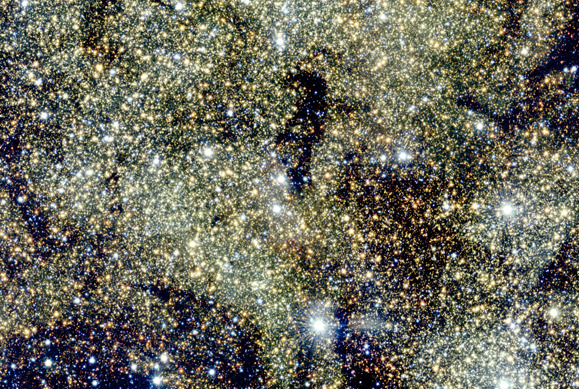
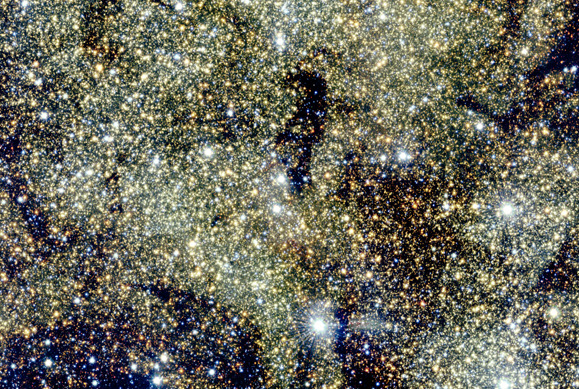
It’s not a photo of a celebrity. Or a sunset. Or a historical event. It’s a picture of our galactic neighborhood, and it’s so vast, so packed with information, that if you tried to print it at standard resolution, you’d need a billboard the size of a city block. This single image, a 9-gigapixel behemoth, captured 84 million individual stars in the heart of our Milky Way.
Eighty. Four. Million.
Let that number sink in. That’s more people than live in Germany. Each one a sun. Many, probably most, with their own orbiting planets. A celestial census of unimaginable proportions.
And here’s the kicker. The part that should make the hair on your arms stand up.
That colossal image, with its 84 million suns? It covers about one percent of the night sky.
One. Percent.
We’re not just looking at a picture. We’re peering through a pinhole into an abyss, and the scale of what lies beyond is something the human mind was simply not built to comprehend. This isn’t just about astronomy anymore. This is about our place in the cosmos, and the questions it forces us to ask are staggering, thrilling, and frankly, a little terrifying.
Deep Dive: The Machine That Counted the Stars
This reality-bending photograph wasn’t taken with your cousin’s fancy DSLR. It was the work of a monster. A high-tech behemoth called the Visible and Infrared Survey Telescope for Astronomy, or VISTA, perched high in the desolate, bone-dry Atacama Desert of Chile. The air there is so thin and clear, it’s like there’s nothing between you and the void.
VISTA doesn’t see like we do. It’s designed to peer through the thick, cosmic dust clouds that obscure the heart of our galaxy. These colossal curtains of gas and debris hide the Milky Way’s most crowded, chaotic, and ancient regions from normal telescopes. But VISTA, with its infrared eyes, slices right through the veil. It sees the heat signatures of stars that have been hidden from humanity for our entire existence.
The project was called the VISTA Variables in the VÃa Láctea survey, or VVV. Over several years, astronomers methodically scanned the central bulge and disk of our galaxy. The result was a digital file so enormous it would take thousands of high-definition TVs to display it all at once. Inside this single file lies a treasure map of stellar nurseries, dying red giants, and countless main-sequence stars, each a potential anchor for a planetary system.
Think about what they found. Eighty-four million points of light confirmed. They didn’t just see them; they cataloged them. Their brightness. Their color. Their position. A database of suns. And this was just one project. A single, focused effort. What else is hiding out there, just beyond the reach of our current technology?
The Scale Problem: A Grains of Sand on an Infinite Beach
It’s easy to throw numbers around. 84 million. 100 billion. A trillion. They become meaningless, like Monopoly money. So let’s try to ground this.
Imagine you’re standing on a beach. A truly massive beach that stretches from horizon to horizon in every direction. You bend down and scoop up a single handful of sand. You meticulously count every single grain in your palm. It takes you a lifetime, but you do it. You count 84 million grains.
Congratulations. You’ve just counted the stars in the VISTA photograph.
Now look up. Look at the beach that stretches to infinity around you. All of that is the rest of the Milky Way galaxy. Scientists estimate there are, at a minimum, 100 to 400 billion stars in our galaxy alone. We haven’t even counted one percent of one percent of them. Our epic photo, our 9-gigapixel masterpiece, is less than a single handful of sand on a planet-sized beach.
Feeling small yet? Good. Because we’re just getting started.
Leaving the Neighborhood
Our galaxy, the Milky Way, is just one island in a sea of other islands. For a long time, we thought our star-beach was the only one. We were wrong. Terribly, beautifully wrong. Thanks to pioneers like Edwin Hubble, we realized those fuzzy little smudges in the sky weren’t clouds of gas in our own galaxy. They were other galaxies. Entirely separate universes of stars, each containing hundreds of billions of their own suns.
And how many of these cosmic islands are there? The current best guess, based on our deepest space observations, is somewhere around two trillion. That’s 2,000,000,000,000.
Try to picture that. It’s impossible. So let’s go back to our analogy. Our handful of sand was the VISTA photo. The entire beach was the Milky Way. Now, imagine that every single grain of sand on every beach on the entire planet Earth represents another galaxy. Not another star. Another *galaxy*, each packed with its own billions of stars. That’s the scale we’re dealing with.
And we’ve only just begun to look.
Peering Through God’s Keyhole: The Hubble Deep Field
How do we even know this? How do we get a number like two trillion? It comes from one of the most audacious experiments in the history of science. An act of supreme cosmic gambling.
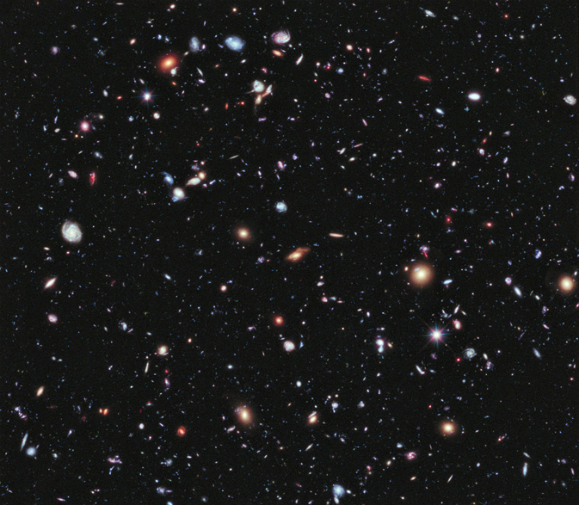
Back in 1995, astronomers with the Hubble Space Telescope did something that sounded insane. They pointed the world’s most powerful telescope at a patch of sky that was, for all intents and purposes, empty. It was a tiny sliver of darkness near the Big Dipper, a section of space about the size of a grain of sand held at arm’s length. Other astronomers thought it was a colossal waste of time and money. There was nothing there.

For ten consecutive days, Hubble stared. It opened its electronic eye and just drank in the faint, ancient light trickling in from the blackness. It was collecting photons that had been traveling through space for billions of years, since before the Earth had even formed. When the final image was processed and released, it changed everything.
The blackness wasn’t empty. It was overflowing.
The image, now famously known as the Hubble Deep Field, contained over 3,000 objects. And they weren’t stars. Almost every single one was an entire galaxy. Some were majestic spirals like our own. Others were messy, chaotic blobs, caught in the act of colliding. Some were just faint, red smudges—galaxies so far away that their light had been traveling for over 12 billion years to reach us. We were looking at the universe when it was just a toddler.
This experiment was so successful they did it again, creating the Hubble Ultra-Deep Field and the eXtreme Deep Field. Each time they stared into the “void,” they found it paved with galaxies. It was a stunning revelation: the universe is isotropic. In every direction you look, it’s the same story. Galaxies. Everywhere.
The New Sheriff in Town: What the James Webb Telescope is Telling Us
For decades, Hubble was the king. The undisputed champion of deep space observation. But the original post you read is now a relic of a bygone era. A new eye has opened on the cosmos, and it’s a hundred times more powerful. Enter the James Webb Space Telescope (JWST).
Launched on Christmas Day 2021, the JWST is an infrared telescope. Think of it as having cosmic night-vision goggles. While Hubble sees primarily in visible light, Webb is tuned to see the longer wavelengths of infrared. Why does this matter? Because of something called “redshift.” As the universe expands, light from the most distant objects gets stretched out, like the sound of an ambulance siren changing pitch as it moves away from you. The light shifts from visible to infrared. This means the oldest, most distant galaxies are completely invisible to Hubble. But to Webb, they shine like beacons.
Rewriting the First Chapter of the Universe
The very first images from Webb in 2022 were a bombshell. They weren’t just better than Hubble’s; they were… impossible. At least according to the theories we had.
The telescope found massive, well-formed, structured galaxies from just 300-400 million years after the Big Bang. This shouldn’t be possible. That’s like finding a fully grown redwood tree just a week after you planted the seed. The prevailing wisdom said that early galaxies should have been small, messy, and chaotic. Instead, Webb is showing us a cosmic nursery filled with surprisingly mature infants. This has sent astrophysicists scrambling, forcing them to rethink the very first chapter of cosmic history.
What does this mean? It could mean that the process of galaxy and star formation is far more efficient and rapid than we ever imagined. Or it could mean something is fundamentally wrong with our model of the early universe. The mystery just got deeper.
Are We Alone? The Chilling Silence of a Crowded Universe
This brings us to the most profound and unsettling question of all. A question that haunts the edges of all these incredible discoveries. We’ve established the universe is almost comically large and filled with an uncountable number of stars. The VVV survey showed us 84 million in our own backyard. Webb is showing us trillions of galaxies. The chemical ingredients for life—carbon, oxygen, water—are common throughout the cosmos.
So… where is everybody?
This is the heart of the Fermi Paradox, named after physicist Enrico Fermi, who supposedly posed the question during a casual lunch. The logic is simple and brutal:
- There are billions of sun-like stars in our galaxy.
- Many of these stars likely have Earth-like planets.
- Some of these planets should have developed life.
- A fraction of those might have developed intelligent life.
- Some of those should have developed interstellar travel by now.
Even with the vast distances, if a civilization started exploring the galaxy millions of years ago (a cosmic blink of an eye), they should be here. Their probes, their signals, their artifacts should be everywhere. Yet we see nothing. We hear nothing. Just a great, cosmic silence.
What if the Silence is the Answer?
This is where things move from science into the realm of chilling speculation. The potential solutions to the Fermi Paradox read like plots from the best science fiction.
The Great Filter: What if there’s a barrier that almost no species can overcome? Maybe the leap from single-celled to multi-celled life is nearly impossible. Or maybe the invention of technology inevitably leads to self-destruction through war or environmental collapse. We might be approaching this filter ourselves, and we have no idea if we’ll make it through.
The Zoo Hypothesis: Maybe they are out there, and they’re watching us. We could be in a cosmic wildlife preserve, a protected “zoo” where advanced civilizations observe our primitive development without interfering. The “Prime Directive” from Star Trek, but on a cosmic scale.
We Can’t Understand the Signal: Perhaps the universe is teeming with signals, but we’re too technologically backward to recognize them. It’s like giving a tribe in the Amazon a smartphone; they might use it as a shiny rock, never comprehending the global communication network it represents. Advanced alien communication might be woven into the fabric of spacetime itself, and we’re trying to find it with radio dishes.
We Are First: This is perhaps the loneliest and most humbling possibility. What if we are simply the first? In 13.8 billion years of cosmic history, what if we are the very first species to reach self-awareness and look up at the stars? If this is true, it bestows a terrifying and awesome responsibility upon humanity. The light of consciousness in the universe might rest entirely in our fragile hands.
Beyond the Edge: The Wall at the End of Spacetime
There’s one final twist in this cosmic story. Even with the James Webb Telescope, there’s a hard limit to what we can ever see. The universe is about 13.8 billion years old. That means we can’t see anything farther than 13.8 billion light-years away, because the light from beyond that point hasn’t had time to reach us yet. This boundary is called the Cosmic Light Horizon.
It’s not a physical wall. It’s a temporal one. And because the universe is constantly expanding—an expansion that is accelerating—there are galaxies whose light will *never* reach us. They are being carried away by the expansion of space itself faster than the speed of light. We are, in a very real sense, forever cut off from the vast majority of the cosmos.
What lies beyond that horizon? Is it just more of the same? More galaxies, more stars, stretching on into a true, physical infinity? Or does our universe itself have an edge? And if it does, what’s on the other side?
This leads to the wild theories of the multiverse. The idea that our entire universe, everything we can and cannot see, is just one bubble in a boiling foam of other universes, each with potentially different laws of physics. It’s a mind-shattering concept, one that lives on the bleeding edge of theoretical physics, but it’s a natural extension of this journey.
We started with a photograph of 84 million stars. We zoomed out to a galaxy of 400 billion. We zoomed out further to a visible universe of 2 trillion galaxies. And now we stand at the precipice, wondering if it all might be just a single grain of sand on a beach of infinite, unknowable universes.
So the next time you feel big, the next time your problems feel overwhelming, look up. Remember the 9-gigapixel photo. Remember the handful of sand. Remember the silent, crowded, impossible cosmos. We are a tiny flicker of awareness in an ocean of magnificent, terrifying mystery. And the exploration has only just begun.