The Silence Breakers: Did We Actually Hear Them in 2004?
Space is quiet. Terrifyingly quiet. For decades, we have pointed our biggest, most sensitive metal ears toward the stars, begging for a whisper. We want to know we aren’t alone in this infinite black ocean. Most of the time? We get nothing. Just the hiss of cosmic background radiation. The sound of the universe exploding in slow motion.
But sometimes, the static breaks.
There are moments in history where the needles jump. Where the data screams. We aren’t talking about glitches or microwave ovens in the breakroom. We are talking about mathematical impossibilities. This is the story of the times the universe might have called us back.

The Arecibo Anomaly: SHGb02+14a
February 2003. The massive Arecibo Observatory in Puerto Rico—a titan of engineering that has since tragically collapsed—was scanning the heavens. The SETI (Search for Extraterrestrial Intelligence) team wasn’t just fishing randomly. They were re-examining 200 specific spots in the sky. These were the “hot spots.” The places that had previously burped out strange, unexplained noises.
They checked them again. Silence. One by one, the candidates failed. Just random noise. Space dust. Nothing.
Except for one.
The signal is technically named SHGb02+14a. Catchy, right? But what it represents is mind-bending. In 2004, after analyzing the data, researchers realized this signal didn’t just persist. It got stronger.
The Impossible Location
Here is where your skin should start to crawl. The signal originated from a specific patch of darkness between the constellations Pisces and Aries. Look at that spot through a standard telescope, and you will see… nothing. No nearby stars. No known planetary systems. No nebulae.
It was a ghost signal coming from a void.
If there is a civilization out there, they aren’t broadcasting from a sunny Earth-like rock next door. They might be hiding in the deep dark, far away from any star we can see. Or perhaps, they are transmitting from a ship moving through the emptiness.
The “Watering Hole” Frequency
Why do astronomers care about this specific blip? It’s all about the frequency. The signal hit the antennae at 1420 MHz.
To the average person, that number means nothing. To an astrophysicist, it is the Holy Grail. This is the frequency of neutral hydrogen. Hydrogen is the most abundant stuff in the universe. It is the building block of everything. If you were an intelligent alien trying to get the attention of another intelligent species, you wouldn’t send a message on a random channel. You would pick the one channel everyone is listening to.
We call this the “Watering Hole.” It’s the universal meeting place. And SHGb02+14a was singing right in that key.
The Drift: A Spinning Mystery
But it wasn’t a perfect tone. It was drifting. The frequency changed rapidly, by about 8 to 37 Hertz per second. This usually means the source is moving. Spinning. Rotating fast.
This is where the skeptics jump in. They say, “It’s just a pulsar!” A pulsar is a dead star spinning like a lighthouse, blasting radiation. It makes sense. Except for one problem. A pulsar doesn’t just buzz once or twice. It repeats with the precision of an atomic clock. We know what pulsars look like.
This didn’t look like a pulsar. It looked… messy. It looked artificial.
The drift was so fast that if it were coming from a planet, that planet would have to be rotating nearly 40 times faster than Earth. Is that impossible? No. But it is extreme. Some theorists suggest the signal could be a byproduct of a massive alien engine, or a communication beam sweeping across our solar system like a spotlight.

The Hacker Theory
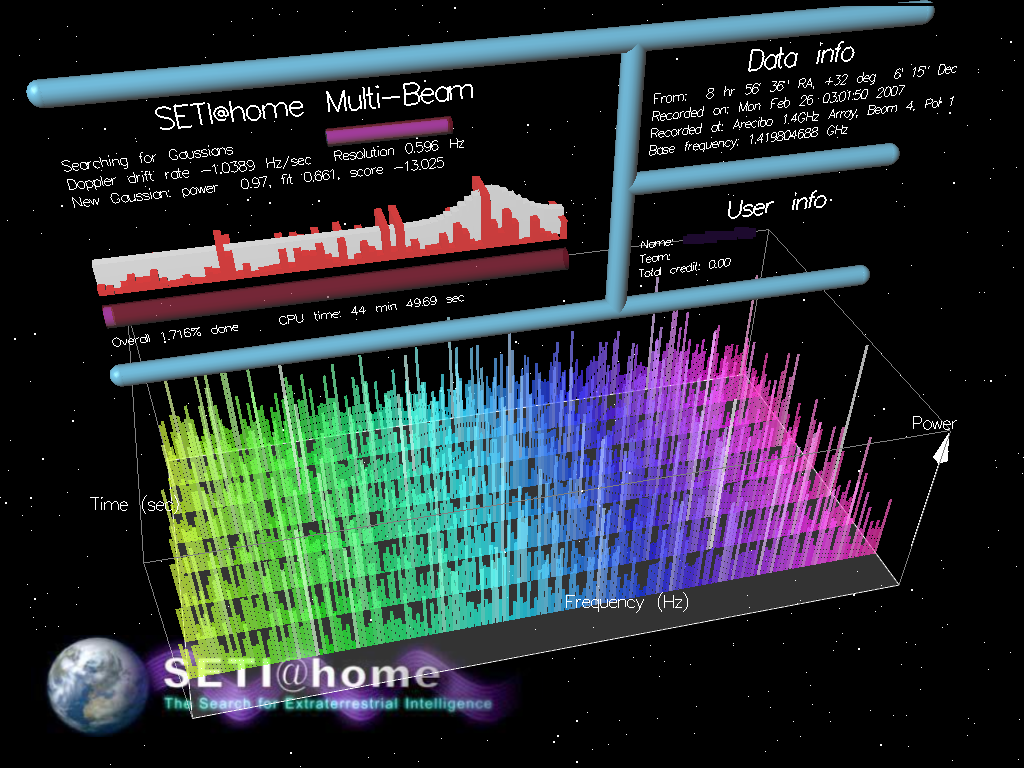
We have to look at the other side. The skepticism. The image above shows the SETI@home screensaver. Millions of people in the early 2000s downloaded this. It used their idle home computers to crunch data from Arecibo. It was a beautiful experiment in distributed computing.
But it also introduced a weak link. Humans.
Some cynics believe SHGb02+14a wasn’t aliens. They think it was a hacker. Someone who wanted to be part of history. Could a user have modified the data packet on their home PC and sent it back to the SETI servers? “Hey look, I found aliens!” It is possible. But SETI engineers scrubbed the data. They checked for tampering. They claimed the signal appeared in data processed by two different users.
Unless it was a very sophisticated attack, the signal was real. It was in the sky. And then, like a phantom, it vanished.
1977: The Night the Universe Screamed “Wow!”
You cannot talk about the 2004 signal without bowing down to the grandfather of all space mysteries. The “Wow!” signal.
August 15, 1977. Elvis Presley was about to die. Star Wars was in theaters. And in Ohio, a radio telescope nicknamed “The Big Ear” was listening to the constellation Sagittarius.
Jerry Ehman, a volunteer astronomer, was reviewing the computer printouts a few days later. He saw a string of characters that shouldn’t have been there. He circled them in red pen and wrote one word in the margin: Wow!
6EQUJ5: Decoded
People get confused about this. They think “6EQUJ5” is the message. Like an alien language. It’s not. It’s just a measurement of volume.
The telescope used numbers 1-9 to rate signal intensity. If the signal got louder than a 9, it used letters. ‘A’ is louder than ‘9’. ‘B’ is louder than ‘A’.
This signal went all the way up to ‘U’. That is deafeningly loud. It was 30 times stronger than the background noise of deep space. It was a scream.
The Perfect Profile
Here is why the Wow! signal keeps scientists awake at night:
- It was Narrowband: Nature is messy. Natural radio sources (like the Sun or Jupiter) blast out noise across a wide range of frequencies. This signal was razor-sharp. It was focused.
- The Frequency: 1420 MHz. Again. The Hydrogen Line. The exact same “hello” channel we would use.
- The Duration: It lasted exactly 72 seconds. Why? Because that is exactly how long it took for the rotation of the Earth to push the “Big Ear” telescope past that specific point in the sky. The signal didn’t stop; we moved away from it. It was a continuous beam coming from deep space.
The nearest star in that direction is 220 million light-years away. If it came from there, the transmitter would need to be powerful enough to light up half the galaxy.
Why Haven’t They Called Back?
This is the question that drives us crazy. We went back. We listened to Sagittarius again. We listened to Pisces again. We pointed better, stronger, modern ears at these coordinates.
Dead silence.
Why? If you are sending a message, don’t you repeat it? If you are a lighthouse, you don’t flash once and then turn off the bulb.
Modern internet theories offer some chilling explanations.
Theory 1: The Sweeping Beam
Imagine a lighthouse beam sweeping across the ocean. If you are standing on the shore, you see the light flash for a split second, then it’s gone. You might wait hours or years for the rotation to bring it back to your eyes. Maybe these alien transmitters are rotating. Maybe the “Wow!” signal hits Earth once every 400 years. We just got lucky in 1977.
Theory 2: The Dark Forest
This is the scary one. Based on the sci-fi novel by Liu Cixin, the “Dark Forest” theory suggests the universe is a dark room full of hunters. If you make a noise, you die.
Maybe the signals we heard—in 1977 and 2004—were mistakes. Maybe a civilization slipped up. They left the microphone on. And then, realizing their error, they cut the feed immediately. They went dark to survive. They know something we don’t: that there is something else out there listening, something hungry.
The Comet Controversy
We must be fair. Science demands skepticism. In 2017, a researcher named Antonio Paris claimed he solved the Wow! signal. He said it was a comet. Two comets, actually (266P/Christensen and 335P/Gibbs), were passing through that area in 1977. Comets release hydrogen clouds. Mystery solved?
Not so fast. The astronomy community fought back hard. They pointed out that comets don’t emit radio waves on the specific, narrowband frequency seen in the Wow! signal. If comets did that, our radio telescopes would be blinded by them constantly. They aren’t. The comet theory has largely been debunked by the heavy hitters at the SETI Institute.
The mystery stands.
What If It Happens Tomorrow?
We are better at listening now. We have the Allen Telescope Array. We have the MeerKAT telescope in South Africa. We have “Breakthrough Listen,” a $100 million project scanning millions of stars.
But the data from 2004 and 1977 serves as a haunting reminder. We are looking for a needle in a haystack, but the haystack is infinite, and the needle might be camouflaged.
If SHGb02+14a was a message, we missed the follow-up. We missed the second sentence. We are like a person who heard a knock at the door in the middle of the night, opened it, and found an empty porch. Was it the wind? Was it a prank?
Or is someone standing just out of sight, in the shadows, waiting for us to step outside?