Home Weird World Strange Places Bermuda Triangle location

Bermuda Triangle location

0
442

The Bermuda Triangle: DIVE DEEP Into The World’s Greatest Unsolved Mystery

What if a place on Earth could simply erase you from existence?

Wipe you out. No trace. No wreckage. No explanation. Just… gone.

It sounds like something from a movie. A campfire story. But for decades, whispers and warnings have pointed to a very real patch of our planet where the rules of reality seem to bend and break. A phantom zone of deep blue water and empty skies.

They call it the Devil’s Triangle.

You know it as the Bermuda Triangle.

Officially, it doesn’t exist. The U.S. Navy scoffs at the very idea. The U.S. Board on Geographic Names refuses to put it on a map. They’ll tell you it’s all a myth. A product of overactive imaginations, bad reporting, and unfortunate, but perfectly normal, accidents. And maybe they’re right.

But that’s the official story. That’s the clean, tidy explanation they want you to believe. The stories tell a different tale. Stories of vanishing squadrons of military bombers, colossal cargo ships disappearing in calm seas, and rescue planes vanishing while searching for the vanished. Stories of compasses spinning wildly, of strange mists that swallow vessels whole, and of final, panicked radio calls that cut to static.

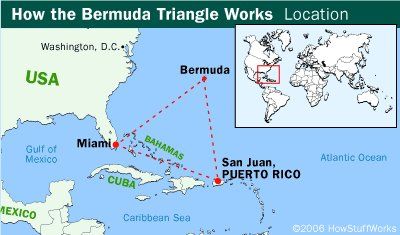
So, what’s the truth? Is this just a case of bad weather and even worse luck? Or is there something else at play in those infamous waters between Bermuda, Miami, and San Juan?

Forget what you think you know. We’re going deep. We’re chasing the ghosts of the Triangle, examining the evidence, and exploring the theories so strange, they just might be true.

Drawing the Devil’s Map: Where Exactly IS the Triangle?

Here’s the first problem. You can’t just pull up the Bermuda Triangle on Google Maps.

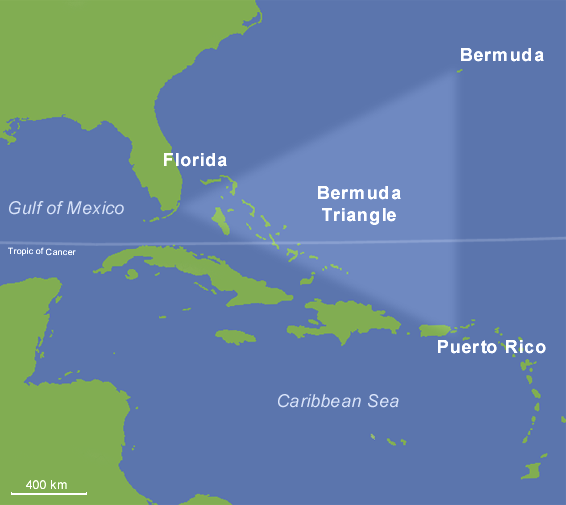
It has no official borders. It’s a phantom territory whose boundaries shift with every storyteller. The classic, most-quoted shape was first laid out by a writer named Vincent Gaddis in a 1964 issue of the pulp magazine Argosy. He drew a line from Miami to San Juan, Puerto Rico. Another from San Juan to the island of Bermuda. And a final line connecting Bermuda back to Miami.

Boom. The Triangle was born. Simple, right?

Wrong.

Later authors, hungry to connect more and more disappearances to the legend, stretched and warped those lines. Some pushed the boundaries out into the Gulf of Mexico. Others extended it north towards Virginia. The total area fluctuates wildly, from a massive 500,000 square miles to an incredible 1.5 million square miles of ocean. This makes the mystery a moving target. Did a ship that went down off the coast of the Azores fall victim to the Triangle? Depends on whose map you’re using.

And here is the ultimate irony. This supposed vortex of doom, this graveyard of the Atlantic, is one of the most heavily trafficked regions on the entire planet. Every single day, countless container ships, cruise liners, and private yachts crisscross its waters. Above, a constant stream of commercial jets and private planes ferry people to and from Florida, the Caribbean, and South America.

It’s a highway. A superhighway, on the sea and in the air. Yet, every so often, something on that highway takes an exit that doesn’t exist.

The Ghosts of the Triangle: The Cases That Built the Legend

A myth needs fuel. And the Bermuda Triangle has a long list of chilling, inexplicable disappearances that serve as its bedrock. These aren’t just statistics; they are stories of real people who set out on a journey and never came home.

Deep Dive: The Vanishing of Flight 19

This is the big one. The absolute granddaddy of all Triangle mysteries. The story that turned a collection of odd incidents into a full-blown phenomenon.

December 5, 1945. Five TBM Avenger torpedo bombers lift off from the Naval Air Station in Fort Lauderdale, Florida. A routine training mission. Fourteen men, all seasoned airmen or promising students, soaring into a clear afternoon sky. The mission was simple: fly east, conduct bombing runs, turn north, and then head back to base. A three-hour flight, tops.

They never returned.

The first sign of trouble came in a radio transmission. The flight leader, Lieutenant Charles Taylor, sounded confused. Baffled. “Both my compasses are out and I’m trying to find Fort Lauderdale,” he radioed. “I am over land but it’s broken. I’m sure I’m in the Keys but I don’t know how far down.”

The control tower was stunned. The Florida Keys were to the southwest. Taylor was supposed to be far out over the Atlantic, to the east. How could he be so lost? The tower operators tried to guide him, but his transmissions grew more erratic. Other voices from the flight were overheard, sounding increasingly nervous. “I don’t know where we are,” one pilot said. “We must have got lost after that last turn.”

Then, the most chilling transmission of all. Taylor was heard saying, “Everything is wrong… strange… we can’t see land… even the ocean doesn’t look as it should.”

As daylight faded and weather worsened, the radio calls grew fainter. The final message was a garbled mess of noise. And then… silence. Five U.S. Navy bombers had just vanished from the sky.

But the nightmare wasn’t over. A PBM Martin Mariner flying boat, a massive rescue plane with a 13-man crew, was dispatched to search for the lost squadron. It was a rugged, reliable aircraft nicknamed “the flying gas tank.” Just 20 minutes after takeoff, the Mariner radioed its position and then it, too, went silent. It also vanished without a trace.

A ship in the area reported seeing a massive explosion in the sky around the time the Mariner disappeared, but an exhaustive search of the sea revealed nothing. Not a single life raft. Not an oil slick. Not a scrap of metal.

In the space of a few hours, six military aircraft and 27 men were gone. The Navy’s final report was a single, haunting word: “Causes Unknown.”

The USS Cyclops: A Behemoth Swallowed Whole

Long before Flight 19, another vanishing act set the stage. The USS Cyclops was not some small boat. It was a monster of the sea, a 542-foot-long Navy collier ship, carrying over 10,000 tons of manganese ore. In March 1918, during the height of World War I, it set sail from Brazil, made a brief stop in Barbados, and then headed for Baltimore.

It was never seen again.

The ship and its 306 crew and passengers disappeared somewhere inside the future boundaries of the Triangle. There was no S.O.S. call. No distress signal. One of the largest ships in the Navy had been utterly and completely swallowed by the ocean. Theories flew wildly. Was it sunk by a German submarine? The Germans, even after the war, denied any knowledge of it. Did the crew mutiny? Did the heavy cargo shift in a storm and capsize the vessel? Possible, but a storm big enough to sink a ship that size without a single radio message would have been legendary. And the weather reports were… fine.

President Woodrow Wilson himself said, “Only God and the sea know what happened to the great ship.” To this day, we still don’t.

The Conspiracy Files: What Are They REALLY Hiding?

When logical explanations fail, human imagination runs wild. And in the vacuum of the Bermuda Triangle, some truly mind-bending theories have taken root. Are these just wild fantasies? Or are they closer to the truth than the debunkers want us to admit?

Extraterrestrials and Underwater Portals

This is the theory everyone knows. The idea that the Triangle is a hotspot for alien activity. A hunting ground. Or maybe something more complex.

What if there’s an alien base deep on the ocean floor, hidden in a trench miles below the surface? Believers in this theory point to the rise of USO sightings—Unidentified Submerged Objects. Reports from sailors and sonar operators describe impossibly fast objects moving underwater, making maneuvers that would crush any man-made submarine. Are these alien craft entering and exiting a hidden base? Do they sometimes “abduct” ships and planes for study, pulling them through a tractor beam or some other advanced technology?

Others suggest it’s not a base, but a portal. A wormhole. A rip in the fabric of spacetime that randomly opens and closes, sucking anything nearby into another dimension, another time, or another galaxy entirely. A ship sails into a patch of empty ocean, the portal flashes open for a microsecond, and the ship is gone. To its crew, nothing might seem wrong. To us, they’ve ceased to exist.

Atlantis and Its Cursed Crystal Tech

Let’s go deeper. Let’s go ancient. Some researchers connect the Triangle to the legendary lost city of Atlantis.

The famous psychic Edgar Cayce once predicted that evidence of Atlantis would be discovered near Bimini, an island chain in the Bahamas squarely within the Triangle. And what did divers find there in the 1960s? The Bimini Road—a series of massive, flat limestone blocks arranged in a neat line underwater. Geologists swear it’s a natural rock formation. Others are convinced it’s part of a road or wall from a long-lost civilization.

The theory goes that the Atlanteans harnessed a powerful form of energy using giant crystals. When their city sank beneath the waves, these massive energy crystals went with it. Now, sitting on the seabed, they are malfunctioning. Periodically, they surge with power, sending out massive waves of energy that disrupt or even disintegrate any technology that passes overhead. Your compasses spin. Your engines die. Your plane’s structure falls apart. You are a victim of ancient, haywire technology.

Electronic Fog: A Journey Through Time?

This is one of the most compelling and bizarre first-hand accounts ever to emerge from the Triangle. In 1970, a pilot named Bruce Gernon was flying his small plane from Andros Island to Miami. On the way, he encountered a strange, almost alive-looking cloud.

It wasn’t a normal storm cloud. He described it as a massive, perfectly circular cloud that formed a tunnel, a swirling vortex. He decided his only option was to fly through it. Inside, he said, the sky was a strange yellowish-grey, and bizarre lines of light zipped past his cockpit. His electronic and magnetic instruments went haywire. He felt a strange sensation, like weightlessness.

When he emerged from the other side, he was shocked to see Miami Beach already below him. He checked his clock. The flight through the tunnel had taken only a few minutes, but he had covered a distance that should have taken over half an hour. He had somehow skipped time and space. Gernon dubbed the phenomenon “Electronic Fog” and believes it’s a naturally occurring atmospheric event that can transport people—or make them disappear forever.

The Official Story: Draining the Devil’s Sea with Science

For every spine-tingling theory, there’s a sober, scientific explanation waiting to bring us back to Earth. Skeptics argue that the Bermuda Triangle is a manufactured mystery, a collection of unrelated tragedies stitched together by sensationalism.

Methane Hydrates: The Ocean’s Deadly Burp

This sounds like science fiction, but it’s a real and documented phenomenon. The ocean floor in certain areas, including parts of the Triangle, is rich in methane hydrates—frozen deposits of methane gas that look like white ice. Under the right conditions of pressure and temperature, these deposits can become unstable.

Imagine a massive, catastrophic eruption from the seabed. A gigantic bubble of methane gas, maybe miles wide, suddenly erupts and surges to the surface. Any ship caught above this eruption would lose all buoyancy in the frothy, gas-filled water. It would sink like a stone, instantly, without a chance to even send an S.O.S. If the methane cloud is large enough to reach the atmosphere, it could be ignited by a plane’s engine, causing a massive explosion and leaving no trace.

Rogue Waves and Savage Weather

The Bermuda Triangle sits in a perfect storm of dangerous natural forces. It’s the heart of “Hurricane Alley,” where some of the world’s most violent storms are born. But even on a clear day, the sea here is treacherous. The Gulf Stream is essentially a massive, fast-moving river within the ocean, creating unpredictable currents, deep troughs, and violent waves.

And then there are rogue waves. For centuries, they were dismissed as sailors’ tall tales—a single, monstrous wall of water rising from a calm sea. We now know they are very real. These waves can reach heights of over 100 feet, powerful enough to snap a supertanker in half like a twig. A rogue wave could easily swallow a ship and leave absolutely no debris, dragging everything down in seconds.

Human Error and the Myth Machine

This is the most boring explanation. And perhaps the most likely.

Researchers who have gone back and checked the original records have found that many of the “mysterious” disappearances weren’t so mysterious after all. Flight 19’s leader, Lt. Taylor, had a history of getting lost. Some believe he mistook the Bahamas for the Florida Keys and, in his confusion, led his squadron far out into the open Atlantic until they ran out of fuel. The Martin Mariner rescue plane had a known design flaw that earned it the nickname “Flying Gas Tank” because it was prone to exploding from a single spark.

Many other famous cases were embellished over time. A ship reported lost in a “strange calm” actually sailed directly into a hurricane. A plane that “vanished” in clear skies actually radioed about severe mechanical trouble. And a significant number of incidents attributed to the Triangle didn’t even happen inside its most generous boundaries.

The reality is, the sea is a dangerous place. Planes and ships had far less reliable navigation and communication equipment in the 40s, 50s, and 60s. Accidents happened. People got lost. It’s a tragedy, but it may not be a mystery.

The Triangle in the 21st Century: Solved or Sleeping?

So where does that leave us today? We live in an age of GPS, satellite surveillance, and instant global communication. Surely, a plane or a massive ship can’t just disappear anymore, right?

For the most part, the rate of disappearances has dropped dramatically. Better technology, better weather forecasting, and better emergency protocols mean we lose far fewer vessels than we used to. A 2013 study by the World Wide Fund for Nature didn’t even list the Triangle among the world’s 10 most dangerous shipping waters.

And yet, the ocean remains a vast, deep, and unconquerable wilderness. We have better maps of the surface of Mars than we do of our own planet’s seafloor. There are canyons and trenches so deep that sunlight has never touched them. Wreckage can sink for miles, carried by unpredictable currents, and be buried under silt before any search party gets close.

The myth is far from dead. It lives on, fueled by the internet. Every strange sonar blip, every garbled radio call, every unexplained piece of underwater footage posted on YouTube adds another layer to the legend. The Bermuda Triangle has become a modern folktale, a symbol of the unknown in a world we think we have fully explored.

Is it a paranormal vortex? An alien hunting ground? A zone of freakish natural phenomena? Or is it just a collection of tragedies, amplified by a very, very good story?

The truth is, nobody knows for sure. The official explanation is neat and tidy. It’s logical. But it doesn’t quite silence the whispers. It doesn’t explain the strange fogs, the spinning compasses, the feeling of wrongness reported by those who made it out.

The next time you fly over that patch of impossibly blue water, look down. Think of the hundreds of souls and thousands of tons of steel that lie beneath. Then ask yourself what might be looking back up at you.