The Devil’s Triangle: Diving Headfirst Into The Ocean’s Greatest Mystery
There’s a patch of ocean that whispers to us. A place on the map that feels… wrong. It’s a hungry void, a blank spot where compasses spin like mad, radios crackle with static, and reality itself seems to fray at the edges. You know its name. We all do.
The Bermuda Triangle.
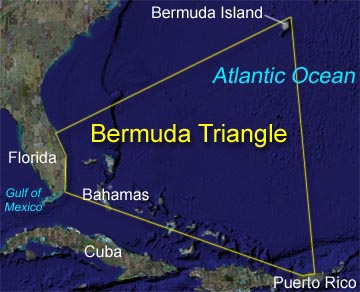
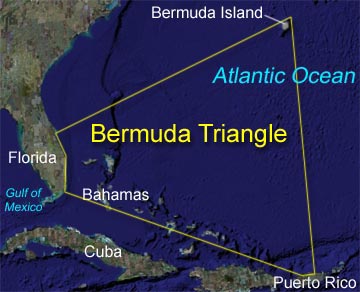
Three invisible points connecting Bermuda, Miami, and Puerto Rico, forming an unholy geometry on the surface of the Atlantic. For decades, it has been the boogeyman of the high seas, a place where hundreds of ships and planes have supposedly vanished without a trace. No wreckage. No survivors. Just silence.
But is it real? Is there a genuine, malevolent force at work in these waters? Or is it something else entirely—a ghost story told by the ocean itself, a modern myth born from coincidence and amplified by our deepest fears of the unknown? Forget what you think you know. We’re going deep. We’re going to pull apart the legends, stare into the abyss, and ask the questions the mainstream is too afraid to answer.
The Anatomy of a Legend: Where Is This Devil’s Graveyard?
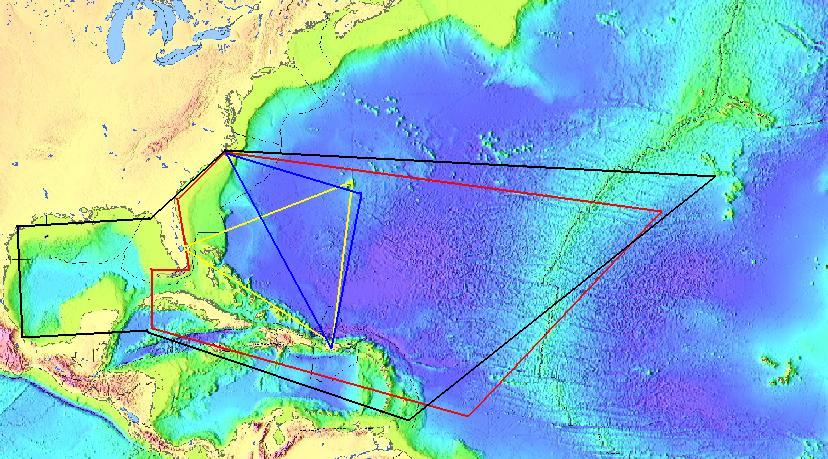
First, let’s draw the map. The lines are surprisingly blurry for such a famous location. Most accounts connect the dots between the sun-soaked shores of Miami, Florida; the idyllic island of Bermuda; and the vibrant city of San Juan, Puerto Rico. Simple enough, right?
Wrong.
The truth is, there are no official lines. The U.S. Board on Geographic Names doesn’t recognize the Bermuda Triangle. It doesn’t appear on any world map produced by any government. This isn’t a country. It isn’t a state. It’s an idea. And that makes it infinitely more powerful.
This stretch of the Atlantic is one of the most heavily trafficked regions in the world. Thousands of planes and ships cross it every single day. Safely. They arrive at their destinations without incident, their passengers sipping drinks, completely unaware they just sliced through the heart of the world’s most terrifying mystery. This simple fact is what makes the stories of those who *didn’t* make it so chilling. It’s not a graveyard where everything dies. It’s a place that chooses.
The Birth of a Mystery: How a Simple Story Became a Global Obsession
Every great monster has an origin story. The Bermuda Triangle wasn’t born overnight. It was stitched together, piece by piece, over decades, by journalists and pulp writers who saw a pattern others had missed. Or maybe, a pattern they *wanted* to see.
The first whispers came in 1950. An Associated Press article by a writer named Edward Van Winkle Jones noted a series of “unusual disappearances” in the area. He didn’t call it the Bermuda Triangle. He didn’t scream about aliens or sea monsters. It was just a curious observation, a small news piece cataloging the strange losses of ships and planes, including a group of Navy bombers that had vanished five years earlier. The seed was planted. But it needed fertile ground to grow.
That ground was found two years later, in the pages of a magazine perfectly suited for the bizarre: *Fate*. In an article titled “Sea Mystery at Our Back Door,” writer George X. Sand took Jones’s observation and gave it a pulse. Sand was the first to connect the dots and draw the now-infamous triangular shape. He focused heavily on the most compelling case of all, the one that would become the crown jewel of the Triangle myth: Flight 19.
Deep Dive: The Disappearance of Flight 19
December 5, 1945. Five TBM Avenger torpedo bombers lifted off from a naval air station in Fort Lauderdale, Florida. It was a routine training exercise. Fourteen men, led by the experienced Lieutenant Charles C. Taylor, were supposed to fly east, conduct bombing runs, and return home. They never did.
The official story is a tragedy of errors. Lt. Taylor, though an experienced pilot, was new to the area and had a history of getting lost. The weather, initially clear, took a turn for the worse. Both of his compasses reportedly malfunctioned. Radio transcripts show a crew that was hopelessly, terrifyingly lost. They thought they were over the Florida Keys when they were likely far out over the Atlantic, battling high winds and running dangerously low on fuel.
But the legend tells a different story. A much scarier one.
In 1962, *American Legion* magazine ran a piece by Allan W. Eckert that took the known facts and drenched them in high-octane weirdness. Eckert claimed the flight leader was heard saying things that have since become iconic phrases of the Triangle mystery: “We are entering white water, nothing seems right.” He followed it up with an even more bizarre transmission: “We don’t know where we are, the water is green, no white.”
Green water. No white. What does that even mean? It sounds like something from another world. And that’s exactly the point. To cap it all off, Eckert wrote that officials at the Navy board of inquiry, baffled by the case, stated the planes “flew off to Mars.”
There is zero credible evidence for any of these quotes. They don’t appear in the official Navy report. But it didn’t matter. They were just too good, too strange to ignore. The story had its supernatural hook. The mystery wasn’t just about getting lost anymore. It was about being taken.
To make matters worse, a PBM Mariner flying boat, sent out with a 13-man crew to search for Flight 19, also vanished that day. The official explanation? Mariners were notoriously known as “Flying Gas Tanks” and were prone to mid-air explosions from fuel vapors. A ship in the area reported seeing a massive fireball in the sky right where the Mariner should have been. The myth’s explanation? The Triangle claimed another victim.
The Triangle Goes Mainstream: The 1970s Craze
The stage was set. The characters were in place. All the Bermuda Triangle needed was a name. In February 1964, a writer named Vincent Gaddis gave it one. In a sensational article for the pulp magazine *Argosy* titled “The Deadly Bermuda Triangle,” he bundled Flight 19 with other disappearances, like the USS Cyclops (a massive Navy cargo ship that vanished in 1918 with 306 souls), and presented it as a singular, terrifying phenomenon. A year later, he expanded it into a book, *Invisible Horizons*, and a global obsession was born.

But the man who truly turned the Triangle into a household name was Charles Berlitz. His 1974 book, *The Bermuda Triangle*, was an absolute juggernaut. It sold millions of copies, was translated into dozens of languages, and cemented the legend in the public consciousness. Berlitz wasn’t just reporting mysteries; he was proposing wild, mind-bending explanations. He connected the dots between the disappearances, UFO sightings, and Edgar Cayce’s prophecies about the lost city of Atlantis. For Berlitz, the Triangle wasn’t just a patch of ocean; it was the site of ancient, powerful technology—Atlantean energy crystals on the seafloor that were malfunctioning and snatching ships and planes from our reality.
The 1970s went Triangle-crazy. A flood of books followed from authors like John Wallace Spencer and Richard Winer, each trying to outdo the last with more chilling tales and crazier theories. Documentaries filled the airwaves. It was the perfect mystery for an era obsessed with the paranormal, UFOs, and government conspiracies. The Bermuda Triangle was no longer a fringe theory; it was a cultural phenomenon.
The Theories: From Rogue Waves to Alien Abductions
So, what’s really going on out there? If we assume *something* is happening, the explanations run the gamut from the scientifically plausible to the utterly fantastic. Let’s explore the evidence locker.
The Scientific & Skeptical Explanations
For every mystery, there’s a debunker. And the Triangle has plenty of rational explanations, if you’re willing to listen.
Rogue Waves: For centuries, sailors told tales of single, monstrous waves rising from a calm sea, capable of swallowing a ship whole. Scientists dismissed them as maritime myths. Until they weren’t. We now have satellite proof of “rogue waves” that can reach heights of 100 feet. A vertical wall of water that can snap a massive freighter in two. No warning. No survivors. Just gone.
Methane Hydrates: This one sounds like science fiction, but it’s real science. The ocean floor in this region is rich with frozen deposits of methane gas. If an undersea landslide or seismic event were to rupture one of these deposits, it could trigger a catastrophic eruption. A massive bubble of methane gas would rocket to the surface. Any ship caught in this “burp” would instantly lose all buoyancy. The water would effectively become foam, and the ship would sink like a stone, straight to the bottom, in seconds.
Extreme Weather and Geography: Let’s be blunt. The “Triangle” is a meteorological nightmare. It’s where tropical storms and hurricanes are born. The Gulf Stream, a powerful and turbulent “river” within the ocean, can create unpredictable and violent sea conditions. The topography of the ocean floor here is also insane, featuring some of the deepest trenches on the planet, like the Puerto Rico Trench. If a ship or plane goes down, finding the wreckage is like finding a needle in a continent-sized haystack.
Compass Confusion & Human Error: This region is one of the few places on Earth where true north and magnetic north align. In theory, this should make navigation easier. But for pilots and captains moving in and out of the area, it can cause confusion if they’re not accounting for the shift. Add in violent weather and the stress of an emergency, and it’s a recipe for getting fatally lost. Many of the famous Triangle cases, when examined closely, show clear evidence of bad decisions, equipment failure, or simply being in the wrong place at the wrong time.
The Paranormal & Fringe Hypotheses
Now, let’s open the other door. The one that leads to the weird stuff.
Atlantis Rising: Charles Berlitz’s pet theory remains one of the most popular. The idea is that the lost city of Atlantis is located at the bottom of the sea right in this area. The disappearances are caused by leftover Atlantean technology—giant energy crystals or power sources that occasionally activate, disrupting instruments and pulling vessels from our world. Some even point to the “Bimini Road,” an underwater rock formation, as a potential remnant of the lost city.
UFOs and Alien Portals: Is the Devil’s Triangle an intergalactic airport? This theory suggests that the disappearances aren’t accidents, but abductions. That aliens have an underwater base in the deep trenches and are harvesting humans and technology for study. Reports of strange lights in the sky and under the water (USOs, or Unidentified Submerged Objects) are common in this region. Perhaps it’s not a triangle at all, but a doorway. A wormhole. A portal to another time or another dimension that opens and closes at will, swallowing anyone unlucky enough to be passing through.
The Triangle in the Digital Age
You might think that in our age of GPS, satellite imagery, and instant communication, the Bermuda Triangle would have faded away. You’d be wrong. The mystery is more potent than ever, thriving in the dark corners of the internet. YouTube is filled with slick documentaries racking up millions of views. Reddit threads spiral into endless debates. TikTokers share “new evidence” and whisper about cover-ups.
Every new incident in the region is immediately scrutinized. When the cargo ship El Faro sank with 33 crew members during Hurricane Joaquin in 2015, the “Triangle” whispers started immediately, even though it was a clear-cut case of a ship sailing directly into a Category 4 hurricane. The myth is so powerful it can overshadow reality.
So, has the Triangle gone quiet? Or are we just better equipped to survive it? Perhaps the answer is both. Modern technology has certainly made navigation safer. But the mystery itself refuses to die. Because it was never really about a location.
It was about a feeling.
The feeling of being small in a vast, indifferent universe. The fear of what lies beneath the waves. The chilling realization that a person, a plane, a massive steel ship can be here one moment and simply… gone the next. The Bermuda Triangle is the ultimate expression of that fear. It’s a place on the map that allows us to focus all our anxieties about the unknown into one terrifying, electrifying story.
Fact or fiction? A meteorological anomaly or a paranormal portal? We may never know for sure. And maybe that’s the whole point. The Triangle remains one of our last great, unsolved enigmas. A dark patch of water on a brightly lit globe, reminding us that for all our science and all our technology, we have not conquered this planet. Not even close.