NASA’s Forbidden Frame: The Apollo Anomaly They Still Can’t Explain
July 20th, 1969. The world held its breath. On grainy television screens across the planet, a ghostly figure in a bulky white suit took a step. One small step. One giant leap. It was humanity’s crowning achievement, the moment we slipped the surly bonds of Earth and walked upon another world. The story we all know.
But what if that’s not the *whole* story?
What if, buried deep within the official NASA photo archives from that historic Apollo 11 mission, lies a single frame that challenges everything? A picture that suggests Neil Armstrong and Buzz Aldrin were not alone. A photograph that, to this day, has NASA officials offering only a deafening silence.
We’re told the Moon is a dead, silent rock. But the camera doesn’t lie. And one of Apollo 11’s own cameras captured something impossible.
Something breaking away from the lunar surface.
The Ghost in the Machine: A Single, Disturbing Photograph
It’s cataloged as photo AS11-40-5922. At first glance, it’s just another majestic shot from the Sea of Tranquility. The lunar module, the Eagle, sits squat and insect-like on the gray dust. An American flag stands proudly. The horizon curves away into the blackness of space. Standard stuff.
Until you look closer.
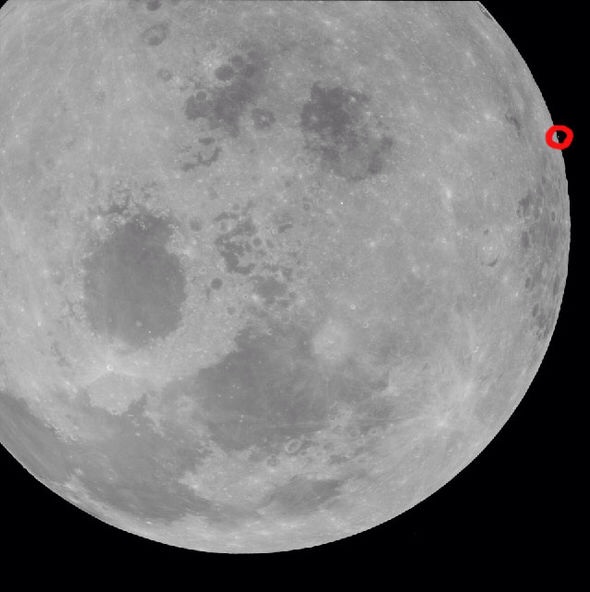
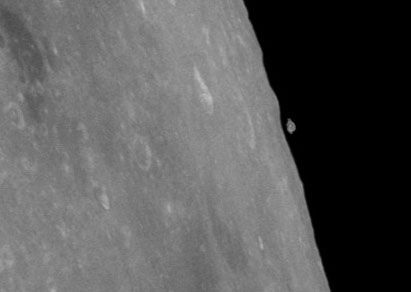
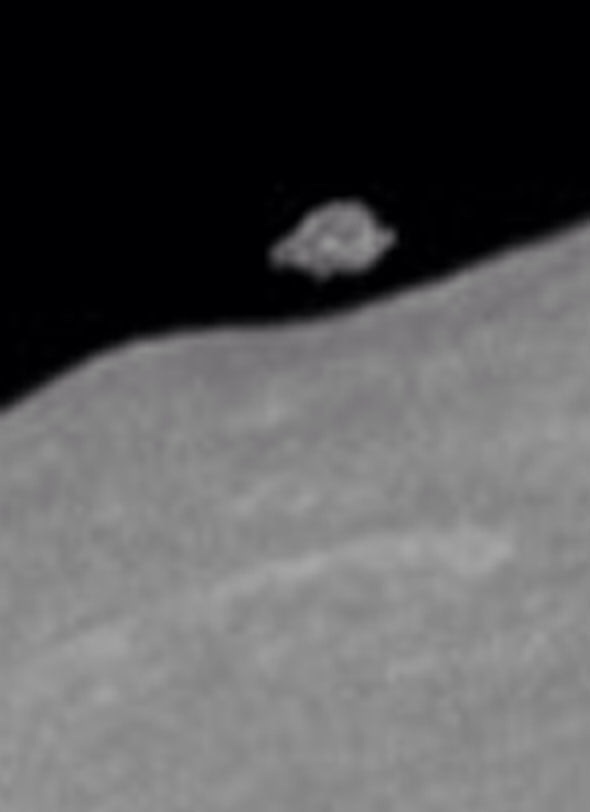
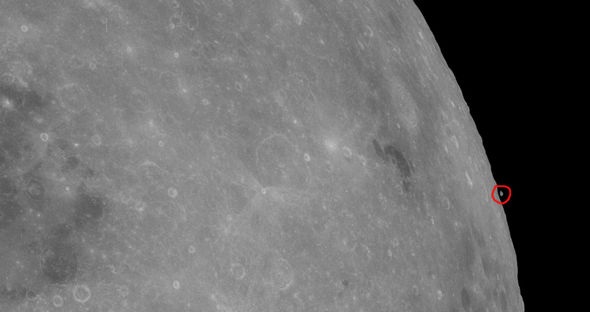
There. Floating in the void above the lunar landscape. A large, dark, geometric object. It looks solid. It appears to be casting its own shadow. It seems to have mass, structure. It looks, for all the world, like a massive chunk of the Moon itself has simply… detached and is drifting away into space.

This isn’t some blurry photo from a backyard telescope. This was taken with a state-of-the-art Hasselblad camera, on the surface of the Moon, by an astronaut. Yet, it contains an object that has no right to be there.
Years ago, investigators at the UK’s Express newspaper did the legwork. They dove into the official NASA archives. They pulled the original, high-resolution scan of AS11-40-5922. The anomaly was there. Real. Baked into the film emulsion.
Then they did the smart thing. They pulled the photos taken just *seconds* before and after.
Photo AS11-40-5921? Nothing. A clear, black sky.
Photo AS11-40-5923? Gone. Vanished without a trace.
This wasn’t a rock formation on a distant hill. This wasn’t a lens flare, which would look entirely different and likely persist across multiple shots. This object appeared in the sky for a fleeting moment, long enough for one single photograph to be taken, and then disappeared forever.

When presented with this evidence—their own photograph—what did NASA say? Nothing. They offered no explanation. No theory. No comment. The silence is the most chilling part of all.
Deep Dive: Debunking the Debunkers
The online skeptics and armchair experts have, of course, tried to explain this away. Their arguments are predictable. And weak.
- “It’s an ice particle or debris from the LEM.” Really? An ice particle that looks that large, that structured, and that dark against the blackness of space? And one that just happens to float perfectly into frame for one shot and then vanish? The physics of that are… convenient, to say the least.
- “It’s a film processing artifact.” A compelling idea, until you remember the rigorous standards of NASA’s photographic lab. These images were among the most valuable in human history. The idea that a random blotch of this size and shape would appear on one single frame, and not on the frames immediately adjacent on the same roll of film, stretches credulity to its breaking point.
- “It’s a reflection in the lander’s window.” Except the photo wasn’t taken from inside the lander. The perspective and setup are clear. This was taken on the lunar surface.
No. The simple explanations don’t work here. They feel like grasping at straws. They feel like a desperate attempt to maintain the clean, sterile version of the story we’ve all been sold.

Look at the object up close. Its shape is unnatural. Almost like a distorted pyramid or a piece of jagged machinery. It has angles. It has depth. It’s not just a smudge.

So what was it? An alien probe watching our first clumsy steps? A piece of ancient technology stirring from its slumber? Or something even stranger?
This single, baffling photo would be enough to fuel conspiracy theories for a lifetime. But it’s not an isolated incident. Not by a long shot. In fact, years before Apollo 11 even left the ground, both the Americans and the Soviets were getting signals that the Moon was a far stranger place than anyone imagined.
The Soviet Secret: Runways on the Ocean of Storms
Three years before Neil Armstrong’s famous bootprint, the Cold War was at its peak. The Space Race was everything. On February 4th, 1966, the Soviet Union scored a major victory. Their unmanned probe, Luna-9, successfully made the first-ever soft landing on the Moon, touching down in the vast, dark plain known as the Ocean of Storms (Oceanus Procellarum).
Its mission was to send back the first pictures from the lunar surface. And it did. But what those pictures showed sent quiet shockwaves through the Soviet space program.
The grainy, panoramic images revealed something that looked utterly artificial. A series of circular stones, all seemingly identical in size and shape, arranged in two perfectly straight, parallel lines. They looked for all the world like landing lights on an airport runway.
They were equidistant. They were geometrically precise. And their positioning was peculiar—angled in such a way that they would catch the sun’s light, making them highly visible from above. Visible to, say, a descending craft.
This wasn’t just the wild speculation of a few low-level technicians. Dr. S. Ivanov, a State Prize Laureate and one of the USSR’s most respected scientists, analyzed the photos. In a lucky accident, the Luna-9 probe had shifted slightly on the unstable lunar soil between transmissions. This meant the “runway” was photographed from two slightly different angles. Using this, Dr. Ivanov and his colleague, Engineer Dr. A. Bruenko, created a stereoscopic 3D image.
Their conclusion was staggering.
“With the stereoscopic effect,” they reported, “we can affirm that the distance between stones… is equal. The stones are identical in measurement… The objects as seen in three-D seem to be arranged according to definite geometric laws.”

Think about that. Nature creates chaos, fractals, and random patterns. It does not create perfectly spaced, identical objects in straight lines. That is the hallmark of intelligence. Of design.
The official explanation? Pathetic. Moscow claimed the ground must have settled under the probe, or a small rock caused it to tilt. A convenient excuse for the lucky accident that allowed them to see the objects in 3D, but it did nothing to explain the objects themselves. The “runway” was dismissed as a trick of light and shadow. The matter was dropped. The memo was clear: do not discuss this publicly.
America’s Quiet Confirmation: The Spires of Orbiter-2
Were the Soviets the only ones finding things? Not a chance. While Luna-9 was photographing its mysterious runway, the United States was busy with its own reconnaissance program: the Lunar Orbiters.
Their public mission was simple: map the entire lunar surface in high detail to find safe landing spots for the upcoming Apollo missions. Their secret mission? Nobody’s talking. But the images they sent back contained anomalies of their own.
Months after Luna-9’s discovery, in November 1966, America’s Orbiter-2 was flying over a region near the Sea of Vapors (Mare Vaporum). It was snapping thousands of pictures, beaming them back to Earth. One of these photos, Frame LO2-61, would become legendary in fringe circles.
On it, rising from the lunar surface, appeared to be a series of eight spires. Tall, thin structures casting impossibly long shadows across the dust. One of these anomalies, nicknamed “The Shard” by modern researchers, appears to be a towering needle of a structure, over a mile high, catching the glint of the sun.
These weren’t mountains. They weren’t crater rims. They looked artificial. Like towers. Or antennae. They became known as the “Blair Cuspids,” named after the researcher who first brought them to public attention.
NASA’s response? The usual. A trick of the light. Overexposed pixels on the film. A processing error. The same playbook they used for every other anomaly. Deny. Dismiss. Deflect.
But put it all together. The Soviets find a runway. The Americans find what look like towers. Both superpowers, rivals in a bitter Cold War, independently photograph evidence of artificial structures on the Moon. And both, officially, pretend they saw nothing.
This raises a terrifying question. Was the Space Race really about planting a flag and beating the other guy? Or was it a frantic scramble to get to the Moon first to investigate—and possibly salvage—whatever was already there?
The Modern Investigation: What Google Moon Is Revealing
For decades, this was where the trail went cold. The evidence was locked away in dusty archives. But the internet changed everything.
Today, a new generation of digital archaeologists is poring over high-resolution scans from NASA’s own Lunar Reconnaissance Orbiter (LRO). These images are thousands of times more detailed than anything from the Apollo era. And the anomalies are still showing up.
Internet sleuths, using public tools like Google Moon, have cataloged dozens of inexplicable things:
- Geometric Entrances: Perfectly square or rectangular “openings” on the sides of craters, looking like hangar doors or tunnel entrances.
- Tracks in the Dust: Strange tracks, not from any known rover, that cross vast distances, sometimes appearing to go into or come out of craters.
- The “Castle”: A highly complex, reflective object sitting on the lunar surface that looks for all the world like a massive, partially ruined structure.
Every time one of these is discovered and goes viral, the official explanation is the same. It’s pixelation. It’s a boulder. It’s a trick of light and shadow, a phenomenon called “pareidolia,” where the brain sees patterns in randomness.
Perhaps. But how many times can you play the same card before it starts to look like a cover-up?
What If It’s All Connected?
Let’s take a step back and look at the whole picture. Let’s play “What If?” for a moment.
What if ancient, intelligent beings visited our solar system millennia ago? They used the Moon as a base of operations. A watchtower. They built structures—runways, spires, maybe more. Then, they left. Leaving their silent ruins behind.
Fast forward to the 1960s. Two primitive civilizations from the third planet out suddenly develop the technology to send probes to the Moon. First the Russians, with Luna-9, stumble upon the ruins of a landing strip. Then the Americans, with Orbiter-2, photograph the decaying spires of a forgotten city.
Suddenly, the Space Race takes on a whole new meaning. It’s a race to claim the ultimate prize: alien technology.
Then comes Apollo 11. They land. And as they’re taking pictures, one of the ancient defense or observation systems, dormant for eons, briefly activates. It moves. It’s captured in a single, impossible frame—AS11-40-5922—before shutting down again. Maybe it was a drone. A sentry. Or maybe just a piece of debris dislodged by the landing itself.
It’s a wild theory. It sounds like science fiction. But it’s a theory that connects all the dots. It explains the Soviet “runway.” It explains the American “spires.” And it provides a chilling context for that dark, silent object floating in the sky above the Sea of Tranquility.
It explains NASA’s silence. Because how do you tell the world that the greatest moment in human history was gatecrashed? How do you admit that we may have been the second intelligent species to walk on the Moon, not the first?
You don’t. You classify the data. You dismiss the anomalies. And you hope nobody looks too closely at the pictures.
But we are looking. And the questions won’t go away. The truth is in the archives. It’s written in the lunar dust. We just have to be brave enough to read it.